



Isolating China won't boost US security









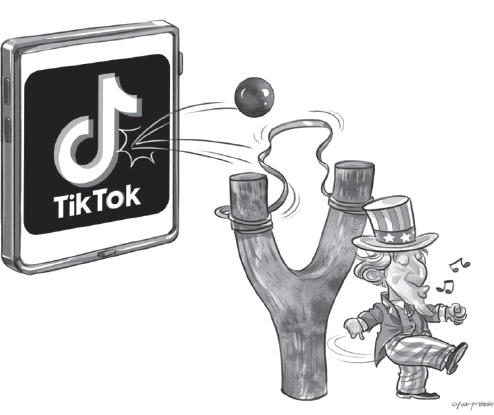
The White House's orders on Thursday banning transactions with ByteDance and Tencent, the owners of TikTok and WeChat respectively, on the pretext that the two apps "threaten the national security, foreign policy, and economy of the United States" is part of the administration's "Clean Network to Safeguard America's Assets" program to ban a whole range of Chinese apps.
That the White House is concerned about the impact of Chinese apps on American society is understandable. For instance, the rising popularity of TikTok has been phenomenal because it helps subscribers to watch massive numbers of short, amusing videos as well as socialize with other users. TikTok is very popular in the US, and therefore a competitor to YouTube, which dominates the US market.
Similarly, WeChat is providing comprehensive social media service for its users, and is probably more advanced than US apps such as WhatsApp.
The fast rise of Chinese apps and their increasing popularity in foreign countries have a lot to do with the huge Chinese population base. With such a massive target group to test their software, Chinese IT companies have the unique opportunity to test and upgrade their apps before "going global".
Another factor behind their success is the global vision of the younger generation of business professionals in China. These young high-tech leaders have become an integral part of the highly interlinked global economy. Today's young Chinese entrepreneurs are sensitive to the changes in global high-tech development, and swift and courageous enough to adapt to the changing global market. For China, they have become an important link with the world.
Certainly, any use of apps carries some unintended consequences. On June 22, the US president launched his presidential campaign in Tulsa, Oklahoma, but the crowd turnout was not satisfactory. Some claimed people used TikTok to make "reservations" to attend the event, but did not turn up to embarrass the president. TikTok was embarrassed too.
Of course, it would have been ideal if the US administration hadn't launched a large-scale campaign against Chinese apps amid the COVID-19 pandemic, giving ByteDance the chance to reflect on how to prevent being used as a tool in US politics in the future.
Instead, thanks to the White House's move, Microsoft has expedited its talks with ByteDance to purchase TikTok's operations in the US. And if the talks fail, TikTok will have to exit the US market next month. Despite the popular speculation that the White House's move against TikTok is directly related to the Tulsa campaign fiasco, the US administration has tried to justify it by claiming it is aimed at protecting US citizens' privacy and US companies' data.
The US has not only tried to ban Tik-Tok and WeChat, but also threatened to take action against other Chinese apps and companies. Such hideous attempts to force Chinese companies out of the US market and take targeted action against the Chinese government also go against ordinary Chinese and American peoples, who use WeChat to keep in touch with each other. And although US Secretary of State Mike Pompeo has tried to draw a delicate line between the Republican Party and the US state, the White House's ban doesn't seem to support his rhetoric.
Indeed, the rise of social media apps has created new, complicated challenges for countries, prompting them to strengthen vigilance against external attempts to destabilize their societies and economies. But despite China issuing regulations to safeguard internet security, some US high-tech companies can still flourish in the Chinese market by accepting China's term. Microsoft and Yahoo are apt examples of such companies.
That's why it is surprising to see the White House failing to devise definitive terms for foreign social apps to be used in the US, and instead kick them out.
History shows that building, not destroying, bridges helps strengthen communication and understanding. National security is impaired, rather than being strengthened, by building walls. For decades, US politicians like former president Dwight Eisenhower and senator James William Fulbright have been calling for better communication and increased international exchanges.
Eisenhower called for "responsive and responsible leadership", and we hope the incumbent president will display such leadership. And since Microsoft, Yahoo and other American IT companies still operate in China, we hope the White House will refrain from banning Chinese companies and apps from the US.
The author is a professor at and former executive dean of the Institute of International Studies, Fudan University.
The views don't necessarily reflect those of China Daily.


Today's Top News
- Need for reshaping academic structure
- Shared Journey: Chinese new energy vehicles in Europe: competition or co-creation?
- Deep sea needs down-to-earth scientific research
- Deeper opening-up promised for steady growth
- China to rebalance growth with domestic demand boost
- Consultative suggestions provide policymakers with essential inputs to finalize five-year plan





