Australia needs a pragmatic approach to China









The annual Australia-United States Ministerial Consultations are always seen as a high point in the Canberra-Washington relationship.
The fact that Australian Foreign Minister Marise Payne and Defense Minister Linda Reynolds flew to Washington in the middle of a global pandemic to meet with their US counterparts was seen by some commentators as solidifying the alliance.
The talks on July 28 came amid an escalation of tensions between Washington and Beijing over Hong Kong's new national security law, the South China Sea, allegations of cyberattacks and theft, and the closure of consulates in the US and China.
It seemed like a long way to fly for a couple of meetings that could have been done via videoconference.
The joint communique said little of substance, but that did not stop some commentators from lauding the talks' success.
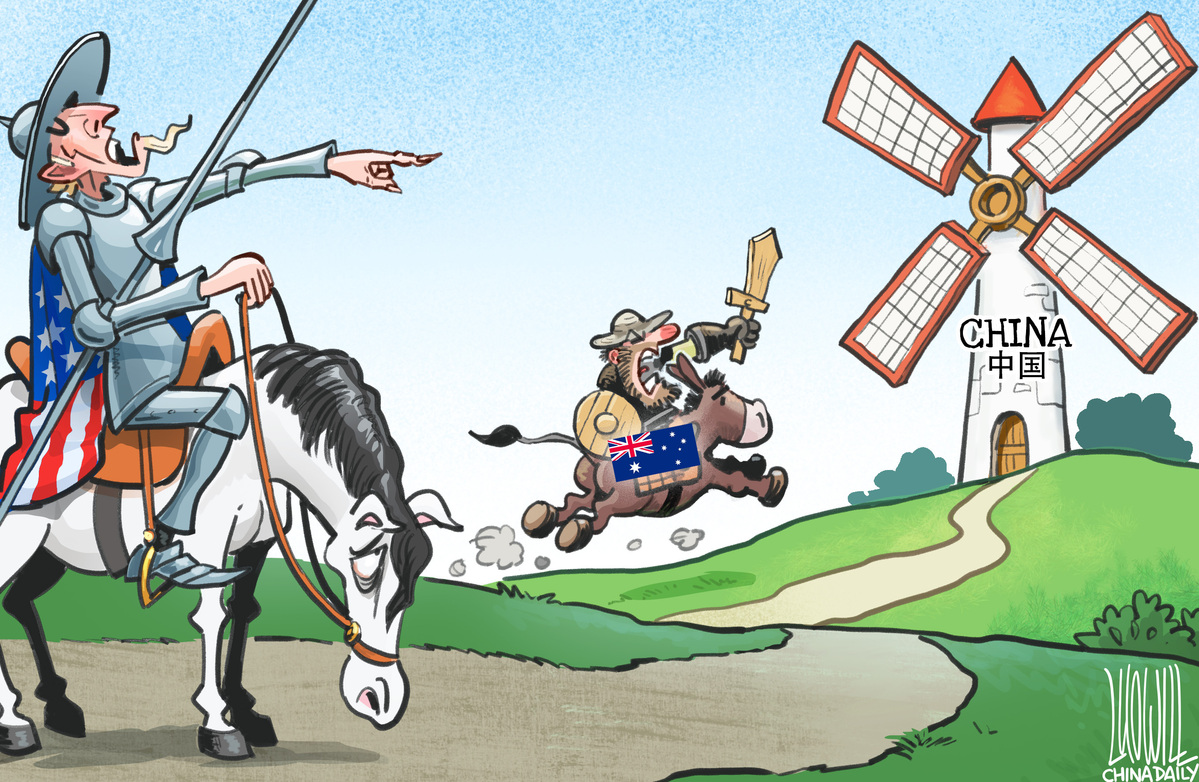
Some analysts were hoping Australia would throw everything in with the US and officially cast China as a strategic rival. Instead, Australia took a more pragmatic approach, especially when it came to the South China Sea.
It has been known for some time that Washington has wanted Australia to play a more assertive role in the so-called freedom of navigation exercises in the South China Sea - in other words, to join the US in saber-rattling.
Reynolds, when asked if the US had pressured Australia to conduct exercises closer to the contested islands, said "it was a subject of discussion".
When pushed by journalists, she added: "From our perspective, we make our decisions, our own judgments in the Australian national interest and about upholding our security, our prosperity and our values.
"Our relationship with China is important and we have no intention of injuring it."
She also made the point that Australia would make its own "independent" foreign policy when it came to China.
Canberra must realize that a more pragmatic approach is safer than being antagonistic toward its biggest trading partner.
In recent weeks, Prime Minister Scott Morrison has said he will not ban the Chinese social platform WeChat, which has around 800,000 users in Australia, or the video-sharing app TikTok, which has 1.6 million subscribers in Australia.
These are two companies Washington intends to ban in the US over alleged "security concerns".
Maybe Canberra is starting to listen to some of the saner voices within the foreign and trade bureaucracy when it comes to China, rather than the hawks who work toward a much different agenda - one that is being orchestrated by defense and security interests both in Canberra and Washington.
Being totally aligned with the US does not serve Australia's best interest. Australia needs to consider its geography, and the importance of China for its economic well-being.
The point is, when Washington pushes back against China, there are little or no trade repercussions for the US. Why? Because of the massive trade surplus that China has with the US.
When Australia pushes back, it loses and loses badly, not just in business but in whole industries and the jobs that go with them.
Who gained when China imposed an 80 percent tariff on Australian barley exports to China earlier this year? US barley farmers, of course. And it was the same story when some Australian beef exports were halted.
Now we have the US wanting to free an Afghan soldier who murdered three Australians as they played cards at their fortified base in Afghanistan.
The Afghan soldier, who was being trained by the Australians, is part of a prisoner swap being organized by Washington.
Did the US consult Australia? No.
So much for the alliance. What if the murdered soldiers were American? Would Washington still push for the killer's release?
No one is denying Canberra's right to form security alliances, but it needs to be more measured with its other relationships, especially with countries that do not share similar cultural backgrounds.
Australia's business community manages to nurture relationships in China, yet this government seems unable to. Why is that?
When former Australian prime minister Gough Whitlam officially recognized China in 1972, he offered the hand of friendship and mutual respect to China.
Whitlam, his government and bureaucrats in foreign affairs and trade saw the potential of that relationship.
Today, China is Australia's biggest trading partner. Before COVID-19, it was the biggest source of foreign tourists and foreign university students, and is the biggest source for joint research.
Australia cannot and should not throw all of this away.
The author is a China Daily correspondent based in Sydney.