Heroic wartime siege in Shanghai relived










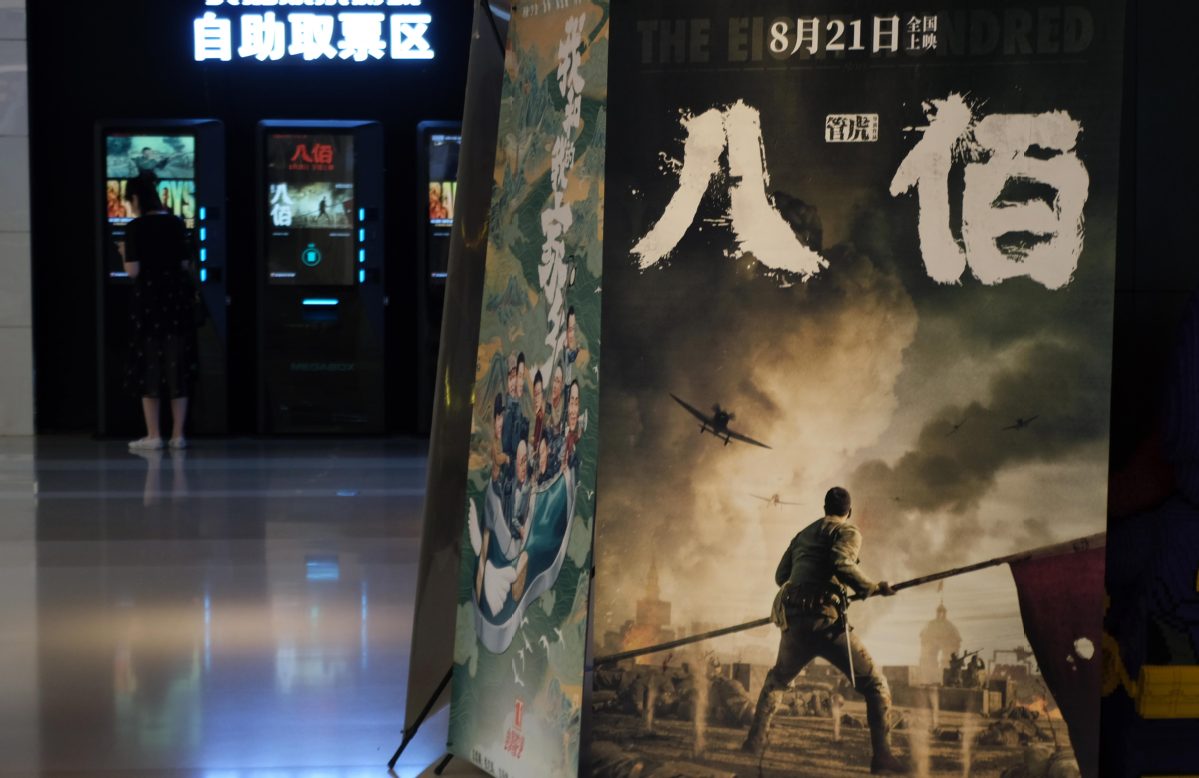
Soldier's death leap
One scene in particular, based on a real incident, that struck Zhang and many other moviegoers features soldier Chen Shusheng, with hand grenades tied to his body, jumping to his death from a wall, killing Japanese troops hiding underneath.
A note left by Chen to his mother stated that he wanted to sacrifice his life for a just cause.
Chen was one of some 400 soldiers and their officers from the First Battalion of the 524th regiment of the 88th division of the Chinese Army defending the Sihang Warehouse under the leadership of Xie Jinyuan.
The battle took place in 1937, when the main force of the army, after losing to the Japanese in Zhabei, Shanghai, withdrew to the rural western fringes of the city. Xie and the battalion were left behind, guarding the divisional headquarters at the Sihang Warehouse to buy time and show the international community that China was determined to resist the Japanese.
Xie and his troops fought valiantly from Oct 26 to Nov 1, and the successful defense of the warehouse was witnessed by locals and expatriates in the international settlement on the other side of Suzhou Creek.
The soldiers and their officers later became known as The Eight Hundred Warriors, as Xie in an attempt to hide their true strength from the enemy, provided an exaggerated figure to Yang Huimin, a visiting girl scout, who announced it publicly.
Handwritten testimony is on view at the memorial hall, signed by local resident Shen Ji on July 1, 2015, when Shen was 92. It states: "I was a 14-year-old middle school student in 1937. My family lived on Xinzha Road. The Sihang Warehouse was just across Suzhou Creek, and I climbed to the top of our building and watched through my binoculars.
"I saw a soldier with hand grenades tied to his body jumping in the air and killing Japanese soldiers.
"I also saw soldiers on the warehouse roof sacrificing their lives guarding the national flag. Such scenes have remained in my mind ever since."
While much of the movie is based on true events, the filmmakers have combined fact and fiction to create a big-screen blockbuster.
However, while The Eight Hundred features spectacular scenes of soldiers gathering in a spacious lobby at the warehouse, in real life the building's foyer is relatively confined, so it is unlikely that fierce fighting took place there. Neither does the building have an underground water link to Suzhou Creek, or an elaborately decorated office, as featured in the movie.
Footage of Suzhou Creek has also been targeted by critics, as fighting at the site is shown against a backdrop of the neon lights and high-rises of downtown Shanghai. However, when you look out from the warehouse in real life, the south bank of the creek is lined by buildings no more than two stories high.
Tang Weijie, a scholar of Shanghai's filmmaking history and professor in the humanities faculty at Tongji University, said, "Such exaggeration of historical events, along with intentional plot twists, set a bad example for filmmakers in the future."
In 2015, restoration work at the Sihang Warehouse was completed, with part of the building housing the memorial hall featuring the 1937 battle.
The warehouse building consists of two parts. The eastern section was built in 1930 as a warehouse for the Continental Bank, while the western part was constructed five years later to house the Sihang Joint Savings Bank.
In the 1920s, Shanghai was an open port, a center of international trade and home to China's major banks. Four leading lenders from northern areas of the country-Gold City Bank, Salt Bank, South Central Bank and the Continental Bank-formed the Sihang Joint Savings Bank.
In the 1930s, this bank was so successful that it bought a plot of land in downtown Shanghai on which the Park Hotel was built. The hotel later became known as the "No 1 high-rise of the Far East".
When the War of Resistance Against Japanese Aggression started, the savings bank was the largest of its kind in China, approving many loans and receiving numerous goods in return as collateral. The goods were stored in the warehouse built alongside Suzhou Creek.