



Why US won't 'decouple' from China in finance









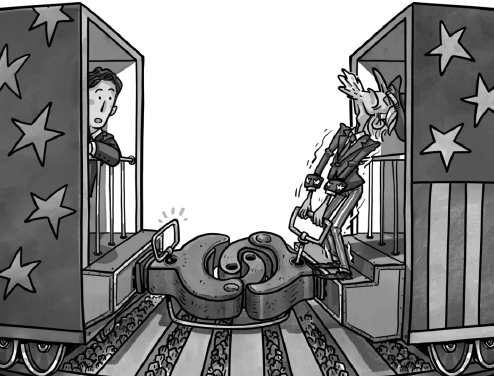
Does the United States really want to decouple from China in the financial industry? Presumably, the answer is "No".
The US administration's recent actions against short video-sharing app TikTok, which is owned by Chinese company ByteDance, the tightening regulatory scrutiny of Chinese companies listed in the US, and some news of individual companies delisting from the US stock market, have all boosted discussions on the reported US initiative to decouple from China in the financial services sector.
The reason is, it is not difficult to think of financial decoupling in the context of escalated China-US frictions. Financial decoupling is much more complicated than technological decoupling. It involves the securities market, cross-border payments and capital flows, as well as the performance of the international monetary system.
If we first look at the US dollar-denominated international monetary system, the cost and boundaries of the financial capital and the physical capital (especially for technology), and the trend of integration in the Chinese and US financial markets, one conclusion is inescapable: the US side still needs China to maintain the existing international monetary system, and has better business opportunities in China's financial market.
Any action like decoupling will hurt the two sides; instead, cooperation will achieve a win-win situation.
Operations relating to flows of global capital denominated in the US dollar are the foundation that sustains the international monetary system. If the US dollar does not participate in China's economy and financial market, it could mean the US will likely end up weakening the whole monetary system.
China's economy is the second-largest in the world. Its exports account for about 12 percent of the global total. China's capital market-stock and bond markets-now is the world's second-largest.
However, the global monetary system is still dominated by the US dollar. There is a significant asymmetry in the proportion of the US economy, trade and the dollar in the international monetary system.
So far, about 50 percent of the global trade settlements are done in the US dollar. China is an important participant and promoter of global trade. However, a large part of the trade is still settled in US dollars. The greenback accounts for about 60 percent of global official reserves and nearly 85 percent of global foreign exchange transactions.
China's huge foreign exchange reserves are also denominated in the US dollar. If China does not use the US dollar but chooses the euro or other currencies to settle its trade deals, it will shock the US dollar system. So the US will not take the risk of decoupling from China, because that will weaken the US dollar system.
The US has added some Chinese tech companies, including ZTE and Huawei, to its so-called Entity List and carried out sanction measures. It also took unreasonable actions against enterprises such as Byte-Dance, and tightened regulatory scrutiny of Chinese companies listed in the US.
Such actions were not to decouple from China's financial sector but to suppress Chinese companies that pose a challenge to US competitors. Washington aims to prevent Chinese enterprises from participating in areas related to the so-called national security, hoping to maintain the US companies' international competitiveness through improper means.
However, it is difficult to reverse the globalization trend of financial capital. The global allocation of financial assets is determined by the nature of arbitrage for financial capital, and the boundaries of financial capital flows are blurred.
Since the subprime mortgage crisis, the US Federal Reserve's balance sheet has expanded dramatically, from $450 billion to about $7 trillion. According to World Bank data, the proportion of securitization in developed economies has reached 120 percent, which is much higher than that in developing economies (60 to 70 percent).
The expansion of the balance sheet of central banks in major economies has led to a sharp expansion of financial assets against a background of financial innovation. The globalization of financial capital presents an irreversible trend, which is determined by the financial capital's nature-seeking arbitrage opportunities globally.
Financial capital is globalized, and the boundaries of international financial capital flows are blurred. As we can see, Chinese companies will list in the US even if the US government tightens regulatory scrutiny. "Globalization "means that many enterprises can leverage the international capital market to get better development opportunities.
History provides a good example in the eurodollar. The deterioration of the relationship between the US and the Soviet Union pushed the latter to deposit US dollars in Europe, which promoted the development of the European offshore dollar market, and investors could borrow dollars in the European offshore market.
With the development of financial globalization, the power of the international capital dominates the development of global financial markets. Enterprises can choose the ways of financing, but there are certain differences determined by the cost of financial capital arbitrage.
The financial integration between China and the US has entered a new stage, which is mainly determined by the high-quality opening-up of China's capital market and the profit-seeking behavior of the US capital.
US investors hold a large amount of securities in China's capital market, which was about $260 billion in 2018, accounting for 2.3 percent of their holdings of foreign securities. Chinese investors also hold a large number of US securities, including more than $1 trillion in treasury bonds.
Since this year, the US has accelerated its investment in China's financial sector. Goldman Sachs increased its holding of shares of Beijing Gaohua Securities Co Ltd, the joint venture securities company, to 51 percent from 33 percent in March. Morgan Stanley also increased its shareholding in the joint venture securities company Morgan Stanley Huaxin Securities Co Ltd from 49 percent to 51 percent.
In June, JPMorgan received the approval to open a wholly foreign-owned futures company. And in the same month, American Express received the approval to establish its joint venture with Lianlian DigiTech Co Ltd. AmEx became the first foreign bank card provider to do clearing business on the Chinese mainland.
In addition, capital flows into China's securities market this year have reached a record high, and a part of the funds came from US investors.
All these facts show that US financial institutions were accelerating their access to China's financial market, which prove that the US is not decoupling from China's financial industry.
The reason behind that is very straight: people always prefer to use something that costs nearly zero but promises huge profits. In the current international monetary system, the higher the monopoly seigniorage, the stronger the pricing power.
Thus, the US does not want to see China reducing usage of the dollar and shifting to use the renminbi or other currencies in international transactions.
The writer is a researcher of the National Academy of Development and Strategy, which is part of the Renmin University of China in Beijing.
The views don't necessarily reflect those of China Daily.


Today's Top News
- Highlights of NPC press conference on China's diplomacy
- Need for reshaping academic structure
- Shared Journey: Chinese new energy vehicles in Europe: competition or co-creation?
- Deep sea needs down-to-earth scientific research
- Deeper opening-up promised for steady growth
- China to rebalance growth with domestic demand boost





