



UN chief calls for post-COVID global governance based on solidarity, multilateralism









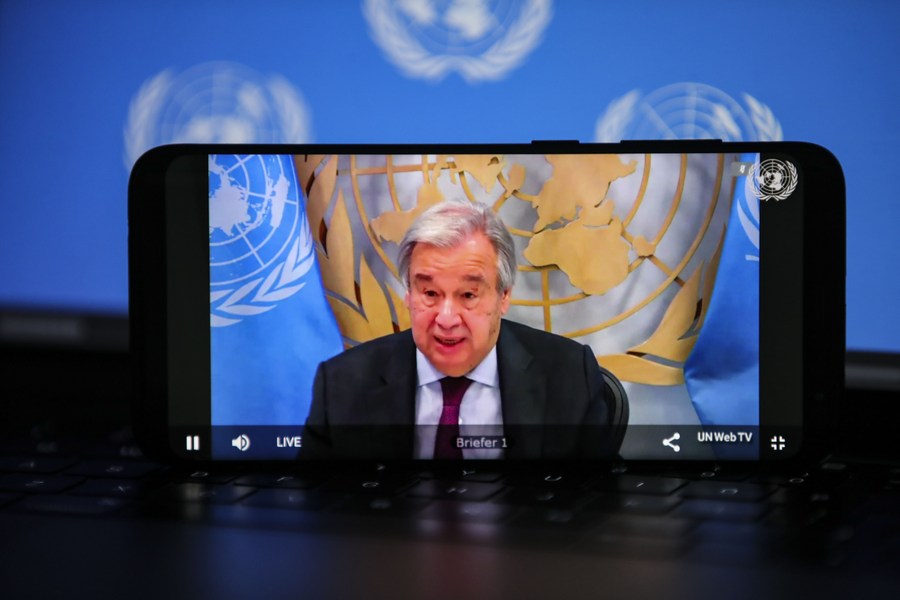
UNITED NATIONS - UN Secretary-General Antonio Guterres on Thursday called for post-COVID global governance that features solidarity and multilateralism.
The COVID-19 pandemic is a full-blown crisis in itself, unfolding against a backdrop of high geopolitical tensions and other global threats in unpredictable and dangerous ways, he told a summit-level Security Council debate on "global governance after COVID-19."
"The pandemic is a clear test of international cooperation, a test we have essentially failed," Guterres said.
The virus has killed nearly 1 million people around the world, infected over 30 million, and remains largely out of control. This was the result of a lack of global preparedness, cooperation, unity and solidarity, he said.
COVID-19 is a wake-up call for even more catastrophic challenges that may arise, starting with the climate crisis, he said. "If we meet these with the same disunity and disarray we have seen this year, I fear the worst."
There is an urgent need for innovative thinking on global governance and multilateralism, so that they are fit for the 21st century, said Guterres.
He called for global governance that is resolute, coordinated, flexible, and ready to react to the full range of challenges.
The world is no longer bipolar or unipolar, and is instead moving toward multipolarity, he noted. "We experienced fragmentation and polarization without effective mechanisms of multilateral governance 100 years ago. The result was the First World War, followed by the second (World War)."
COVID-19 is a warning that must spur the world to action, he said. "We have no choice. Either we come together in global institutions that are fit for purpose, or we will be crushed by divisiveness and chaos."
He asked for multilateralism for post-COVID global governance to work.
"Reformed global governance is about approaches, and institutions, which must be reformed and strengthened," he said. "We need more and better multilateralism that works effectively and delivers for the people we serve."
"We need more and better global governance based on national sovereignty and expressed through our shared ideals, eloquently expressed in the United Nations Charter," he added.
COVID-19 has illustrated beyond dispute the gaps in the multilateral system. As countries go in different directions, the virus goes in every direction, he said.
A rational and equitable approach to vaccination would reduce preventable deaths by prioritizing front-line workers and the most vulnerable. But the world has struggled to mobilize the resources needed to ensure a vaccine as a global public good, available and affordable to all, he lamented.
In a world of interconnected threats, solidarity is self-interest, he said.
"We urgently need multilateral institutions that can act decisively, based on global consent, for the global good. And we need multilateral institutions that are fair, with better representation of the developing world, so that all have a proportional voice at the global table," said Guterres.
He called for "a networked multilateralism" that is based on strong links and cooperation between global and regional organizations, international financial institutions and other global alliances and institutions.
Networked multilateralism must extend beyond peace and security, encompassing the Bretton Woods institutions, development banks, trade alliances and more, he said.
Many of the cross-border challenges, from the climate crisis to rising inequality to cybercrime, involve interest groups, businesses, organizations and entire sectors that are outside traditional concepts of global governance, he said. "These challenges cannot be addressed effectively by states alone. We need to broaden our idea of global governance, to take in businesses, civil society, cities and regions, academia and young people."
International conventions are not the only way to reach binding agreements for the common good. There is a need for flexible mechanisms in which different stakeholders come together, adopt protocols and codes of conduct, define red lines and create conditions for successful cooperation which is particularly relevant in the digital world, he said.
"Global governance must also recognize our responsibilities to our planet and to future generations. Civil society movements, particularly those led by young people, are global leaders on these issues," he said.
Global governance mechanisms until now have been exclusive, and the largest group left out in the cold is women, half of humanity, said Guterres.
Women watching this week's General Debate have a perfect right to feel that they are not represented, and their voices are not valued, he said, referring to the fact that few of the speakers are female leaders.
"The COVID-19 pandemic has proven what is obvious: women's leadership is highly effective. We cannot hope to turn the climate crisis around, reduce social divisions or make sustained peace without the full contributions of all of society," the UN chief said.
The United Nations has a responsibility to improve the effectiveness of global governance. But the primary responsibility for making global governance work lies with member states, he said.
Reform of global governance cannot be a substitute for collective action by member states to confront common challenges, said Guterres.
"Conflict, human rights abuses, humanitarian crisis and stalled progress on development reinforce each other and are interlinked, while our global response is more and more fragmented. We are not keeping pace with the world as it is. The institutions of global governance should work together in coordination, to contain, mitigate and reduce risks of all kinds," he said.
Thursday's Security Council debate, held during the General Assembly high-level week, was a signature event with Niger assuming the Security Council presidency for the month of September.
Nigerien President Mahamadou Issoufou chaired the virtual meeting. Guterres briefed the council. African Union Commission Chairperson Moussa Faki, South African President Cyril Ramaphosa, Estonian President Kersti Kaljulaid, and Tunisian President Kais Saied attended the debate via video teleconference.










