



How US policies may help China in the long run









The Sinophobic policies of the United States are causing losses to China in the near term, but in the long run, China could benefit from them. As absurd as it sounds, it is a reality that deserves attention.
As the US administration picks fights with Chinese high-tech giants such as Huawei, Chinese enterprises have realized they have to develop their own key technologies instead of buying them from US companies, so they no longer have to rely on the whims of US politicians. Such changes could cause irreparable and irreversible damage to the US high-tech sector.
Business relations are not faucets you can turn on and off at will. Once such relations are broken, it is very difficult to repair them, because the market will move on, building new partnerships along the way-without waiting for their old partners to change their minds.
The US administration is making a strategic mistake by attributing Chinese companies' growth to the "theft" of US technology. The fast growth of Chinese companies such as Tencent is based on a number of factors.
First, employees in enterprises such as Tencent work hard to stay competitive within a fairly large pool of high-tech workers. Their work ethic and habits matter to the growth of their employers.
Second, Chinese companies, due to fierce competition at the early stage of their existence, have developed a culture of extreme responsiveness to customers. If a customer demands a key feature from a software company, its engineers work overtime to get it delivered in weeks, if not days. In the US, I have found that response to feature requests is very slow. Calls are often redirected to automatic responses.
Besides, as the market matures, cross-pollinations happen, leading to more creativity. Attributing their growth to intellectual property theft is an insult to the character of all Chinese people. Simply put, it is racism on a national level.
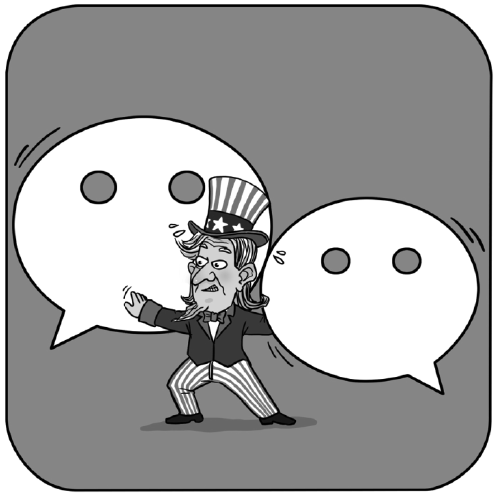
If you follow Chinese social media, you will realize that many Chinese think the opposite is happening in terms of intellectual property. Facebook is trying to push copycat products resembling some of the functions and features of short video sharing app TikTok or messaging and social media app WeChat while lobbying to ban or block its Chinese competitors. Copycat products of TikTok are also being introduced by other US companies.
The US has many blind spots in its trade talks with China. For instance, the US side of the negotiation has focused more on tangible products such as cement and steel but failed to see the larger wads of cash raked in by services and intangible products: Hollywood movies, the National Basketball Association, education services, consulting firms and training companies. A management consulting firm or an accounting firm can earn millions of dollars simply by selling PowerPoint presentations in China. Their losses from the trade war and the resulting sour relationship would far outweigh tariff incomes for the US economy.
Also, high-tech giants such as Apple and Microsoft will lose out because of the ban on WeChat if it goes ahead. Most Chinese would not bat an eye to ditch Apple devices if it is no longer possible to install WeChat on them. To the Chinese, it is like "picking up the sesame and forgetting about the watermelon".
Hawkish talk about China has become a trend because the US politicians know they are speaking to people who know little about China beyond banal narratives from so-called experts who don't really know anything about China either.
Current anti-China strategy masterminds, especially senators Marco Rubio and Ted Cruz, Secretary of State Mike Pompeo, and former White House chief strategist Steve Bannon (now charged with fraud), have misread public opinions and social dynamics within China. From their speeches, one can tell they don't know enough about China to provide competent advice to the US administration. They are only interested in reviving McCarthyism.
Both candidates for this year's presidential election have vowed to be tough on China. But they had better not continue their unimaginative "blame China" game, because it has not worked. Has China kowtowed to the US at the "tough" talks? The US closes the Chinese consulate in Houston. China closes the US' consulate in Chengdu. The US increases tariffs on Chinese goods, China does the same on US goods. The Chinese leadership will not yield to US pressure as that would stir up bitter memories of the years of oppression and invasion of China by foreign powers.
It might be time for the United States to rethink strategies toward China.
The author is a columnist based in Texas. The views don't necessarily represent those of China Daily.


Today's Top News
- Need for reshaping academic structure
- Shared Journey: Chinese new energy vehicles in Europe: competition or co-creation?
- Deep sea needs down-to-earth scientific research
- Deeper opening-up promised for steady growth
- China to rebalance growth with domestic demand boost
- Consultative suggestions provide policymakers with essential inputs to finalize five-year plan





