



A chance to advance rural transformation









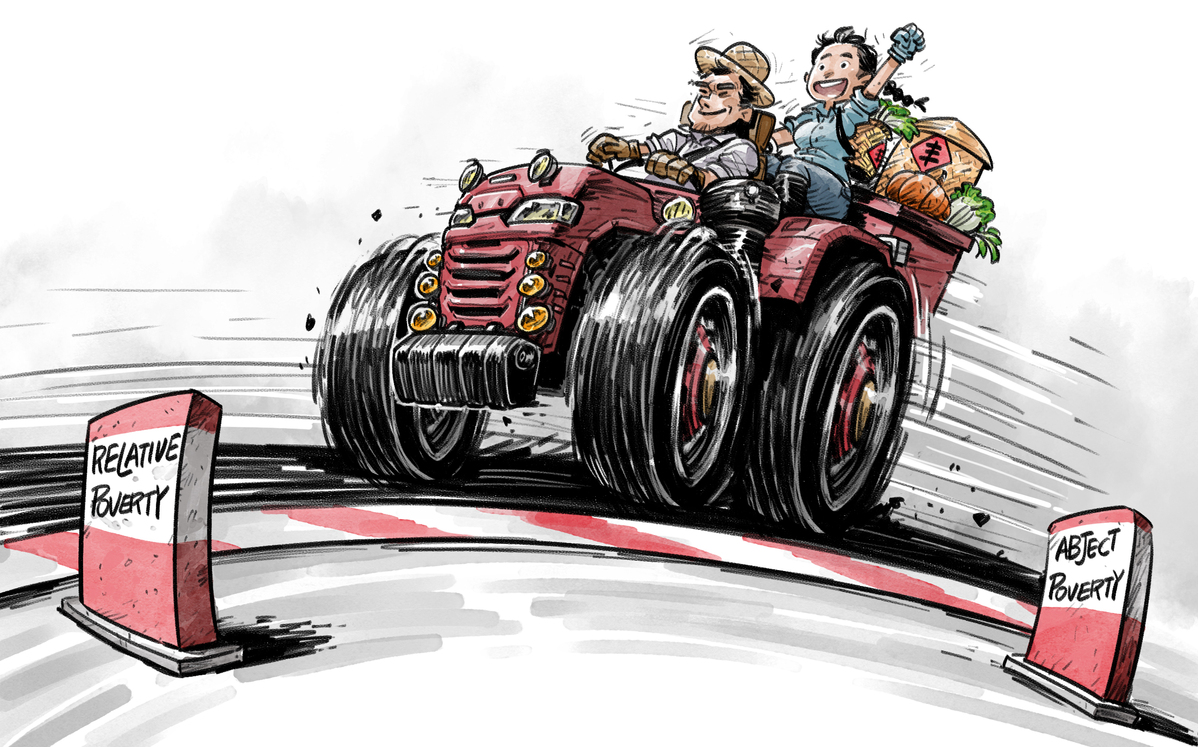
The discussion on the 14th Five-Year Plan (2021-25), which will be held during the Fifth Plenary Session of the 19th Central Committee of the Communist Party of China next week, offers a unique opportunity for China to update its development model to the new context.
How can China take this opportunity to further advance its agricultural and rural transformation agenda for the 2021-25 period and beyond?
Agriculture has been a significant driver of China's economic growth and poverty reduction over the past four decades. Investment in agriculture, in fact, drove productivity enhancement-which in turn led to widespread commercialization of agriculture and the development of business opportunities across the agri-food industry.
Agriculture, however, is becoming less and less competitive. The costs of domestic production are increasing because of rising labor and land costs, and domestic prices of the main agricultural produce in many cases exceed those in the international market. Profits have declined, yet government spending on agriculture has grown.
Moreover, despite the profound transformation in the agricultural sector over the past 40 years, China's agricultural production still extensively relies on the participation of smallholder farmers. But the increasing costs of production and the lack of sufficient scale to be competitive make the "smallholder model" non-viable and unsustainable in the long term.
Few opportunities for employment
Finally, despite massive migration to urban areas over the past decades, a large percentage of the population still lives in rural areas. Yet rural areas do not offer sufficient employment opportunities to retain the active work-force, inducing people, particularly youth, to migrate to cities, leaving the elderly, some middle-generation women, children and sick and disabled people in rural areas, and creating a new category of "vulnerable" people.
As for the COVID-19 outbreak, it shows that vulnerable people have been more severely impacted, as they had limited access to medical and social services and less capacity to cope with the economic consequences of an outbreak.
On top of all this, pollution and natural resource depletion are now a worrying legacy of the past growth model: about one-fifth of the land in China has been polluted-40 percent of the land area degraded, and overuse of water resources has depleted water tables.
Suggestions for the future
Against this backdrop, I would like to offer a few suggestions on how the 14th Five-Year Plan could contribute to an agricultural and rural transformation agenda in the country in the next years.
First, China needs to invest in rural areas to create attractive employment and investment opportunities. This would contribute to retaining and/or attracting back the people who have migrated, and to rebalance the existing divide between urban and rural areas, which is in line with the underlying principles of the recently devised "rural revitalization" strategy.
Second, there is a need to focus on income-generating opportunities outside the agricultural sector, while taking advantage of the opportunities generated by a modernizing agricultural sector. The percentage of income of rural households from agriculture-related activities has been declining over time. And there is limited scope for agriculture to absorb surplus labor in rural areas.
Therefore, focus should be placed instead on creating additional and diversified income generating opportunities outside the agricultural sector, for instance in the service, tourism, logistics, transport, construction or digital economy sectors.
At the same time, the expansion of the service industries linked to agriculture (for instance, agro-processing and food services) has the potential to attract investors and generate new employment opportunities that could retain people in rural areas.
The application of digital technologies and other innovations to agriculture can, in addition, help increase agricultural productivity. Both opportunities should be leveraged.
Focus should be on high-value farm goods
Third, the authorities need to manage the transition from smallholder agriculture. It is likely that a full transition to a large-scale and mechanized agriculture will take some time, and that smallholder production will remain an important feature of China's agricultural sector for some time in the future.
But the rising demand for high-value agricultural products from an expanding urban middle-income group, the rapid transformation of the agri-food value chains, and the spread-out of technological innovations open up opportunities for smallholders, as high-value products are more labor intensive to produce and generate a higher return per hectare.
In this context, China should pursue a dual strategy. To begin with, there is a need to integrate smallholders in modern agriculture.
This would entail, for example, improving their capacity to produce goods at the required quality standards, and improving their capacity to access high-value and remunerative markets, including through improved collective organization capacity.
At the same time it is important to favor the release of labor currently engaged in smallholder farming to more productive and remunerative activities, for example, by creating new income-generating opportunities in rural areas outside the agricultural sector.
Focus on 'greening' and sustainable agriculture
And fourth, special focus needs to be paid to "greening" agriculture and promoting sustainable agriculture. Technologies that are less polluting and utilize land and water resources more sustainably, crop varieties that are more resilient to the effects of climate change, and infrastructure that improve water efficiency, (sustainable agricultural practices) are more effective in reducing the impact of agriculture on natural resources. Also, improving the quality and safety of agricultural products should be promoted more widely.
The application of digital technologies in agriculture, too, can contribute to a more efficient and less pollutant use of resources.
And the International Fund for Agricultural Development remains committed to supporting the Chinese government in advancing agricultural modernization and rural revitalization in the coming years.
The author is country director and representative of the International Fund for Agricultural Development.





