Trade pact for region hailed









Reduced tariffs under RCEP will help revive battered economies, experts say
The signing of the world's largest free-trade agreement will support the efforts of Asia-Pacific nations to rebuild their pandemic-hit economies and further integrate operations, analysts said.
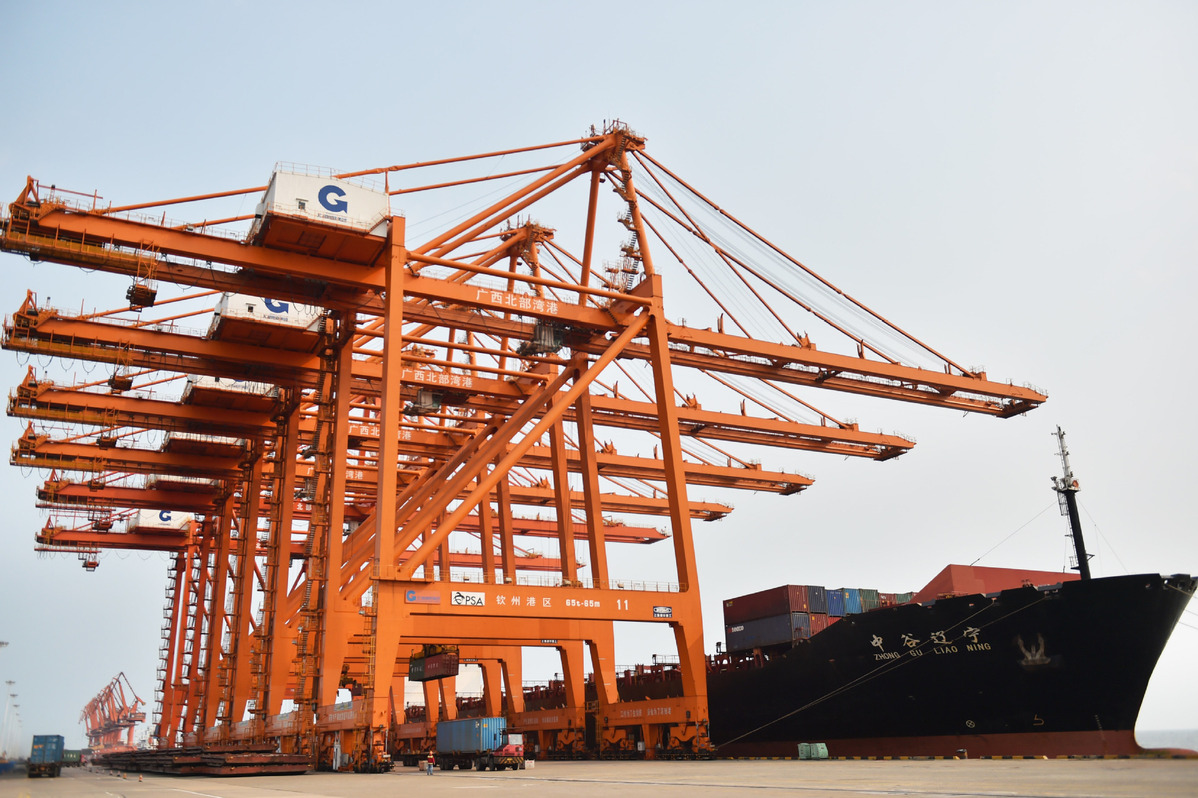
The Regional Comprehensive Economic Partnership, or RCEP, signed on Sunday by 15 Asia-Pacific economies will progressively reduce tariff rates, eliminate trade barriers and bolster investments among the 10 members of the Association of Southeast Asian Nations, or ASEAN, and China, Japan, South Korea, Australia and New Zealand.
Somkiat Tangkitvanich, president of the Thailand Development Research Institute, said the deal is important as it is "the first and biggest mega-FTA (free-trade agreement) signed".
Somkiat said the trade pact's signatories include two of the world's biggest economies in China and Japan, and Southeast Asia, one of the fastest growing regional economies.
"The signing of RCEP signifies that the region is committed to free trade and rule-based trade regime," he said.
The RCEP encompasses the supply chain across the East Asian and Southeast Asian regions, home to key manufacturing and exporting countries that can benefit from intraregional tariff reduction programs, Somkiat said.
Ruben Carlo Asuncion, chief economist at Union Bank of the Philippines, said the initiative is "very significant especially at a time of 'deglobalization'". But the "historic signing" of the RCEP has shown that the participating Asia-Pacific economies are committed to open and free trade.
"There is a higher likelihood of trade integration because of the RCEP signing," Asuncion said. "Many studies have delved into the development of strong intraregional trade among ASEAN economies, and having a trade agreement between economies does improve the exchange of goods and services."
The trade pact was first proposed during the 2012 ASEAN Summit in Cambodia and went through more than 30 rounds of negotiations. The eight years of talks were concluded this year, and the agreement was signed at the 37th ASEAN Summit.
The final document has over 500 pages and 20 chapters and included provisions on trade remedies, small and medium-sized enterprises, intellectual property, and sanitary and phytosanitary measures.
A joint statement signed by the leaders of the 15 countries hailed the trade pact and its expected boost to the region's economy.
Timely signing
The signing the trade pact is considered timely, given that Asia-Pacific countries are gradually rebuilding their economies while fending off another wave of coronavirus infections. The pandemic, for a time, clamped manufacturing and disrupted trade. But now the RCEP will "bring back momentum to trade and investments around the world", said Oh Ei Sun, senior fellow with the Singapore Institute of International Affairs.
Nicholas Antonio Mapa, a senior economist for Dutch investment bank ING, said tariff cuts and the integration of the supply chain through the RCEP countries will speed up trade and bolster economic activity across the Asia-Pacific region.
"Overall (the RCEP) would be a plus in combating the fallout from COVID-19," Mapa said.
Park Jin, former president of Seoul-based think tank the Asia Future Institute, and a member of South Korea's National Assembly, said the pact will promote economic cooperation between East Asian countries and ASEAN.
Countries that signed the RCEP "can interact with each other through trade investment and economic partnerships", he said.
Ho Meng Kit, CEO of the Singapore Business Federation, said that by enhancing cross-border trade, the trade agreement will help Singaporean companies "to enjoy greater flexibility in sourcing from a larger pool of suppliers in the region".
Chheang Vannarith, president of the Cambodia-based think tank Asian Vision Institute, said the RCEP can serve as a "legal and institutional instrument" that can facilitate the growth of e-commerce.
"What (the private sector) can get is obviously a new opportunity for trade and investment, especially e-commerce and technology, as they can use technology to advance their business interests," he said.