



Pandemic rings the changes









Evolving competition among the major economies will shape the post-pandemic global landscape in the next five years
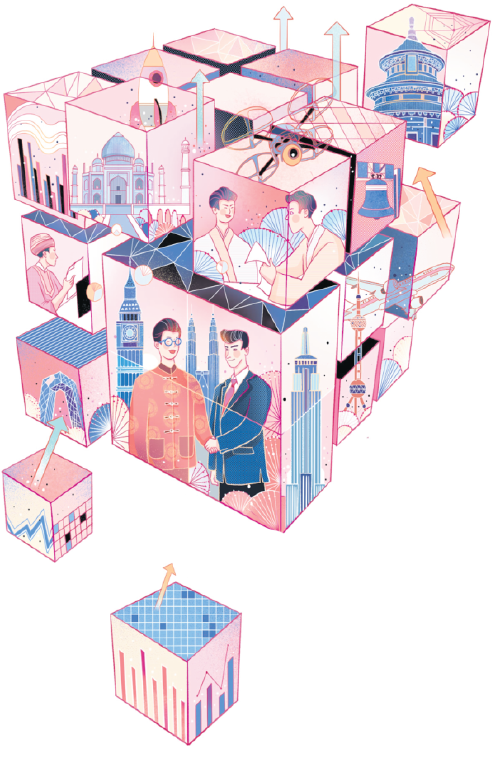
When the novel coronavirus broke out, the world was undergoing changes in the international order. The rapid spread of the virus has accelerated this process.
In the short run, the world will see the worst economic downturn and unemployment since World War II due to the pandemic. The International Monetary Fund predicted in October the global economy would contract by 4.4 percent in 2020. In the mid-to-long run, the world economy is very likely to plunge into a recession. Although some countries and regions may see a second wave of the virus, it will have less impact on their economic recoveries and market sentiment as with stronger public awareness and more control and prevention experience, it is highly possible that the pandemic will be strictly controlled as preventative measures are normalized.
Prior to the pandemic, developed economies had already been suffering low growth rates, low inflation and low interest rates together with high debts, widening wealth gap, high asset prices and aging populations. The pandemic has further exposed these. With marked fluctuations in asset prices, there is no doubt that the spillover effects of the pandemic will destabilize emerging and developing economies to varying degrees.
The pandemic will definitely have a far-reaching impact on globalization's progress as it has strengthened the anti-globalization sentiment that has come to the fore in some countries. Despite calls for strengthened international cooperation in public health during the pandemic, countries are still not united in the fight against the virus.
The economic slowdown caused by the pandemic has not only affected businesses on the demand side, but also on the supply side. Besides the protective measures adopted by countries for the purpose of reducing the fragility of the global supply chains and the risk of accessibility for strategically important materials have given a boost to the anti-globalization forces, which are likely to grow much stronger in the foreseeable future.
The next five years will see the rivalry between major powers or blocs in economic, political, scientific and technological fronts continue to evolve.
The significant impacts of the pandemic have not been felt to the same extent by different countries. Clearly, the US is expecting to see China catching up quickly in terms of economic power. Other major economies will continue to lag behind. This will offer opportunities for the US and China to play stronger economic roles.
With the impact of the pandemic, the global political landscape dominated by one superpower and multiple major powers will be maintained, barring major geopolitical conflicts. Over the next five years, the US will still be the world's most important country. However, its position as a global leader has been undermined by the US government's unilateral measures and disastrous pandemic control. Regaining the support and loyalty of the country's allies will be a major challenge for the next administration.
At the same time, China is rising as a global leader next to the US. European integration has suffered a setback due to Brexit, social destabilizations and the impacts of the pandemic. The European Union will have to work much harder if it wants the "tripolar world" it envisions to materialize. To be a key balancer is the role that Russia would like to play, which clearly shows Russia's expectations for its position and international influence.
Japan, whose economy has long been mired in stagnation, and India, which has suffered an abrupt economic slowdown after being hit by the virus following swift growth, will play more important roles in the global arena, although it will not be an easy job for them to find a balance in the fierce rivalry between China and the US and the competition among China, the US and the EU.
There will be a new round of technological competition. Major powers will compete and impose blockades and counter blockades to gain an edge in technologies such as 5G, quantum computing, artificial intelligence, genetic engineering, and space technologies. At the same time, the gap between the technologically powerful and weak countries will continue to widen.
The global order will likely experience one of the following four scenarios. The first scenario is the complete collapse of the current multilateral system. The law of the jungle holds sway. The checks on hegemonic behavior will be lost and "might is right" will become the only standard for dealing with international relations.
The second scenario is an incapacitated global system dominated by several major powers or power groups. Regionalism will be rebooted, with some existing regional mechanisms strengthened, new ones created, some reorganized and others abolished.
In the third scenario, two or more parallel systems will emerge, characterized by broken supply chains or at least partial decoupling. As a result, the multilateral system will be dismembered or play a lesser role. There will be many ways to shape the parallel systems, including via the interpretation and implementation of the rules of the system, the form of the social, economic and political institutions, and their cultural and ideological backgrounds.
In the last scenario, globalization may recommence. The novel coronavirus as an enemy of the whole world may awaken people's common humanity and foster a shared recognition of the importance of building a community with a shared destiny for humanity and a multilateral system that is strong, robust and innovative.
The possibility of the first scenario happening is much lower than that for any of the other three scenarios. Among which, the one that would benefit China the most is to boost regional cooperation and improve the multilateral system. However, as to which one will be the reality, that depends on how the game between the major economies plays out.
The author is the director of the Institute of World Economics and Politics, Chinese Academy of Social Sciences. The author contributed this article to China Watch, a think tank powered by China Daily. The views do not necessarily reflect those of China Daily.
If you have a specific expertise and would like to contribute to China Daily, please contact us at opinion@chinadaily.com.cn, and comment@chinadaily.com.cn.





