



What shifting US politics means for China









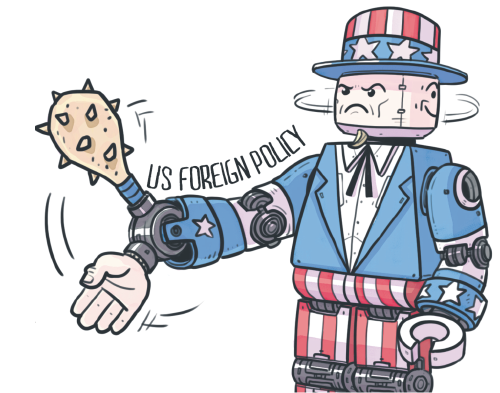
Four years ago, real estate developer and self-described political outsider Donald Trump raised the anti-establishment banner, unleashed a populist political storm in the United States, and won the US presidential election, overturning power in Washington and changing the country's foreign policy.
About two months ago, the political situation in the US flipped again, as Trump's opponents voted Democrat Joe Biden to power. Trump's rejection of the election results and his efforts to create obstacles to Biden's presidency have prompted the president-elect to make preparations for the White House on his own and, until recently, without the usual federal transition assistance.
Biden has already announced his administration's key diplomatic and national security staff, and by the look of it, the establishment of the past is set to return.
Biden may not necessarily change US foreign policy
It should be noted, however, that a change of president does not automatically signal the beginning of a dramatic new chapter in US politics or foreign policy. The great changes brought about by Trump's four years in power are not just a personal legacy but an unfinished historical process of political change in the US. Trump and his policies will have a significant impact on Biden's four-year term.
The US political upheaval is essentially a political crisis. Longstanding economic and social conflicts have intensified, and the political polarization has reached an almost unprecedented level-both between and within the Democratic and Republican parties. The long-held political orthodoxy of both parties has been discredited, the liberal consensus on governance among major interest groups shattered, and the checks and balances mechanism of bipartisan politics have given way to a veto mechanism.
American political scientist Francis Fukuyama has called this "the decay of democracy". And the sudden onset of the novel coronavirus pandemic has magnified these problems and the inherent flaws of the US political and economic systems in unexpected ways. The US has been plunged into a new political, economic and social crisis, similar to the crises of the 1930s and 1960s.
So-called Trumpism is a combination of Trump's personal ambitions and populist political movements as represented by former White House chief strategist Steve Bannon and Trump's trade adviser Peter Navarro, operating in a political alliance with the religious right and the far right wing of the Republican Party. The vast majority of Trump's grassroots support come from the ethnically white, blue-collar middle class and lower working class-people who have been increasingly marginalized in the process of globalization over the past 20 years or so. They are typified by Trump's fans in the Rust Belt states (where notably a majority of voters turned to Biden).
The outsourcing of traditional American manufacturing, the dramatic growth of economic financialization, information and communications technology, the internet, high-tech industries (including artificial intelligence), the new division of brain work and manual labor, the widening wealth gap and the precariousness of jobs have rendered this major group, long the poster child for the "American Dream", increasingly irrelevant, even socially stigmatized.
Despite the election's outcome, there remains a huge group of voters that, after a long period of disappointment and frustration, has raised Trump to what some say a messianic level while opposing globalization and becoming anti-Wall Street and anti-Washington establishment. They are now agitators contemptuous of political correctness, and an impetuous leader has become their strongest advocate.
From the inside out, the "America first" rhetoric is designed to relieve their pain points. As the hallmark of Trump's foreign policy, this so-called first principle is a mixture of populism, protectionism and isolationism. It's essentially an externalization or outreach of political changes within the US.
China's rise has changed global balance of power
That strategic competition has become the dominant topic in China-US relations in the new era can be attributed to three developments. First, the rise of China is rapidly changing the global balance of power and thus the relationship between the two countries. Second, the development of multipolarity is changing the international landscape. And third, the political changes in the US are leading to advocacy and outreach by needy parties.
During the later part of the Barack Obama administration, owing mainly to the first two changes and the new dominant approach, strategic competition became the consensus in Washington's strategic and diplomatic circles for policy adjustments related to China. The policy development of the Trump administration has added another factor, the prominence of outreach forces generated by political changes.
Ideological factors have thus become a new marker in the US' policy toward China-a change that became more unbridled after several key members of the establishment were kicked out, adding momentum to the attempts to decouple the Chinese and US economies. The Trump administration's failure to appropriately respond to the pandemic and the increased political tension and hostility between China and the US caused by the attempt to label China the "bad guy" have exacerbated the deterioration of bilateral ties.
New Sino-US ties have taken shape
In summary, a new relationship between China and the US has taken shape. One substantial change is the emergence of strategic competition as the dominant factor of the relationship. Two points need to be made clear in this regard.
First, the US has made China its main rival and accordingly adjusted its strategic orientation toward China-a reality that China must face. And second, it is difficult for China to change the reality of strategic competition at the moment (and for some time to come) in accordance with its own wishes-as the US still enjoys a significant advantage.
But there is room for both Chinese and US policymakers to play a role in deciding the way in which the strategic competition is conducted. What strategic competition actually means is determined by the interactions between the two sides, and it is primarily expressed in the handling of a number of important issues.
Finally, there remains the question of the incoming Biden administration's policy direction. The incoming US administration may adjust its China policy. But the basic approach to strategic competition with China-which reflects the mainstream view of both Democrats and Republicans-is not likely to be much different from that of the Trump administration. What may change is the manner in which that policy is carried out, and here there is uncertainty. The new direction will depend on how US politics evolves.
The incoming Biden administration's biggest challenge will be to make tangible progress on several fronts-containing the pandemic, nursing the domestic economy back to health, healing the divisions within the Democratic Party and easing the deep partisan rivalry in the country so that the democratic momentum can continue. Yet how the Biden administration handles the important issue of relations with China will be critical to global political development.
The author is a senior researcher at Taihe Institute.
Source: chinausfocus
The views don't necessarily reflect those of China Daily.





