New urbanized growth









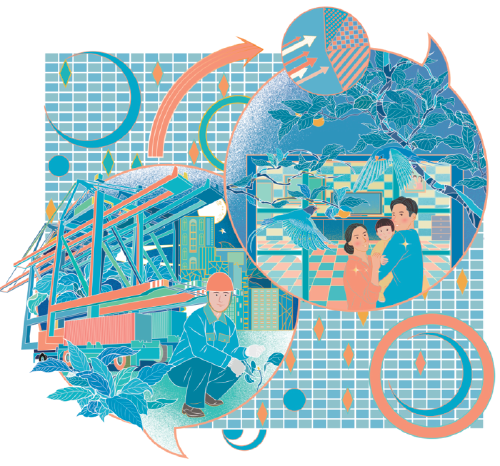
Much consumption potential to be tapped by transforming migrant workers into urban residents
In recent years, consumer demand has played an increasingly important role in driving China's economic growth.
But according to the World Bank, China's consumption rate is lower than that of other major economies in the world. China's consumption rate, which had been on a downward trend for years, is now picking up, but it remains low. There are many reasons for this, the most important of which is that in the past, the growth of incomes did not keep pace with the growth of the national economy. Although the situation has improved, there is still a long way to go.
China accounts for 18.2 percent of the world's population and 16.3 percent of its GDP at the official exchange rate, but China's final consumption only accounts for 12.1 percent of the world's total, which means there is a gap of about 4 percentage points between China's share of global GDP and its share of global consumption. If this gap is to be closed, the released consumption will be equivalent to the total consumption of the United Kingdom, significantly boosting China's economy.
China's urbanization rate is now 60.6 percent, which means that about 40 percent of the population still live in rural areas. Since they contribute just 22 percent to the household consumption of China, their consumption has the greatest potential to drive China's economy in the future.
The biggest challenge in tapping the potential is to keep people's incomes growing in step with the economy.
To ensure that China's personal income grows in step with GDP growth, it is important to promote a new type of urbanization. Over the past four decades, China has urbanized at a pace the world has never seen before. But its urbanization rate is still dwarfed by the average rate of high-income countries. On the other hand, it has not caught up with the average of upper middle-income countries while China's per capita GDP is above the average among upper middle-income countries. In 2019, China's per capita GDP exceeded $10,000, while the average level was $9,000. However, China's urbanization rate is 6 percentage points lower than the average level of upper middle-income countries. It is estimated that during the 14th Five-Year Plan period (2021-25), China's per capita GDP will exceed $12,000, meaning it will become a high-income country.
There is a unique gap in China between the permanent residents urbanization rate and the registered residents urbanization rate. The National Bureau of Statistics defines a person who has lived in a place for six months or longer as being a permanent resident in that place. Then the population who has lived in urban areas for six months or longer is the permanent resident population in cities and towns, and is counted in the urbanization rate of permanent resident population. The bureau also defines out-migrant workers as rural workers who have been away from their towns for six months or longer. Most of the outmigrant workers work in the cities, so it can be seen that migrant workers should be urbanized.
However, the migrant workers do not have hukou, or household registration status, in cities, and so do not have equal access to basic public services. Meanwhile, their incomes are low and unstable, and their employment is also insecure, which constrains their consumption. Studies have shown that if migrant workers were transformed into urban residents, their consumption level could be increased by 27 percent even if their wages are not raised and other conditions remain unchanged. Therefore, filling up the 16 percentage points gap between the urbanization rate of the registered population and the urbanization rate of the permanent population represents huge consumption potential unique to China at present.
In fact, with urban household registration, these workers are more stable in employment, receive more skills training; faster wage increases and greater social mobility, which can significantly help expand the middle-income group, benefiting both the State and individuals.
At present, the income growth of rural residents mainly comes from wage income, that is, the income from working as migrant workers. If the employment opportunities are not stable and life-long, workers are not fully mobile and there is lack of equal treatment in the labor market and basic public services, the sustainability and stability of farmers' household incomes will be affected.
In fact, the COVID-19 pandemic has exposed a major drawback in this incomplete urbanization. The inconsistency between the place of residence and the place of work, the place of household registration and the place of permanent residence, increases the unnecessary seasonal flow of personnel. In the event of an emergency, large-scale return home and return to the city are more difficult, resulting in abnormal life and work, and delayed resumption of work and production. In addition, many basic public services are linked to household registration, which hinders equal access to opportunities and prevents workers from spending without worry.
Therefore, the core of the newtype urbanization is the urbanization of migrant workers. In order to solve the problems of incomplete urbanization and insufficient progress of the reform of the household registration system, the central government raised specific objectives to be accomplished, such as increasing the proportion of the population registered as urban hukou. Local governments have made efforts to narrow the gaps in access to public services between migrants and locals in cities.
However, that is not enough. The new-type urbanization should focus on migrant workers living in cities, take household registration system reform as the main driving force of the new urbanization, and eliminate the huge gap between the urbanization rate of the resident population and the permanent population as soon as possible.
The author is vice-president of the Chinese Academy of Social Sciences. The author contributed this article to China Watch, a think tank powered by China Daily. The views do not necessarily reflect those of China Daily.