



Fast data sharing boosts global virus fight









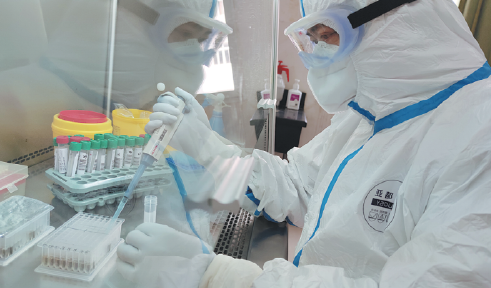
Chinese researchers involved in identifying the pathogen that causes COVID-19 as the disease first began its rapid spread said they stress both speed and prudence in their work in order to provide quick and accurate information to aid the global fight against the virus.
After COVID-19 hit Wuhan, Hubei province, in late December 2019, they managed to isolate the virus on Jan 7, 2020 after about a week's work, breaking the record for the shortest time to get a grip on an emerging contagious illness, said Wu Zunyou, chief epidemiologist at the Chinese Center for Disease Control and Prevention.
Two days later, China shared its initial progress in determining the pathogen that caused the viral outbreak with the World Health Organization. Then on Jan 12, Chinese researchers from three institutions uploaded genome sequences of five viral strains to GISAID-the global initiative on sharing all influenza data-an international genomic database.
"Lack of understanding about the pathogen is analogous to missing enemies on the battlefield," said Wu Guizhen, the chief expert on biosafety at the China CDC. She added that swift identification of the pathogen won precious time for global scientists to develop testing kits and vaccines, screen for effective treatment and trace the origin of the virus.
Zhou Peng, a researcher at the Chinese Academy of Sciences' Wuhan Institute of Virology, said technological advances have markedly shortened how long it takes scientists to sequence the genome of a viral sample.
By comparison, the full genome sequence of the virus that caused the severe acute respiratory syndrome outbreak in 2003 was released by Canadian scientists six months after the first case was detected.
"Currently, a genome sequence can be obtained within 24 hours at the fastest. But when faced with an emerging new virus, it will certainly take longer to verify results and analyze which pathogen causes the disease," he said.
Among the first group of novel coronavirus genome sequences released publicly, three were mapped out by the emergency technical center under the China CDC's National Institute for Viral Disease Control and Prevention in Beijing.
Tan Wenjie, head of the center, said it took less than two days for laboratory workers to obtain the genetic makeup of the four viral samples from Wuhan that arrived on Jan 2.
To ensure the accuracy of the results, Tan said three generations of genome sequencing techniques were deployed to verify the results, and multiple units at the China CDC, including its P3-level biosafety laboratory and the China National Influenza Center, were mobilized to expedite the procedure.
The fast-paced search for the pathogen also played out at the Chinese Academy of Medical Sciences' Institute of Pathogen Biology in Beijing, which contributed to sharing one genome sequence on Jan 12.
Ren Lili, a researcher at the institute, said the first hurdle in putting together a complete genome sequence was the low viral load in the samples available.
"Compared with the huge quantities of human genome and microbiome in viral samples, the virus genome only takes up a very small proportion," she said. "It is thus challenging to minimize effects from other genomes when handling clinical samples." A microbiome is a collection of the genetic material of all microbes in a human body.
In addition to laying out the genome sequence of the virus, Ren said it is crucial to parsing the genomic information to extrapolate whether it is a new or known pathogen that causes the patient to get sick, which requires extensive knowledge and a profound understanding of virology.
"Within 50 hours of receiving the sample, we had sequenced the virus' genome, verified our findings and compared it with known coronaviruses to point out differences," she said.
The National Health Commission said it had commissioned a handful of high-level laboratories in the country to isolate the virus and identify genome sequences independently and simultaneously.
Wu Zunyou, from the China CDC, said during a previous interview that the top health authority was not assured until results from all laboratories had unanimously suggested that a novel coronavirus was the pathogen. "High-level experts were also convened together again to verify the results and confirm the conclusion," he added.
"In terms of sequencing the virus," Ren said, "speed is not the sole purpose. It is equally important, if not more so, to ensure that the information and data that we produce is of high quality."






- The Fujian Coast Guard conducts regular law enforcement patrol in the waters near Jinmen
- IP protection for new fields to improve
- Draft rules define premade dishes in consumer interest
- Self-powering pacemaker could last a lifetime
- China intensifies crackdown on misuse of personal data
- China issues new rules classifying online content harmful to minors














