Important tasks to be fulfilled in next five years









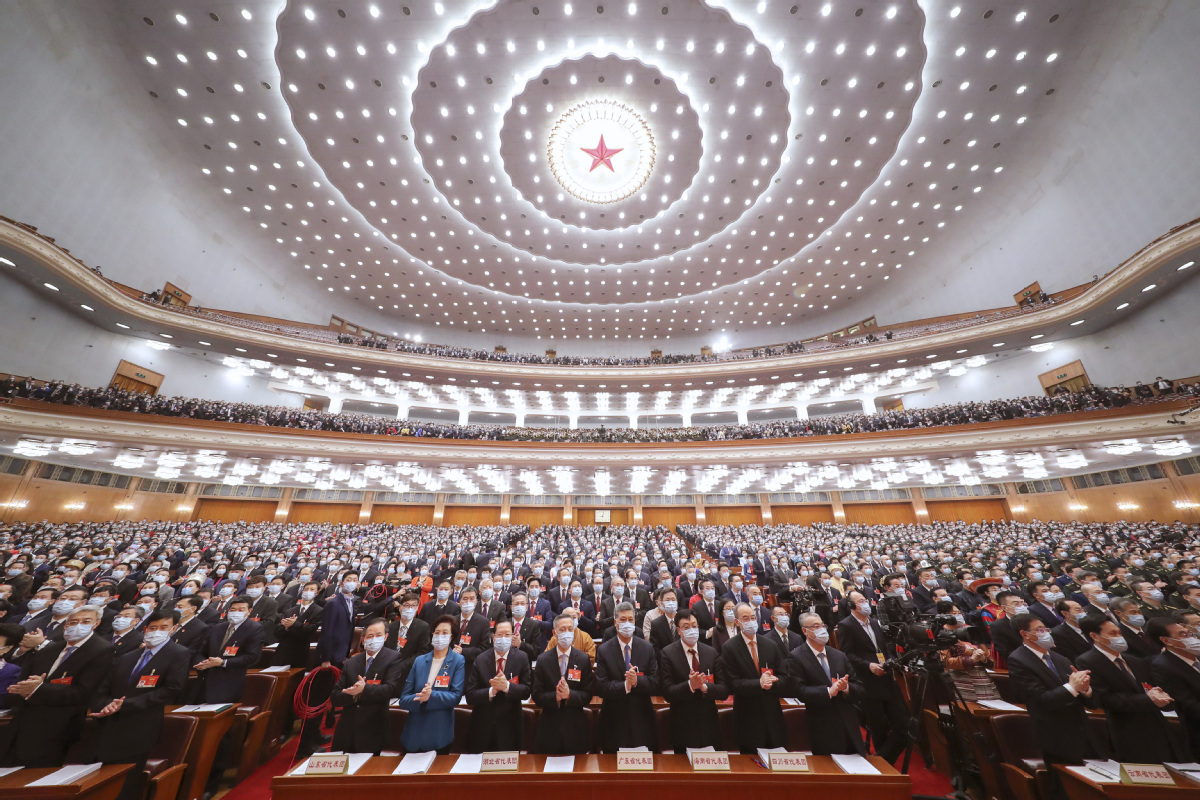
The ongoing annual session of the National People's Congress is especially important because, among other things, it is deliberating on the 14th Five-Year Plan (2021-25) for National Economic and Social Development and the Long-Range Objectives Through the Year 2035.
In the Government Work Report he delivered on the opening day of the NPC session on Friday, Premier Li Keqiang has listed several major targets and tasks for the 14th Five-Year Plan, from maintaining healthy economic growth, boosting innovation, and fostering a new development pattern to advancing rural revitalization, promoting coordinated regional development, and deepening reform and opening-up.
In order to achieve these goals, the government has to fulfill some important tasks in the next five years.
To begin with, the government should keep raising total factor productivity, because the total economic productivity of China is determined by three factors contributing to total production as measured by GDP: natural resources and capital input; human resources and labor input; and technological base (or total factor productivity). To become a modern country, China's total factor productivity should reach 65 percent that of the United States by 2035. Which means China needs an annual total factor productivity growth rate of 1.95 percent or more than that of the US to achieve the target.
China has basically accomplished industrialization over the past four decades, and its total factor productivity will decline if labor-intensive industries continue to be the major driver of the economy. So during the 14th Five-Year Plan period, China needs to develop other engines, such as the digital economy and new infrastructure, to boost total factor productivity and drive the economy.
Besides, it would be unwise of China to abandon its advantages in manufacturing, which is important for the smooth functioning of its industrial and supply chains. Further reform and opening-up, and more efficient allocation of resources, too, can increase total factor productivity.
Moreover, for four decades, China has relied on investment to drive economic growth, but from now on it should focus on boosting domestic demand and increasing consumption, in order to expedite internal circulation, which is the mainstay of the new "dual circulation" development paradigm.
There is an inverse relationship between a country's per capita GDP and its dependence on foreign trade: the wealthier a nation, the lower the share of exports in its GDP. For China, the share of exports in GDP peaked in 2017 at 35 percent, dropping to about 18 percent in 2019. And with China's GDP increasing steadily, exports' share in GDP will continue to decline.
Although there was negative growth in consumption despite the 2.3 percent GDP growth in 2020-mainly because of the COVID-19 pandemic-consumption is expected to see robust growth in the next five years. In fact, by 2035, the share of domestic consumption in GDP is forecast to increase to 60 percent from 39 percent in 2019, with consumption of services exceeding consumption of goods.
To boost domestic consumption, however, the government needs to supplement household incomes and promote fairer distribution of wealth by, for instance, taking measures to bridge the urban-rural development gap and the income disparity between the rich and the poor.
This is important because about 20 percent of China's total workforce is expected to shift from the agriculture to the service sector. In 2017, 27 percent of the country's total workforce was engaged in the agriculture sector, but the figure is expected to drop to 6 percent in 2035. Since this means the government has to address the housing, education and social welfare problems of the new workforce entering the service sector, achieving people-centered urbanization will be a daunting task.
Also, China has to make greater efforts to move up the global value chains, so as to accelerate the development of core technologies and reduce its reliance on imports. For semi-conductors, for example, China has to import up to 85 percent of the parts from other countries. Therefore, the government needs to more vigorously promote innovation and better protect intellectual property rights. The annual 7 percent increase in overall R&D over the next five years is a welcome and timely move in this direction.
It is widely believed that China, with concrete measures, will achieve the targets it has set for itself in the next five years, paving the way for the realization of the goals of vision 2035.
The author is dean of the Guanghua School of Management, Peking University. The views don't necessarily reflect those of China Daily.