



Low-carbon growth key to realizing green goals









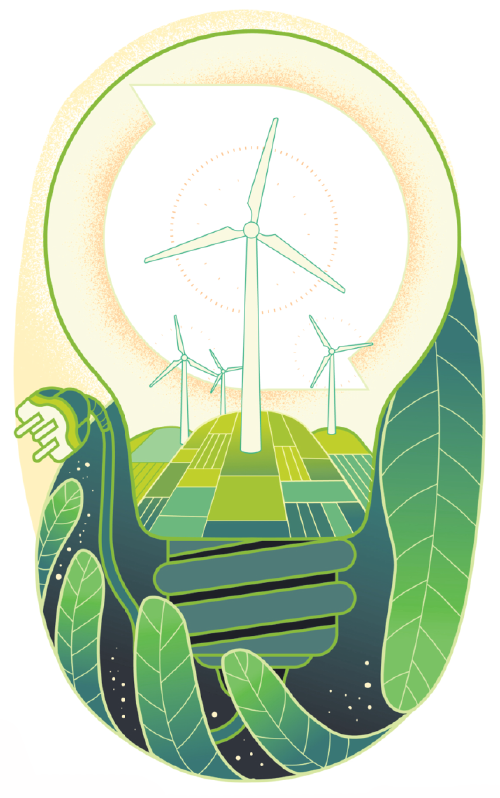
The COVID-19 pandemic has had a huge impact on the global economy, while cautioning the world to follow a green development path if it does not want to face a crisis much worse than the global public health crisis created by a warming planet. China chose an environmentally friendly development path when it shifted its focus from quantitative economic growth to qualitative, sustainable development.
China's commitment to green development was once again highlighted by Premier Li Keqiang at the two sessions on Friday. While delivering the Government Work Report, Li reiterated the goals of peak carbon emissions and carbon neutrality, saying "we will draw up an action plan for carbon emissions to peak by 2030".
On Sept 22 last year President Xi Jinping said at the general debate of the 75th annual session of the United Nations General Assembly-that China's carbon emissions will peak before 2030 and the country will achieve carbon neutrality before 2060.
Which means that, while making efforts to boost the economy during the 14th Five-Year Plan (2021-25) period, China will focus on low-carbon development.
But it is an arduous task to achieve carbon emission peak before 2030 and carbon neutrality in the following 30 years. To realize the two environmental goals, China has to make sustained efforts to ensure its emission nearly peak by the end of the 14th Five-Year Plan in 2025 by, among other things, improving its economic structure, saving energy and increasing the use of clean energy, so that the country has more room for achieving carbon neutrality before 2060.
In fact, while addressing the UN climate meeting via video link on Dec 12, Xi emphasized that China will reduce carbon emissions per unit of GDP, or carbon intensity, by more than 65 percent from 2005 levels by 2030. Which in turn may help emissions to peak ahead of schedule.
Accordingly, the country is working out an action plan for peaking carbon emissions before 2030. China is estimated to have emitted nearly 10 billion tons of carbon from burning fossil fuels, with coal accounting for more than 7.5 billion tons, followed by oil and gas. As an industries-based economy, China's carbon emissions come primarily from power generation and the industrial sector, a smaller percentage from the transportation sector and an even smaller percentage from the agricultural, commercial, residential and public service sectors. And more than half of the emissions come from fuel burning by power plants, according to International Energy Agency data.
Among industries, the major emitters are the energy, chemical, and iron and steel sectors, with the industrial sector, excluding thermal power and other electricity generating plants, accounting for nearly 30 percent of the carbon emissions.
Rapid urbanization, on the other hand, has greatly increased the transportation sector's energy consumption and, as a result, the sector's carbon emissions account for almost 10 percent of the total emissions.
Power plants, and the industrial and transportation sectors are the main carbon emitters in China. And since fossil fuels will continue to be the major source of energy in the country in the near future and the demand for electricity will increase as China industrializes further, emissions from the power, industrial and transportation sectors may keep rising.
Therefore, peaking carbon emissions as early as possible is important for achieving carbon neutrality before 2060. In order to do that, China needs to control the consumption of fossil fuels and reduce the growth of high-energy intensive and heavy industries, apart from shifting its reliance from thermal power to clean and renewable sources of energy. It also needs to build a clean energy structure, accelerate the development of the renewable and clean energy sector, and promote carbon capture, utilization and storage.
In fact, the goals set in the 14th Five-Year Plan should help China to peak its carbon emissions before 2030 and continue reducing emissions after that.
Thanks to the impact of the pandemic, the global economy plunged into recession, as lockdowns and other strict anti-pandemic measures affected manufacturing, employment and investment in almost all economies, disrupted global climate action, and challenged the economic foundations of many countries.
Countries striving to recover from the impact of the pandemic face a tough question: How to blend economic recovery with low-carbon transformation, in order to combat climate change?
The United Nations Environment Programme has called for green economic recovery and "building back better". Accordingly, after China pledged to achieve carbon neutrality before 2060, countries such as Japan and the Republic of Korea vowed to more rapidly reduce carbon emissions on way to realizing carbon neutrality. This, along with the United States' return to the Paris Agreement in February, shows much of the world has realized the importance of green economic recovery.
Besides, China's economic development is in line with its commitment to achieve carbon neutrality before 2060. It has taken a low-carbon, green path to economic recovery through measures such as increasing the share of new energy vehicles, and promoting renewable energy and carbon trading. But since the demand and supply situation for energy has not fundamentally changed, there still could be an increase in energy consumption and carbon emissions, which means China faces many challenges in low-carbon transformation.
In general, China especially needs to take four measures during the 14th Five-Year Plan period to achieve the two environmental goals.
First, it should integrate the carbon neutrality goal into its development plans, which will allow it to implement laws and regulations to realize the 2030 and 2060 goals. It should also develop more effective mechanisms for the national carbon trading market.
Second, the government should issue policies conducive to promoting innovation in energy technology and developing carbon-neutral and carbon-negative technologies, especially in the power generation, industrial and transportation sectors.
Third, with more and more countries committed to achieving carbon neutrality, China's pledge to reduce carbon emissions will boost the fight against climate change. And by deepening global cooperation in global climate action, China will not only widen its global influence but also help other countries to better adapt to and mitigate climate change and boost common development.
Fourth, a broader concept of energy conservation should be promoted to include improving energy efficiency, developing a circular economy and making economic structural changes toward lower energy intensive economy.
Also, carbon trading market and power market reforms are needed to make clean energy more competitive and to reduce energy consumption.
The author is dean of the China Institute for Energy Policy Studies at Xiamen University.
The views don't necessarily reflect those of China Daily.





