



US needs more investment, not relief bills, to revive economy









The COVID-19 pandemic has wreaked havoc on the United States economy, creating a big hole in the job market probably on the scale of the Great Depression. There have been many reports about people without jobs for months now. It is dreadful to see single mothers with children facing eviction and having difficulty putting food on the table.
The scenes of thousands of cars waiting in line at the North Texas Food Bank in Dallas, Texas, which distributed more than 600,000 pounds of food among about 25,000 people on a single Saturday in November last year, looked disheartening and scary. Millions of Americans are suffering, and they need government help.
The $1.9 trillion COVID-19 relief bill passed by Congress on March 10 is the US administration's response to the calamitous deterioration of livelihoods in the country. Yet as much as I loathe the Republicans' history of halfhearted empathy toward the working class, I am critical of this bill, because it will create perhaps the biggest hole in the federal budget.
This relief amount is much higher than necessary, especially since the Congress has already passed five bills totaling about $4 trillion. At a time when it appears the US has started to contain the spread of the novel coronavirus-as indicated by the dramatically declining numbers of infections and deaths-does it make sense to issue massive numbers of welfare checks?
It seems the US is intent on spending out of the pandemic rather that vaccinating out of it.
Yet the astronomical amount of the bill is not the most important reason why I support the Republicans. The US' national debt is already beyond control, so it doesn't make much of a difference to print another $1.9 trillion worth of currency notes. Yet the relief package will make little difference to millions of American households.
The issue is not so much about whether to spend the money, but about how to spend it.
During the most difficult period of the COVID-19 pandemic last year, in March-April, when the Chinese government was talking about a relief package, some economists and experts, including me, opposed the idea of handing money directly to the poor and the needy.
Instead, the experts advocated increasing government expenditure on infrastructure and other civil projects which tend to create jobs, especially for the poor and the needy. In order to widen the impact of the relief package, the money injected into the economy needs to circulate and eventually percolate to the wallets of those in need. In other words, the relief bill can be more effective if it is mainly based on investment, instead of consumption.
Besides, investment is precisely what the US needs at this juncture. Former US president Donald Trump used to boast about "making America great again", yet he didn't ask the Congress to pass a single bill sanctioning funds to be used to improve the US' crumbling infrastructure facilities as he had promised to do during his campaign trail. Instead, he kicked out Gary Cohn, his chief economic advisor, who worked out a public-private-partnership plan for infrastructure investment.
During his election campaign, President Joe Biden, too, promised massive infrastructure investment. And this is the right time to kick-start the much-needed public work projects rather than delaying them any further. Such projects create jobs that do not require highly educated workers and benefit mostly the low-income group. But will Biden order the printing of trillions of dollars worth of greenbacks to fund these projects?
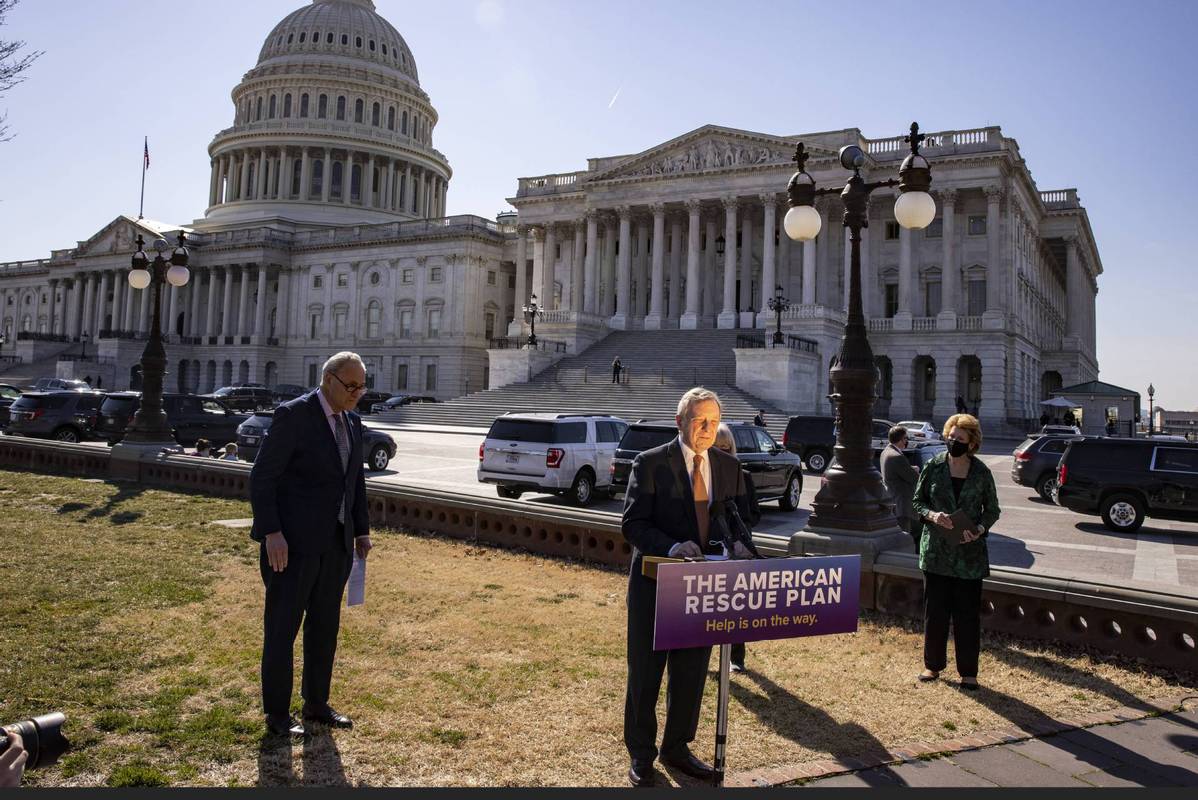
There is no doubt that giving people checks totaling $1.9 trillion will help them in the short term, but in the long run inflation and the dollar's depreciation will unfortunately hurt all Americans. Democrats claim their $1.9 trillion bill is an "American Rescue Plan" that will help the country defeat the virus and nurse the economy back to health. But this kind of "health" will be short-lived.
The author is a professor at the University of International Business and Economics and a research fellow at the Academy of China Open Economy Studies at UIBE.
The views don't necessarily reflect those of China Daily.
If you have a specific expertise and would like to contribute to China Daily, please contact us at opinion@chinadaily.com.cn, and comment@chinadaily.com.cn.





