



Online healthcare needs more govt support









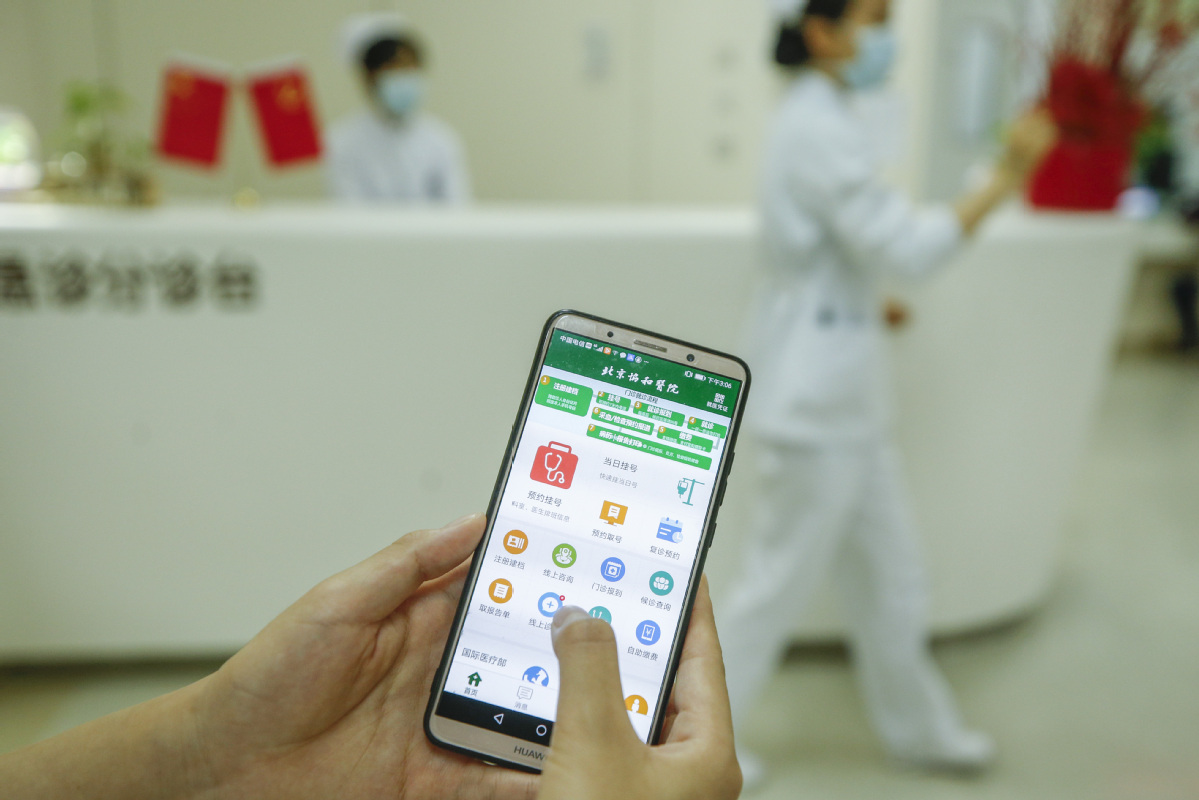
Facilities at the grassroots level must be better developed to serve patients
The online healthcare insurance system should be better developed to form a closed loop encompassing online healthcare consultation all the way to payment methods to better serve patients, said national legislators.
"What is offered offline should also be offered online. Patients of common ailments and chronic diseases should be able to see a doctor online, and the service fee should be included in the national healthcare insurance fund," said Sun Wei, a deputy of the 13th National People's Congress and honorary director of the Second Affiliated Hospital of Shandong University of Traditional Chinese Medicine, during an interview with Qilu Evening News.
Sun said that when COVID-19 broke out, the internet healthcare sector experienced burgeoning development. However, practical problems still remain.
"The cost and reimbursement policies of online hospitals should be consistent with those of brick-and-mortar hospitals. Real-name registered online consultations should be implemented. Meanwhile, online expense review systems and medical service supervision mechanisms should be established to ensure the safety and security of the national healthcare insurance fund," she added.
On Feb 23, 2020, when the novel coronavirus was spreading in Wuhan, Hubei province, the Wuhan Healthcare Security Administration launched 18 measures to control the outbreak and ensure routine primary care.
One measure was to support the inclusion of online healthcare services into the public insurance system. Apart from Wuhan, over 10 cities also launched similar policies, thus allowing online healthcare services to unclog a major bottleneck seen amid the contagion.
On Nov 2, the National Healthcare Security Administration issued a guideline promoting "internet plus" healthcare insurance payments while clarifying management scope, application requirements and settlement targets of online medical insurance, thus indicating that the inclusion of internet healthcare into the public insurance system had entered a practical stage.
Zhang Xiaoxu, a research fellow at VCBeat, an online healthcare website, said: "Currently, the policies have been better implemented in first-tier cities such as Beijing and Shanghai as these cities have relatively ample public health insurance funds. However, online hospitals in second and third-tier cities, and medical institutions at the grassroots level, still have a long way to go. After the two sessions, it is expected that more policies to boost the inclusion of internet healthcare into the public health insurance system will be carried out."
Currently, even in megacities like Beijing, practical problems still exist.
Zhang Yang, a 28-year-old media professional, recently consulted a doctor online. She downloaded the mobile app developed by Beijing Hospital-a public 3A-grade facility-and registered with her social security identification number.
As Zhang had a sore throat, she was planning to see a respiratory specialist. However, she found out that the online doctor of Beijing Hospital's respiratory department was only on call every Tuesday morning.
"The online doctor personnel resources were limited," she said.
As Zhang registered using her social security ID, her online consultation fee was mostly covered by the public medical insurance. However, when she tried to purchase pharmaceuticals online, she was told that online purchasing only supports out-of-pocket payments. To reimburse using public health insurance, she still needed to go to Beijing Hospital to conduct an offline payment.
"So far, public hospitals in Beijing don't support online drug reimbursement. To open the service, we have to wait for the notice issued by the Beijing Medical Insurance Bureau," said Cao Suyan, chief physician of the general practice department at Beijing Hospital.
With vast development opportunities, online healthcare platforms are also stepping up efforts. Ping An Healthcare and Technology Co Ltd, a Shanghai-based leading online healthcare services platform, had signed agreements for more than 120 internet hospital projects by the end of 2020. Among the projects, 50 are already up and running, with five being connected to online social health insurance payment systems.
Hangzhou, Zhejiang province-based digital health company WeDoctor now runs 28 internet hospitals, among which 17 have enabled online payment reimbursement.
"A medical liability system that includes prevention, diagnosis, treatment, disease management and health maintenance should be established. This is what we are dedicated to now," said Liao Jieyuan, founder and CEO of WeDoctor.




















