



Xiong'an steps on road to long-term development









April 1 marks the 4th anniversary of President Xi Jinping announcing the plan to transform Xiong'an in Hebei province into a green and innovation-oriented city and China's 19th national-level district and economic zone.
Xiong'an New Area, about 100 kilometers southwest of Beijing, is designed to be a "city of the future" characterized by innovation-driven, sustainable development.
Those wondering why Xiong'an has not taken off despite four years of construction should understand that the "city of the future" is "a millennium project", and Xiong'an was a typical rural area until the country's top leadership decided to develop it into a modern city.
According to the 2018-35 master plan for Xiong'an New Area, which was approved in January 2019, Xiong'an would "basically develop into a modern city that is green, intelligent and livable, with relatively strong competitiveness and harmonious human-environment interaction" by 2035.
Nevertheless, Xiong'an has acquired a new look over the past four years thanks to the sustained flow of resources and continuous construction. About 14 million trees of 200 different species had been planted across 310,000 mu (20,667 hectares) in Xiong'an by the end of 2019 in keeping with the pledge to develop a green city.
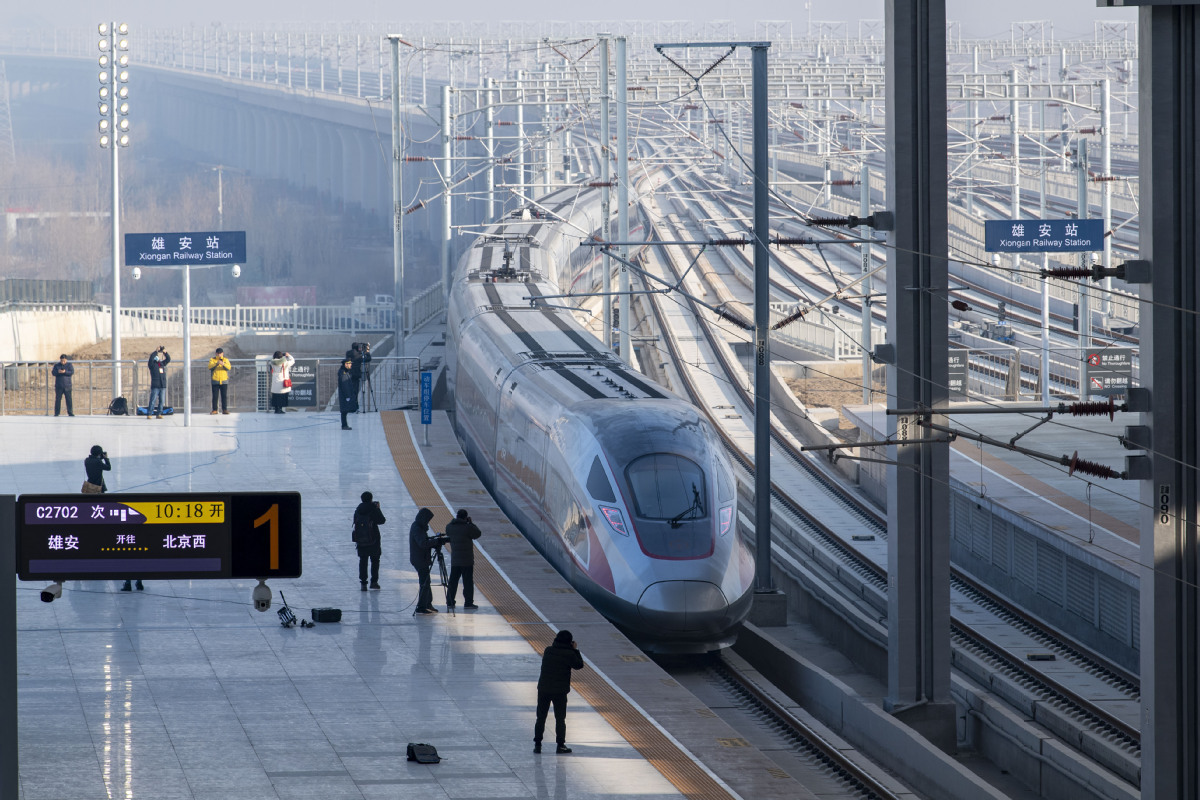
The Beijing-Xiong'an intercity railway, which started operations at the end of 2020, has not only reduced the travel time to about 1 hour but also will play a key role in promoting the coordinated development of the Beijing-Tianjin-Hebei region.
That construction work in Xiong'an continued during 2020 amid strict pandemic prevention and control measures shows the high importance the government attaches to its development.
The pace of Xiong'an's development can be gauged from the fact that by the end of last year, it provided many online and offline vocational skill training courses and created 8,250 new urban jobs. And it already houses blockchain lab, a new-generation internet lab and a pilot financial technology supervision project.
As a national-level pilot zone for innovation and development of the digital economy, Xiong'an will use new infrastructure to facilitate the integration of big data, the internet of things, 5G, new materials and new energy. And to facilitate the use of digital technology in the transportation network of the new city, advanced technology such as building information modeling and city information modeling are being used to build Xiong'an New Area.
Xiong'an is being built as a digital city with synchronous planning and construction and intelligent infrastructure. The new city will promote real-time, all-around intelligent application services, and establish a big-data asset management system. Also, the digitalization of industries, and the integration of the digital and real economies will transform Xiong'an into a model intelligent city.
The Central Committee of the Communist Party of China has emphasized that Xiong'an New Area be built based on careful and clear planning, for the project faces many challenges. Yet the central leadership is prepared to deal with the challenges of building an innovation-oriented city and set an example for the world. After all, over the past four years, Xiong'an has accumulated enough experience to add a new chapter to the theory of urban planning, construction and management.
Xiong'an will be characteristically different from China's two major special economic zones of Shenzhen and Pudong New Area in Shanghai. Shenzhen developed at breakneck speed because the government invested huge resources to make it a bridgehead in the initial stages of reform and opening-up in the 1980s, and the foreign capital and technologies that flowed into the city helped boost the economic development of the country.
As for Pudong New Area, it was developed in the 1990s and soon became the largest shipping, trade and financial hub in the Far East, leading the robust development of the Yangtze River Delta region. One can say Pudong elevated China's urban development model to the global level.
Xiong'an New Area is different from Shenzhen and Pudong in that it is committed to promoting high-quality, innovation-driven and environmentally friendly development for the benefit of the people.
The author is an associate professor at the School of Urban Economics and Public Administration, Capital University of Economics and Business. The views don't necessarily reflect those of China Daily.





