Yunnan's Hebian village shows promise of a diversified future









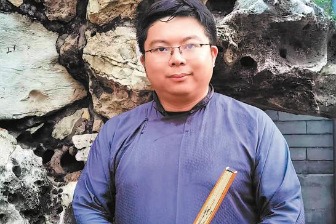
As a professor who has studied poverty alleviation during his whole career, Li Xiaoyun said he was still shocked to see Hebian village on his first visit in 2015.
The village, about 40 kilometers from the border town of Mohan in Yunnan province, has 57 households and 206 people, the majority of whom are from the Yao ethnic group.
"Generally, there will be some kind of divide between the rich and the poor inside a village. But I did not see that in Hebian. Everyone in the village was poor.
"I saw lives that were extremely difficult; dark wooden homes, old and worn-out bedding, rickety furniture and people living with their livestock under the same roof," recalled Li, who is a professor of rural development and global poverty alleviation at China Agricultural University.
The fact that the villagers could only rely on revenue from growing rice, corn and sugar cane, crops that are susceptible to extreme weather and damage from wild elephants, also meant their incomes were highly unstable. Many families went into debt to make ends meet, but their expenditures on education for their children, healthcare and daily necessities remained fixed.
This made it impossible for them to cut spending in order to repay their debts, he said.
What surprised Li even more was the level of diligence among the villagers. Some in their 80s would still harvest wood from the mountains, while most villagers would get up in the middle of the night to tap rubber on their plantations until the morning.
"From Hebian's case, we can tell that poverty does not result from laziness or a lack of intelligence," he said.
Together with teachers and students from CAU, Li initiated a project that empowered the villagers to improve their living environment, a precondition for the development of a tourism industry.
Between 2015 and 2017, Li's team raised about 3 million yuan ($456,000) to help the villagers build new homes based on the traditional buildings of the Yao, each with a guest room, toilet and kitchen. A conference room with a capacity of 50 people was also constructed.
A cooperative was established to manage the tourism industry, and the students instructed cooperative members on how to use computers for registering guests and issuing invoices.
The beauty of the location attracted a stream of tourists and conference goers. Some villagers gave up farming completely, while others were introduced to the cultivation of plants that could be used for traditional Chinese medicine. Others became chicken, pig and fish farmers.
The two approaches have helped villagers shake off poverty and significantly raise their incomes. Most households had a yearly income between 60,000 to 70,000 yuan in 2019, with the per capita income of the village increasing to over 30,000 yuan.
Last year, the COVID-19 outbreak dealt a heavy blow to the village's tourism sector, as it forced travel restrictions. Most households relied on their livestock and crop cultivation to survive during the height of epidemic.
An important lesson from last year, Li said, is that shaking off poverty is only the first step, and there is still a long way to go to achieve long-term prosperity.
"The process of reorienting the village away from agrarian patterns brought about a sharp increase in the income of villagers. In the meantime, the overreliance on new business models simplified the income structure of the farmers. It led to increased vulnerability in their livelihoods," he said.
The fact that many households held on to their farmland during the development of new business models meant they could fall back on farming and also take jobs at nearby villages to make a living, Li said.
Hebian showed the importance of diversified industries in rural areas, which could bring considerable income to rural households and make them more resilient against risk.
Li called the project at Hebian village an experiment in both poverty alleviation and rural vitalization.
"It tells us that the continuous impetus from urbanization and industrialization is indispensable in consolidating the outcomes of poverty alleviation and attaining rural vitalization. Only in this way can we enable the free flow of production elements between urban and rural areas, develop the rural industries and vitalize the rural areas," he said.