Water discharge call draws fire










Pressing problem
A fisherman who wanted to be known only as Eguchi said, "We know that handling this water is a pressing problem, but if it is released into the ocean, all the efforts we fishermen have made to recover from the Fukushima disaster will be meaningless."
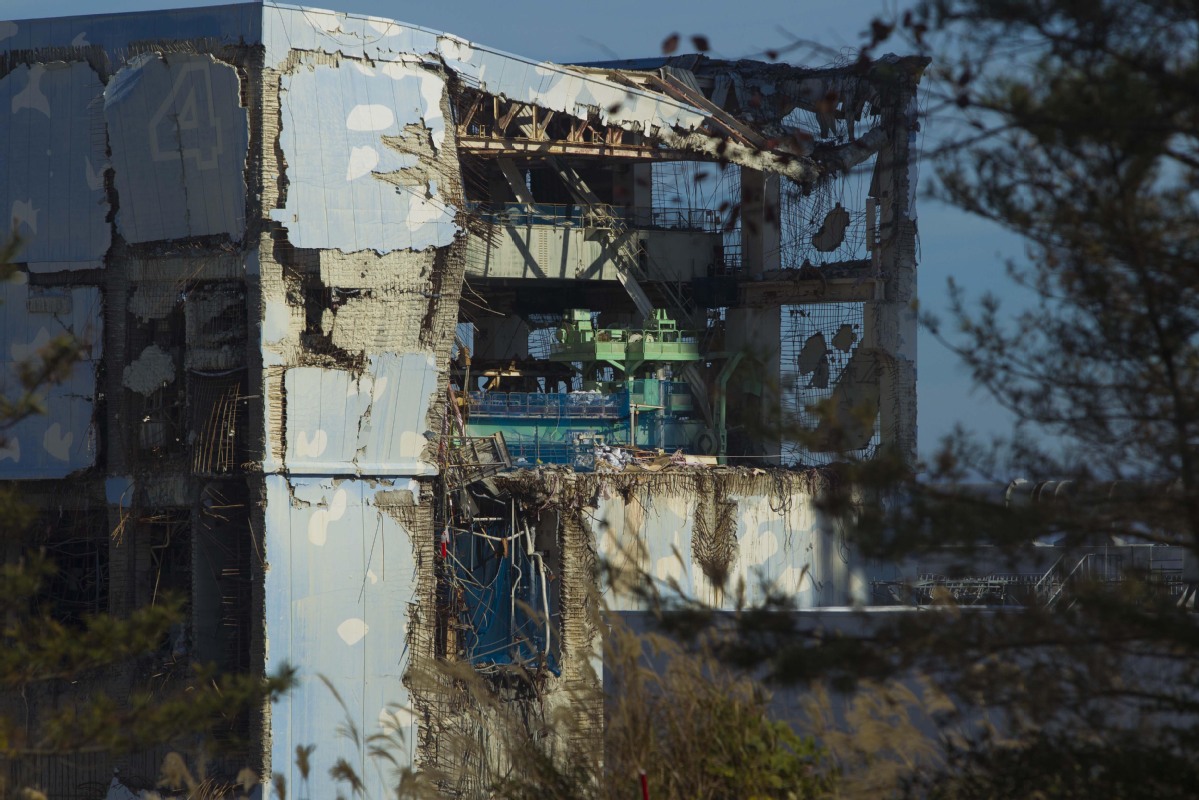
In 2011, a magnitude 9.0 earthquake and a tsunami damaged the Fukushima plant's cooling systems, causing three reactor cores to melt. Since the accident, thousands of tons of seawater have been pumped into the reactors as coolant. Groundwater that flowed into the damaged structures has become contaminated with radioactive nuclides.
TEPCO has stored more than 1 million tons of this water in the tanks at the site, but has said it will run out of storage space by autumn next year.
According to the Japanese government, releasing the contaminated water into the Pacific is the only viable option. The water will be treated with an advanced liquid-processing system, or ALPS, to remove most contaminants. However, this process cannot remove tritium, a radioactive isotope of hydrogen, the lightest element.
Japan insists that dumping tritium-laced water into the sea is a common practice at nuclear reactors around the world, but many observers remain unconvinced.
Erbiao Dai, vice-president of the Asian Growth Research Institute in Fukuoka, said: "Japan and TEPCO have used a series of claims to support their plan. These include: the lack of further storage space for the water by 2022; that the water is not contaminated, as radioactive tritium is the only radionuclide it contains and this is harmless; and that there are no alternatives to discharging the water into the ocean. However, none of these statements are true."
Dai said it is possible to include additional storage space for the water beyond next year, both on and off the Fukushima site, but the Japanese government has ruled this option out, stating that it would take "a substantial amount of coordination and time".
"Meanwhile, long-term storage and processing of the contaminated water is logistically possible because tritium has a short half-life of 12.3 years, so delaying the start of discharges would allow the tritium to diminish naturally, which is a better way to safeguard people's health and the environment," Dai added.
The half-life of a reaction is the amount of time needed for a reactant concentration to decrease by half. Its application is used in chemistry and medicine to predict the concentration of a substance over time.
Dai added, "The ALPS the Japanese government is relying on is flawed. The companies that operate it, Toshiba and Hitachi General Nuclear Electric, have practically no experience in water processing."
The effectiveness of the ALPS has been questioned. In 2018, experts found a large number of radioactive substances other than tritium, such as carbon-14, cobalt-60 and strontium-90, remained in treated wastewater stored the previous year.
TEPCO also acknowledged in August, for the first time, the presence of high levels of carbon-14 in the contaminated tank water. Dai said if the water is discharged into the Pacific, all the carbon-14 would be released into the environment.
"Once introduced into the environment, carbon-14 will be delivered to local, regional and global populations for many generations. Releasing the contaminated water into the ocean is clearly not based on science and engineering, but on the political interest of the Japanese government and the future viability of TEPCO," Dai said.
Asked whether fish would have radioactive contamination, Buesseler, from the Woods Hole Oceanographic Institution, said, "The question is not whether there is radioactivity in fish-yes there is in all fish-but how much more radioactivity has Fukushima added and how much more would be added with the proposed release of tank waters."
Ma Jun, director of the Institute of Public and Environmental Affairs in Beijing, said the Japanese government should release more information on the radioactive water and consult stakeholders before deciding on how to dispose of it.