



Japan cannot use the Pacific as its sewer









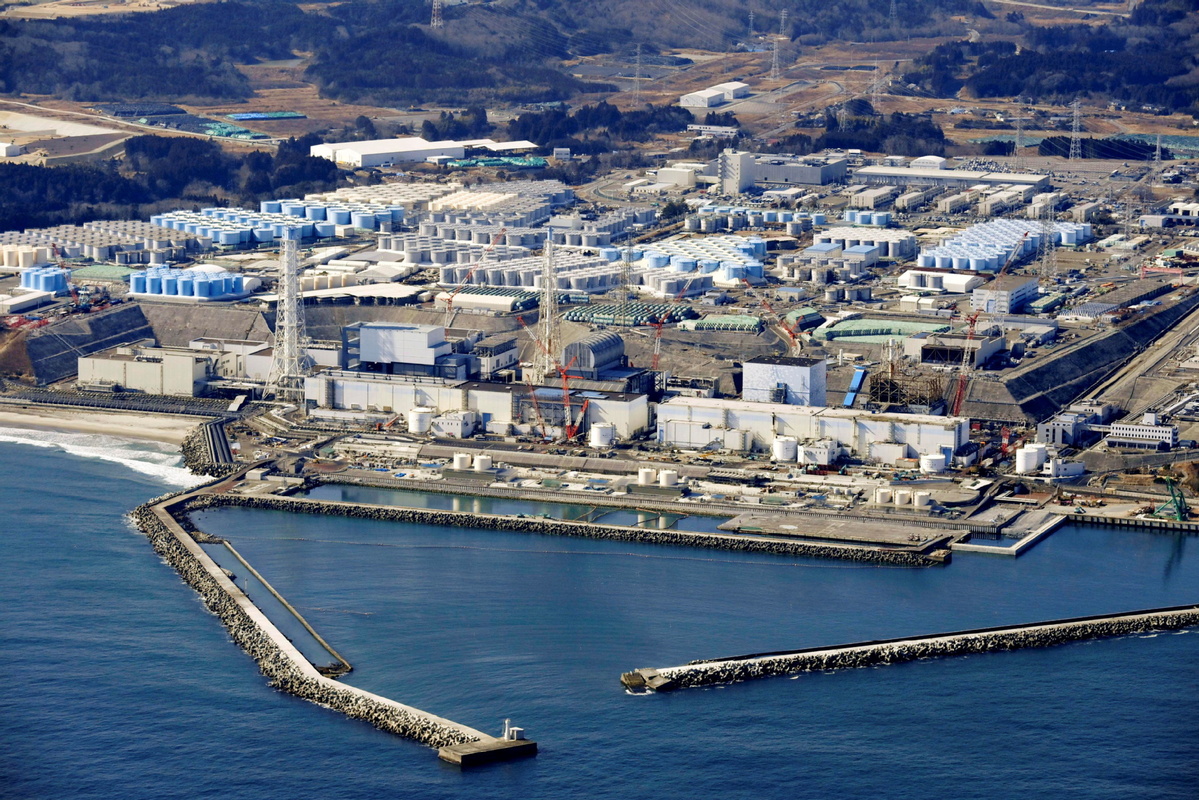
The Japanese government has decided to start releasing 1.25 million tons of radioactive water from the crippled Fukushima Daiichi nuclear power plant into the sea in two years, saying it would ensure that the tritium in the water is one-fortieth of Japan's national drinking water standard and one-seventh of the World Health Organization's standard.
Although Japan's decision has been condemned by people both in Japan and abroad, the United States immediately backed Japan, saying the country "appears to have adopted an approach in accordance with globally accepted nuclear safety standards", with US Secretary of State Antony Blinken tweeting: "We thank Japan for its transparent efforts in its decision to dispose of the treated water from the Fukushima Daiichi site."
Since dumping radioactive water is a global issue, as it poses a risk to human health across the world, the US' endorsement of Japan's decision exposes the double standard the two countries resort to when it comes to meeting international obligations-they have one set of rules for themselves and their allies and another for the countries they perceive as rivals and competitors.
The fierce global opposition against Japan's decision can be attributed to the false claim the country made about the treated wastewater being safe and not exploring safer methods of wastewater disposal. Since the earthquake-triggered tsunami severely damaged the Fukushima plant in 2011, the Japanese authorities have been pumping water into the plant to cool down the nuclear reactors, resulting in the huge volume of radioactive water. Underground water seeping into the reactors has also contributed to the accumulation of the contaminated water.
The problem, as Japan claims, is that all the steel tanks used to store the wastewater will be full by the summer of 2022. And it is due to this fact, Japan says, that it decided to dump the radioactive water into the sea. Japan's plan would have worked had not media reports in August 2018 revealed that 72 percent of the wastewater was highly toxic due to the presence of some very harmful chemicals which could not be removed in the first filtration, belying the claim of Tokyo Electric Power Company, the plant's operator, that tritium concentration increased after the filtration process.
Whether the second round of filtration will remove the excessive radioactive elements from the wastewater is not known. But if that works, why has Japan already decided to release about 1.25 million tons of radioactive water into the sea?
Japan can dispose of the contaminated water in an environmentally friendly way. For instance, since tritium has a half-life of 12.43 years, its concentration level will drop to one-32nd of the current level in 48 years. And Japan needs just 640,000 square meters of vacant land around the Fukushima plant to store the tanks for 48 years.
Yet despite the many meetings and public hearings, the Japanese government chose the cheapest way of wastewater disposal and ignored the other possible options: evaporation, deep-well injection and near-surface disposal.
According to the United Nations Convention on the Law of the Sea, countries should try their utmost to not discharge nuclear waste into the sea. And in April 2020, the International Atomic Energy Agency said that Japan can either "evaporate" the wastewater or release it into the Pacific, but the first is preferable. Yet Japan has opted for the easier but harmful way of disposing the contaminated water and thus failed to fulfill its global obligations of protecting the planet from nuclear pollution.
The US' rush to support Japan's decision shows its long-standing policy of meddling in the Asia-Pacific region. Washington is well aware of the harm the radioactive water would cause to the marine environment, food safety and human health, as the strong ocean currents, according to a German study, will spread the radioactive water to most of the Pacific in 57 days and all the oceans in 10 years.
And although the wastewater is likely to reach the US shores in about 1,000 days, China, the Democratic People's Republic of Korea, the Republic of Korea and Southeast Asian countries, geographically closer to Japan, will bear the brunt of the contamination.
It is clear therefore that by blindly supporting Tokyo's decision, Washington is turning a blind eye to the well-being of humankind as a whole, in order to take advantage of regional disputes to consolidate its alliance with Japan and use it to contain China. Perhaps the US is supporting Japan also because after a partial reactor meltdown at the Three Mile Island nuclear power plant in 1979, it took 33 years to dispose of the nuclear waste.
China is opposing Japan's decision to release radioactive water not only for its own sake but also for the benefit of the rest of the world. Since the seas and oceans are the common wealth of human beings, the discharge of contaminated water in the Pacific is not a domestic issue for Japan nor a Sino-Japanese bilateral issue but a matter of global concern.
China should therefore join hands with other countries and the International Atomic Energy Agency to urge Japan to abandon the idea of discharging the radioactive water into the Pacific, and consult all stakeholder countries before taking any further decision. As China's Ministry of Foreign Affairs said, the Pacific Ocean is not the sewer of Japan.
The author is a researcher at the Institute of American Studies, Chinese Academy of Social Sciences.
The views don't necessarily represent those of China Daily.





