


How plowshare diplomacy won the day









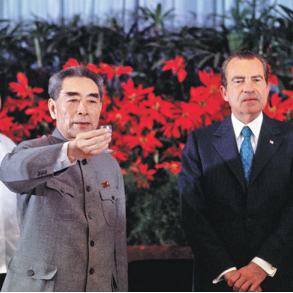
 Nixon and Zhou Enlai share a toast during a dinner in Hangzhou five days later. ETTMANN/CORBIS
Days later on the plane from Beijing to Hangzhou, Freeman had a long conversation with Zhang Wenjin, who served as China's ambassador to the US between 1983 and 1985. In July 1971 Zhang and the other three were in Islamabad to meet Kissinger before they all flew to Beijing on a Pakistani plane.
Then there was Zhou, who had charmed more than a few of his foes and fellow negotiators over the decades."I remember a remark that Dag Hammarskjold (United Nations secretary-general from 1953 to 1961) had made, to the effect that, when he first met Zhou Enlai, as he did, I believe, during the effort to compose a truce in Korea, for the first time in his life he felt uncivilized in the presence of a civilized man," said Freeman, when he was interviewed for the oral history project of the Library of Congress in Washington in 1995.
Speaking to the young man across the dinner table on several occasions, Zhou asked Freeman about his background and Chinese-learning experience. On the group's last day in Beijing, Zhou, apparently having been briefed by his staff on Freeman's search for a set of Chinese history books in one of Beijing's biggest bookstores at the time, told him that he was going to give two sets of the original 18th century edition of these books to the United States.
One of the two sets, which Zhou presented through Freeman, is now in the State Department Library.
With his Chinese counterparts interpreting for Nixon and Zhou, Freeman did interpretation almost exclusively at the foreign minister level, where "all the shouting and screaming" (his words) took place.
"The US secretary of state William Rogers and the Chinese acting foreign minister Ji Pengfei discussed issues including Korea, Vietnam, Kashmir and Japan's role in the region," Freeman said. "We almost couldn't agree about anything except that China and the US should work towards normalizing relations."
The Shanghai Communique issued on Feb 28, one day before Nixon's departure from China, did not shy away from publicizing those conflicting views. "It was Zhou's idea that we put in our disagreements before we put in the areas where we would try to cooperate," Freeman said. "I think it was brilliant. It accomplished the purpose and allowed both sides to show to their respective friends and allies that they had held the line.
"The Chinese translators had bent over backwards to faithfully render the reservations of the United States in the communique," said Freeman, who was asked to review the Chinese text of the communique in Shanghai before its publication, together with Ji Chaozhu, a Chinese translator for the Nixon trip, who later became the Under-secretary General of the United Nations between 1991 and 1996. Ji passed away in April last year.
The most contentious issue was Taiwan. On October 25, 1971, the People's Republic of China was admitted into the UN, as "the world rebelled against the absurdity" of the notion that Taipei, not Beijing, was both the legal capital of China and entitled to represent China internationally"-to quote from a Freeman speech to the Salon of the Committee for the Republic last year.
"Both (Taipei and Beijing) were adamant that there was, should, and could be only one China, of which Taiwan was a part. ... When he visited Beijing in 1972 president Nixon solemnly declared in writing that the United States did 'not challenge' the cross-Straits consensus on this," Freeman said in the speech.
"Beijing accepted Nixon's declaration as the renunciation of any ongoing American intent to divide China by creating 'one China, one Taiwan', 'one China, two governments', 'two Chinas', an 'independent Taiwan' or by advocating that 'the status of Taiwan remains to be determined'."
Euphoria was Freeman's word of choice when asked about the mood on the plane back to the US. Coincidentally on July 11, 1971, when Kissinger arrived back in Pakistan after his secret meeting with Zhou, he cabled a single-word response to Washington-"Eureka."
After the Nixon trip, Freeman, who was "besieged by people with tape recorders who had come in to receive wisdom from the front", saw "a great outburst of misguided interest in China trade on the part of people throughout the country". One involved a man in Texas who read Pearl Buck, thought Chinese slept in their coffins before they died and was trying to sell a lot of them.
"We wanted to have an organization that would educate people-one that was officially created but of a non-governmental nature," said Freeman, who was then the economic/commercial officer for China with the US Department of State. The result was the formation in 1973 of the National Council for US-China Trade, later renamed the US-China Business Council.