



Japan should change wastewater decision









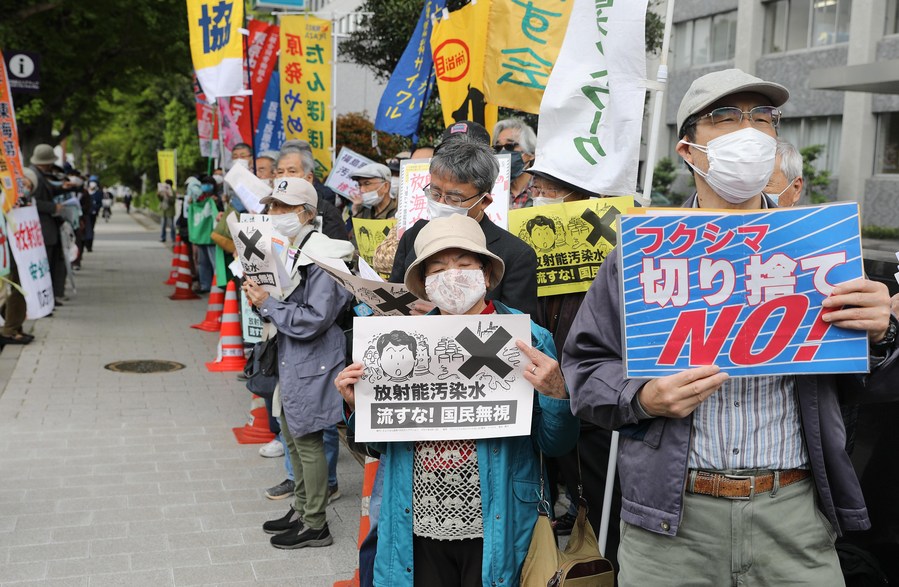
The Japanese government earlier this month decided to discharge radioactive water from the now crippled Fukushima Daiichi nuclear power plant into the sea in two years, causing grave concern at home and abroad and evoking strong opposition from the international community, especially neighboring countries such as China and the Republic of Korea.
If the Fukushima nuclear accident 10 years ago was a natural disaster caused by the earthquake-induced tsunami, then the discharge of nuclear wastewater into the sea would be a purely man-made calamity. The Japanese government's decision to minimize the country's risks and maximize its interests could have a catastrophic impact on the marine environment and human lives around the globe.
The responsibility of this "tragedy of the commons" will essentially be on Japan's choice of "rational evil". Instead of changing its decision in response to the objections raised at home and abroad, Japan has been unsuccessfully trying to defend its choice of "rational evil".
It has been trying to influence domestic as well as global public opinion by claiming that the disposal of radioactive water from the Fukushima plant is necessary because the tanks built to store the water are almost full to capacity.
The Japanese government also claims the treated radioactive water, after further treatment and dilution, would be safe enough to drink, so discharging it into the sea will not harm the marine environment and by extension human health.
On April 13, the day Japan decided to release the radioactive water into the sea, Japanese Deputy Prime Minister and Finance Minister Taro Aso went further to say that "on scientific grounds Japan should have done this a long time ago", stressing that "drinking diluted nuclear wastewater would do no harm" to human health.
A day before, that is, on April 12, Japanese Prime Minister Yoshihide Suga argued that doing so is an effective way of disposing the huge volume of Fukushima wastewater and the only way to rehabilitate the Fukushima prefecture.
In other words, Japan is ignoring marine ecological safety and human health just to revive the Fukushima prefecture.
Dumping nuclear wastewater into the sea is by no means the only solution to the problem. There are other ways to dispose it, including "hydrogen release", "stratum injection" and "underground burial". But Japan has chosen the lowest-cost and most irresponsible way to do so, thereby posing a threat to the marine environment and human health.
The treated nuclear wastewater at Fukushima still contains tritium, carbon-14, cobalt-60, strontium-90 and other radioactive substances that are difficult to completely remove from radioactive water and extremely harmful to the environment and ecology. It is not safe for even washing clothes, let alone drinking. Japan says it will accept the supervision of the International Atomic Energy Agency and discharge the nuclear wastewater following international standards. But by doing so, it is essentially trying to exploit the loopholes in the existing international laws.
The international community has not reached a consensus on the legal definition and standards of radioactive water and nuclear solid waste, so it is difficult to apportion responsibilities or the blame for any breach of nuclear waste disposal norms. Which means Japan is using the lack of an international governance mechanism and international precedents, through sophistry, to release the Fukushima radioactive water into the sea.
Yet most Western media outlets have maintained a studied silence on Japan's "rational evil" decision. In fact, on April 13 itself, the United States said Japan's decision is in accordance with international safety standards, with US Secretary of State Antony Blinken even thanking Japan for its "efforts" and releasing the radioactive water in a "safe and transparent" manner.
The Tokyo Electric Power Company, the operator of the Fukushima plant, has a history of concealing, even falsifying, facts. Plus, the US, without carefully analyzing scientific data and using its political clout, has distorted relevant laws by claiming the discharge of the contaminated water into the sea will not harm the marine environment or human health.
Japan is the only country to suffer the consequences of a nuclear attack and yet have large amounts of plutonium needed to make nuclear weapons and experience a level-7 nuclear accident, the highest level for a nuclear accident. Perhaps that's why Japan is ambivalent about nuclear energy, otherwise why would it embrace nuclear energy and have a love for nuclear despite suffering from nuclear phobia and taking an antinuclear stance.
Japan should have developed a deeper understanding than other countries about the damage nuclear explosions, or nuclear accidents or pollution can cause to human lives and the environment. Yet on the Fukushima wastewater issue, Japan has chosen the "rational evil" to safeguard its own interests, reflecting its political philosophy of risking humanity's interests to realize its narrow national gains.
In short, Japan's choice of "rational evil" and the US support for it will harm the cause of "environmental protection" and sustainable development.
Yin Xiaoliang is a professor at the Institute of Japanese Studies, Nankai University; and Gong Kexin is a postgraduate student at the institute.
Then views don't necessarily reflect those of China Daily.








