Global CO2 emissions and China's challenges









6. China and US: biggest players and beneficiaries of globalization
The world entered a new stage of globalization in the 21st century, with a sharp increase in global trade, investment, technology transactions, and personnel exchanges. If we put global exports in the timeline, we will find the global export volume in 1979 accounted for only 10.8% of the current volume. The net growth during 1980-1999 doubled that of 1979, and made up 23.2% of today's global export volume. Exports were given a boom during 2000-2019, with growth in the period accounting for 69.1% of the current volume. In other words, 70% of today's global exports were created in the 21st century, meaning that wealth model was swiftly shifted from the national economy to the global economy.
It was the globalization that made the explosive growth of global wealth happen. Global GDP in real terms during 2000-2019 grew by 70%. In the period, China's GDP in real terms grew by 420%, becoming the biggest contributor to the world economic growth. Despite a modest growth rate of 50% in the period, which was below the world's average, the US had a colossal growth of wealth due to its large economy.
In the period, 49.6% of the world's GDP in real terms was created by China and the US Specifically, China accounted for 32.2% of the world's increment, the US 17.4%, ranking first and second respectively in the world. The remaining countries in the top 10 were India, the U.K., South Korea, Germany, Russia, Indonesia, Japan and Brazil. Compared with China and the US, those countries had a much smaller share of the global GDP increment.
It is fair to say that it was the division of labor and cooperation between China and the US that propelled globalization and created an age marked by the explosive growth of wealth in human history. The two countries are the biggest players and beneficiaries of the globalization age.
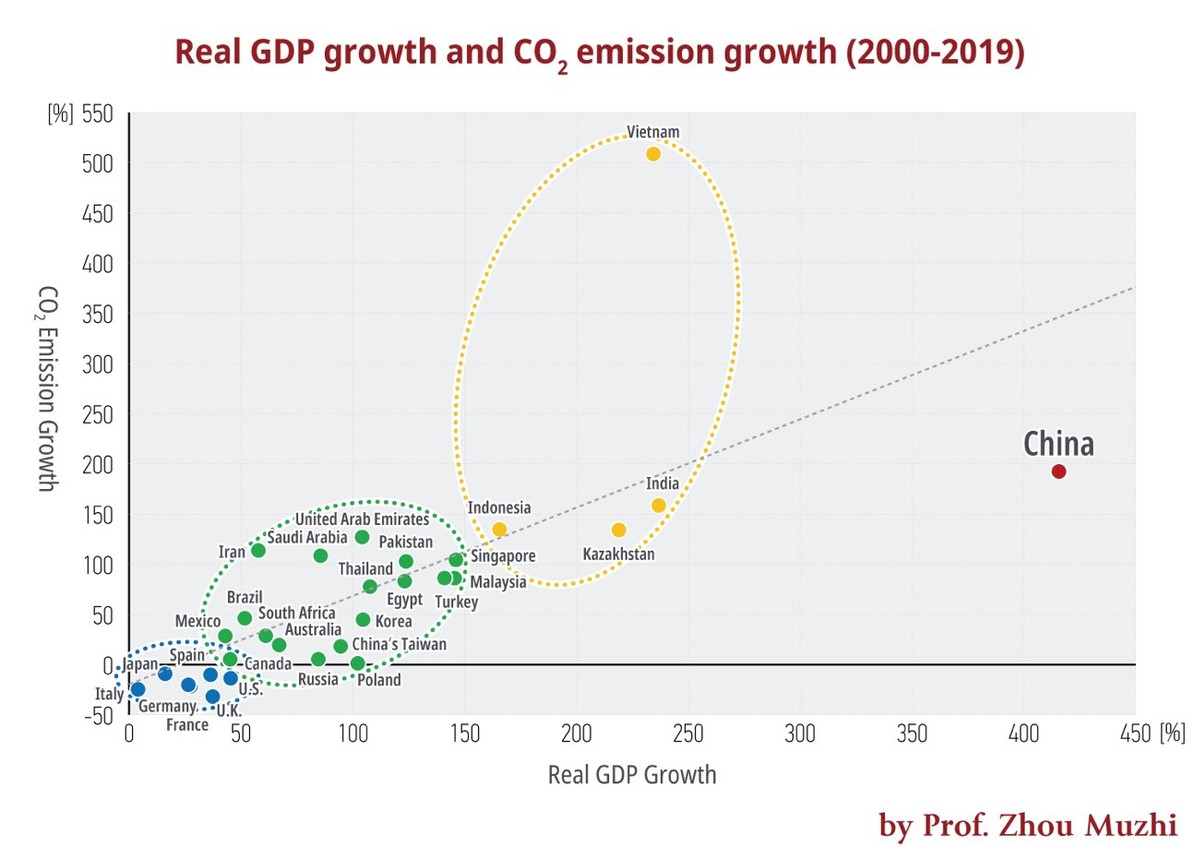
How is the relationship between economic growth and CO2 emissions in this period? Measured by GDP growth rates in real terms and CO2 emission growth rates, the top 30 emitters can be divided into three groups.
The first group includes those countries experiencing a low growth of real GDP and a negative growth of carbon emissions, such as the US, Japan, Germany, the U.K., Italy, France, and Spain, all among major developed countries.
The second group includes 18 countries and regions experiencing a medium-to-low economic growth and a low growth of carbon emissions -- Russia, Iran, South Korea, Saudi Arabia, Canada, South Africa, Mexico, Brazil, Australia, Turkey, Poland, Thailand, the United Arab Emirates, China's Taiwan, Malaysia, Singapore, Egypt, and Pakistan.
The third group includes those countries and regions experiencing a medium-to-high economic growth and a rapid growth of carbon emissions, such as India, Indonesia, Vietnam and Kazakhstan. Among them, Vietnam stands out with a remarkable growth of carbon emissions.
The fourth group includes China that enjoys a fast-growing economy. Its growth rate of carbon emissions is roughly the same with that of the third group.
Graphic: Real GDP growth and CO2 emission growth (2000-2019)
From the analysis above, the first 20 years of the 21st century was marked by the global division and cooperation of labor as well as the exponential growth of global wealth fueled by scientific advances and globalization. In the 20 years which was arguably an extremely special period in human history, labor division developed greatly, accompanied by huge amounts of CO2 emissions.
In the next 20 years, human needs to rely on cooperation to promote energy conservation and emission reduction, realize the growth of a green circular economy and combat climate change through improving the quality of development to retain hard-won prosperity.
Xie Zhenhua, China's special envoy for climate change affairs, met with his US counterpart John Kerry to talk about the climate crisis in Shanghai from April 15-16. In a joint statement issued after the talks, the two parties stressed that the two countries will work together with other countries to cope with the climate crisis and stay committed to implementing the Paris agreement alongside with other signatories.
The IEA estimates global CO2 emissions will increase 4.8% in 2021 year on year, which indicates that the carbon reduction drive still faces grim challenges. China and the US, the biggest players and beneficiaries of the global division of labor and wealth growth, should take the lead in developing the global green circular economy in the next 20 years.
The author is a professor of Tokyo Keizai University and president of Cloud River Urban Research Institute.