



Better protecting pregnant women's work rights vital to easing worries









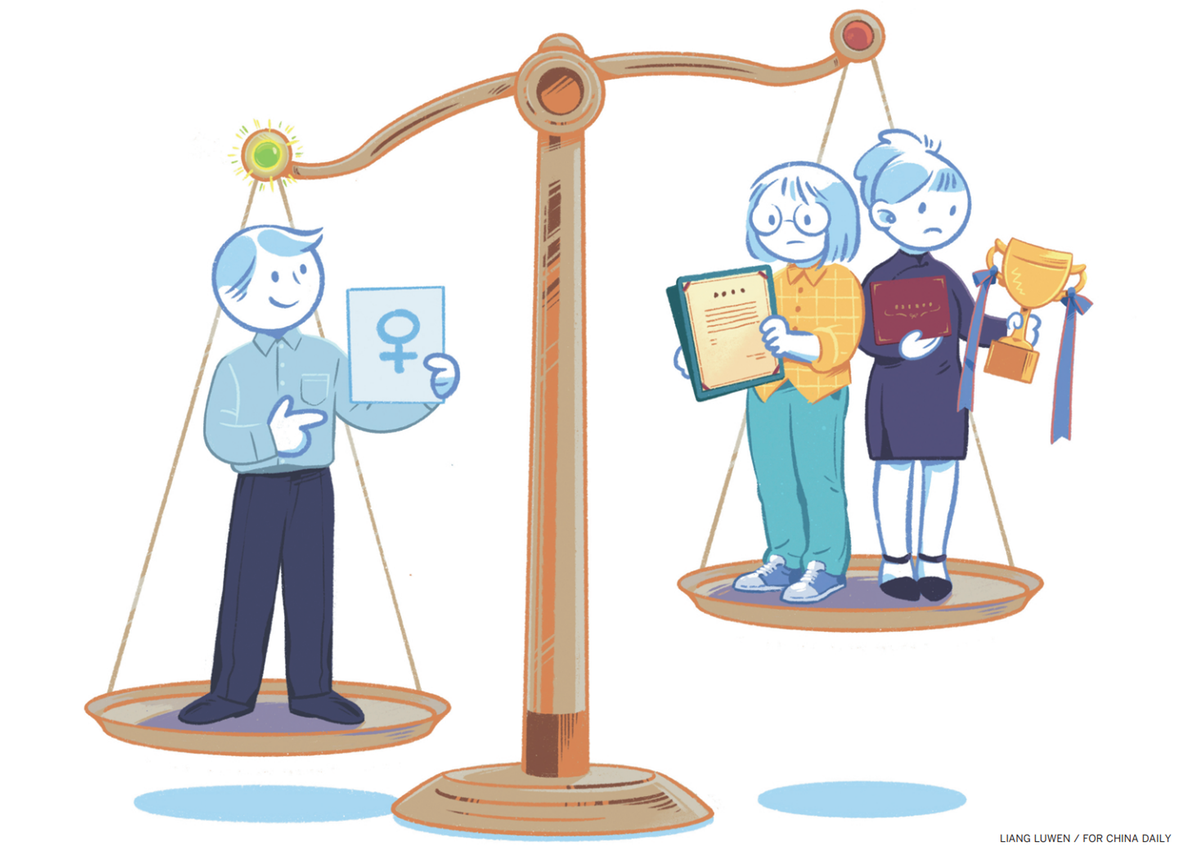
China began to ease the family planning policy in 2016 allowing all couples to have two children in order to counterbalance the rising aging population by boosting the birth rate. Yet the birth rate hasn't increased as much as expected, partly because an increasing number of women are reluctant to have two children-with some choosing to have no kids at all-as they are, more often than not, marginalized at the workplace for becoming pregnant.
Since China's Labor Law prohibits illegal dismissal of pregnant women, many enterprises coerce them to quit their jobs "voluntarily". A woman surnamed Wang from Yangzhou, Jiangsu province, is an apt example of such discrimination. She was forced to resign by her employer for getting pregnant with a second child in 2018.
There are five ways in which an employer forces women like Wang to resign from their job. First, the employer suggests a pregnant woman needs to take rest, hinting that she resign.
Second, as happened with Wang, the employer asks a pregnant employee to resign in exchange for paying her social insurance premium until she gives birth so she could apply for reimbursement of medical expenses for giving birth and get other maternity benefits.
Third, if the employee doesn't agree, the employer threatens to demote her. In fact, after Wang refused to resign from her original post as a clerk, her employer demoted her to the position of a toilet attendant and forbade her from entering the office.
Fourth, the employer denies the pregnant women of normal benefits such as free shuttle service and lunch which could be worth 40 yuan ($6.16) a day-as happened with Wang.
And fifth, the employer, after using one or all the above four methods, waits for the expected result. Wang approached the labor dispute panel challenging her demotion and the withdrawal of her benefits, but was told that since her company had not terminated the labor contract, the panel couldn't ask it to restore her to her original post. She had little choice but to resign.
Such discrimination against female employees is illegal in the United States and European countries. So if Wang had sued her employer in the court would the result have been different?
As a public interest lawyer, I represented Liu Tao (pseudonym) in a lawsuit in which she accused a Beijing company of violating her right to employment. During Liu's early pregnancy, the frequent business trips her company required her to make led to miscarriage. And while Liu, who was then marketing director, was busy making those business trips, the management renamed her department and thus marginalized her in the company.
Besides, after approving her sick leave, the company raised the requirements for sick leave and demanded that Liu submit receipts for diagnosis and treatment during the early days of her pregnancy. Since Liu had not kept all the receipts, the company deducted her maternity benefits for more than seven months and refused to pay her salary for as long as 14 months. And after Liu filed a labor case, the company delayed issuing her a dismissal certificate for 34 days preventing her from applying for a new job.
Thanks to the company's inhuman response, Liu suffered from headaches, insomnia and depression. In the end, she sued the company in court for gender discrimination in employment which forced the company to make a public apology and pay her a compensation of 50,000 yuan. The case lasted for more than two years, during which time 13 experts shared the view that any marginalization of and retaliation against an employee for becoming pregnant is an act of sexual discrimination.
Many women in China are coerced into resigning from their job after getting pregnant. But in Canada, for instance, cases in which employers unilaterally and unexpectedly alter the basic working conditions and thus force an employee to resign are regarded as a violation of the labor law. Hence, to help raise the birth rate and make the national population policy effective, it's imperative to stop the discrimination against female employees, especially against working women who get pregnant.
If the proposal is accepted, it will stop companies from circumventing the labor law to force pregnant women to resign and thus help make the national population policy more effective.
The views don't necessarily represent those of China Daily.
The author is a professor at the School of Law, China Women's University.





