Automakers to up fuel cell vehicle production









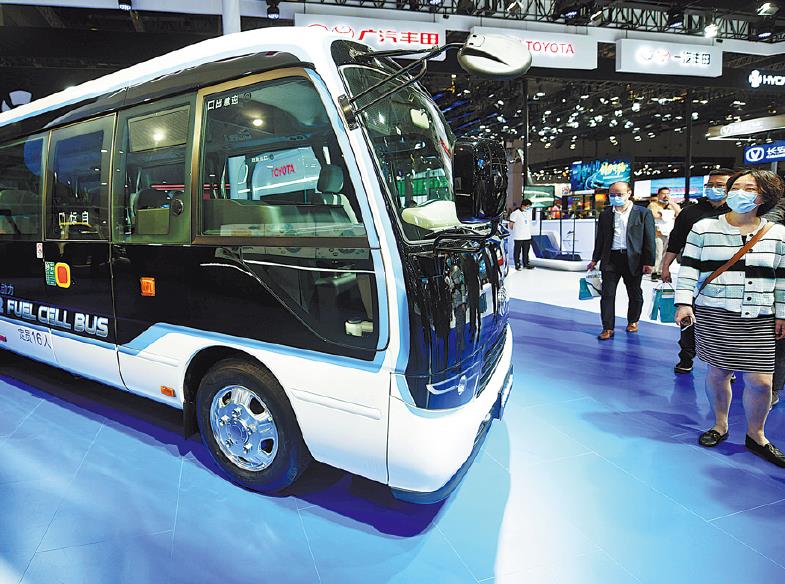
Hydrogen seen as legitimate clean power source to complement hybrids, full electrics
Carmakers in China and abroad are stepping up efforts to build hydrogen fuel cell vehicles, which are thought could play a vital role in initiatives to cut global emissions.
In fuel cell vehicles, abbreviated as FCVs, hydrogen mixes with oxygen in the air to produce electricity that powers an electric motor, which then drives the wheels.
FCVs' only byproducts are water and heat, so they are emissions-free. Their range and refueling processes are comparable to gasoline vehicles.
There are three major FCV producers around the globe: Toyota, Honda and Hyundai. But more automakers are joining the fray as countries set ambitious emissions-cutting goals.
Mu Feng, vice-president of Great Wall Motors, said: "If we have 1 million hydrogen fuel-cell vehicles on our roads (instead of gasoline ones), we can cut carbon emissions by 510 million (metric) tons a year."
Later this year, the Chinese carmaker will roll out its first large-sized hydrogen fuel-cell SUV model, which will have a range of 840 kilometers, and launch a fleet of 100 hydrogen heavy trucks.
To speed up its FCV strategy, the carmaker based in Baoding, Hebei province, joined hands with the country's largest hydrogen producer Sinopec last week.
Also Asia's No 1 refiner, Sinopec produces over 3.5 million tons of hydrogen, accounting for 14 percent of the country's total. It plans to build 1,000 hydrogen stations by 2025.
A Great Wall Motors representative said the two companies will work together in fields ranging from hydrogen station construction to hydrogen production as well as storage and transportation to assist the use of hydrogen vehicles.
The carmaker has ambitious goals in the field. It will invest 3 billion yuan ($456.4 million) over three years into research and development, as part of its efforts to become a major company in the global fuel cell vehicle market.
It plans to expand production and sales of core components and systems in China, while also aiming to become a top-three company for hydrogen vehicle powertrain solutions by 2025.
International companies are accelerating their foray into the segment as well.
French auto supplier Faurecia showcased a hydrogen-powered commercial vehicle solution at the Shanghai auto show in late April.
It has developed a seven-tank hydrogen storage system, which is expected to enable a driving range of over 700 km.
"Faurecia is well-placed to become a leading player in Chinese hydrogen mobility," the company said.
German carmaker BMW will begin small-scale production of its first passenger vehicle in 2022, which will be based on the current X5 SUV and equipped with a hydrogen fuel cell e-drive system.
"Vehicles that run on hydrogen produced using renewable energy can make an important contribution to meeting climate goals," the carmaker said in a statement.
"They are best suited for customers who frequently drive long distances, require a great deal of flexibility or do not have regular access to electric charging infrastructure."
The carmaker has over 40 years of experience with hydrogen technology and more than 20 years in the field of hydrogen fuel cell technology.
Another two giants in Europe, Daimler and Volvo, are gearing up for the arrival of the hydrogen-powered heavy truck era, which they believe will arrive toward the end of this decade.
Martin Daum, CEO of Daimler Truck, told the Financial Times that diesel trucks would dominate sales for the next three to four years, but that hydrogen would take off as fuel between 2027 and 2030 before going "steeply up".
He said hydrogen trucks would remain more expensive than those powered by diesel "at least for the next 15 years".
That price difference is offset, though, because customers typically spend three to four times more money on fuel over a truck's lifespan than on the vehicle itself.
Daimler Truck and Volvo Group have formed a joint venture called Cellcentric. It will develop, produce and commercialize fuel cell systems for use in heavy-duty trucks as the primary focus, as well as in other applications.
A key goal is to start with customer tests of trucks with fuel cells in about three years and to commence mass production during the second half of this decade, the joint venture said in March.
Volvo Group CEO Martin Lundstedt said there would be a "much steeper ramp-up" toward the end of the decade after fuel cell production starts at the joint venture around 2025.
The Swedish truck maker is aiming for half its European sales in 2030 to be trucks powered by batteries or hydrogen fuel cells, while both groups want to be fully emissions-free by 2040.