



US' scheme at G7 meeting only divides allies









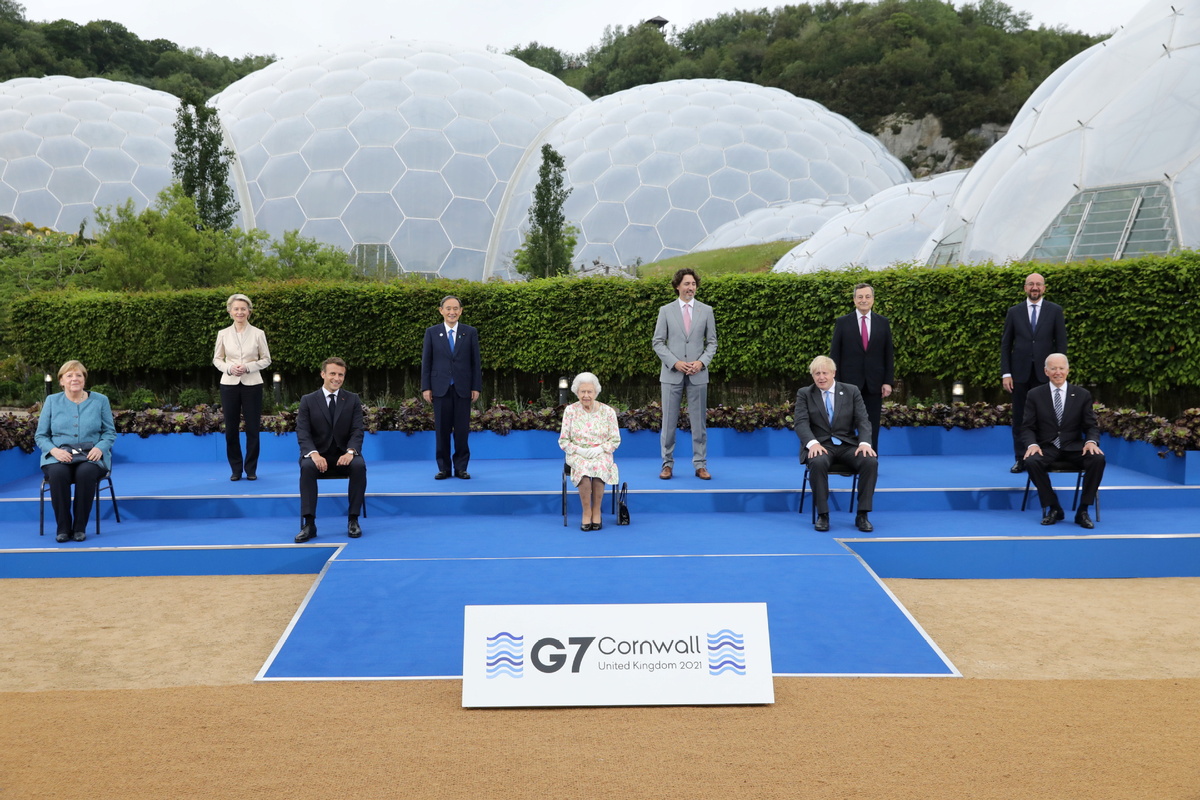
Like many others concerned about the continuation of "civilization" as we know it, I followed the Group of Seven summit in Cornwall, Southwest England with particular interest, and ultimately disappointment. Much of the three-day affair seemed to focus on the Biden administration's continuing fixation on "democracies" versus "autocracies" in general, and on China specifically.
While, without Donald Trump, the G7 summit was a much less chaotic affair than the previous four years, it was still nothing more than a better-organized continuation of the confrontational Trump line when it comes to China. The confab showed US President Joe Biden continues to be laser-focused on attempting to pressure so-called democratic nations, whether in agreement or not, to his will; pushing, pulling or dragging them into a coalition, which to varying degrees is inconsistent with their national interests in pursuit of the Trump-Biden anti-China agenda. As an American I had hoped for much more, but wasn't surprised as the Sino-US relationship continues to rapidly descend down the slippery slope.
It wasn't too long ago many of us looked forward, at the very least, to the new direction regarding China that Antony Blinken talked about last summer: a competitive race to the top and not the bottom. Even this February, we could take hope even when Biden talked about "extreme competition" with China as it requires two to tango and to compete. In Blinken's first foreign policy speech as Secretary of State he said the US approach to China will be "competitive when it should be, collaborative when it can be and adversarial when it must be." It still clearly recognized there were areas of cooperation and benefit where China and the US' interests overlapped.
Cold reality set in a fortnight later at the Sino-American high-level bilateral meetings in Anchorage, where the atmosphere inside was more frigid than the snow and ice of the Alaska winter, although there was glimmer of optimism in the recognition of potential cooperation on climate change by the world's two leading economies.
But hope was utterly shattered when Biden's so-called "Asia czar" on the National Security Council, Kurt Campbell, architect of the 2011 US pivot to Asia, announced three weeks ago that after almost five decades of Sino-American relations, "the period described as engagement has come to an end". Such a pronouncement left little room for cooperation and now replaced Blinken's formulation with a much more aggressive and ominous one: compete, confront and contain China.
It's no surprise then that during the summit and in the concluding nearly 14,000-word Carbis Bay G7 communiqué, this 3 C formula was omnipresent. But it wasn't necessarily smooth sailing as it likely would have been for a post-World War II, pre-Trump American president to impose his will on erstwhile allies since now the national interests of G7 members continue to diverge.
It once again proved the British diplomat Lord Palmerston (1784 – 1865)'s maxim that "we have no eternal allies, and we have no perpetual enemies. Our interests are eternal and perpetual, and those interests it is our duty to follow."
Thus, while there was general agreement to work towards Biden's goal of competing with China, there was no agreement on just how adversarial a public position the US' allies should take. Canada, France and the UK largely endorsed Biden's position of China as an existential threat, while Germany, Italy and the EU were more hesitant to do so. Nor will it be easy to implement even the generalized areas of agreement to counter China, which are more wish lists than concrete plans with funded commitments.
A prime example is the newly minted Biden-led effort for the G7 to counter China's Belt and Road Initiative called the "Build Back Better World" or B3W. According to the White House, it is designed to "help narrow the $40+ trillion infrastructure need in the developing world, which has been exacerbated by the COVID-19 pandemic". But, how would it be funded? Again according to the White House, the US will work with Congress to supplement existing development financing and to "collectively catalyze hundreds of billions of dollars of infrastructure investment". Huh? Work with the same divided Congress that won’t even support Biden's domestic infrastructure bill? So, the Republican "America Firsters" can hardly spend even a fraction of the trillions of dollars necessary to fund the US share of B3W.
This is also a case of déjà vu. In 2018, Trump and former US Secretary of State Mike Pompeo proposed a largely private-sector funded effort to rival BRI. However, people never heard too much about it since then, because with all the arm-twisting they managed to do, they could only raise chump change, a meager $113 million. Now they're trying to beat the same dead horse.
Moreover, BRI has been around now for a long while since President Xi Jinping proposed it in 2013. As of mid-2020 BRI has facilitated over 2,600 projects among 100 emerging economies at a cost of $3.7 trillion dollars. Comparing the US track record and China's experience, it's theoretically possible for B3W to be viable, but I wouldn't bet on it.
It's impossible to tell at this juncture which of the many G7 initiatives agreed in principle will move from words on a page to actual implementation. But it's fair to conclude that Biden's idea of easily raising a compliant coalition of the willing to successfully compete, confront and contain today's more confident and accomplished China has no more than an Alaskan snowball's chance in Hell.
The author is a senior fellow at the Beijing-based Center for China and Globalization. The views don't necessarily reflect those of China Daily.





