



Cast aside pseudo-multilateralism
West's interpretation and practice of multilateralism focuses on the form not the purpose









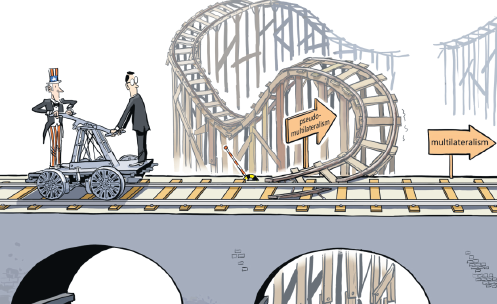
Multilateralism is a universal diplomatic principle and practice that all countries should earnestly uphold. However, some countries are seeking to form cliques in the name of multilateralism, targeting countries that have different ideologies and interest demands. This is "pseudo-multilateralism", which will divide the international community and aggravate conflicts, deteriorating the international situation further. At this crossroad in human history, it is imperative to have an understanding of real multilateralism, what its connotations and true nature are, so as to safeguard world peace and development.
The prefix "multi" means activities jointly conducted by three or more entities; and the word "multilateralism" means the way three or more countries deal with each other.
Multilateralism in a modern sense dates back to the 17th century when the Peace of Westphalia was negotiated and settled. This set a new model of addressing international disputes-by which the parties concerned accept and abide by international norms, and sign treaties they negotiate and agree upon.
The multilateral system developed after World War I with the Versailles-Washington system that created the League of Nations, marking the formation of multilateral mechanisms. The Yalta order after World War II drew lessons from the failure of the League of Nations and established the UN-centered international system with the United Nations Charter as the basic international law, putting in place more mature multilateral mechanisms. But the system is currently being challenged by hegemony and power politics.
US scholar Robert Keohane first put forward the concept of multilateralism "as the practice of coordinating national policies in groups of three or more states, through ad hoc arrangements or by means of institutions." John G. Ruggie, the widely accepted founder of theoretic research on multilateralism, elaborated the concept as "an institutional form which coordinates relations among three or more states based on 'generalized' principles of conduct".
Western countries took the lead in building the modern international order and established a number of institutions for multilateralism, which is of historical and progressive significance.
However, the Western countries' interpretation and practice of multilateralism are focused on the form of multilateralism-coordination among three or more states based on certain principles-and ignore the connotations, features, purposes and results of such activities. According to their interpretation, "military alliances", "small circles", and "cliques" that are aimed at confronting specific countries are also "multilateralism". This practice is a violation of the international order and norms. It goes against the UN Charter, which is the basic international law, and undermines the United Nations as the core of the global governance system. Nor is it in line with the historical trend of joint efforts from all countries to solve common problems in a globalized world in the 21st century.
Considering the original meaning of multilateralism, the purposes and principles as stated in the UN Charter, and the call of the times, real multilateralism should be international coordination in pursuit of the common interests of all peoples. It should be conducted with a spirit characterized by universality, openness, equality, cooperation, mutual benefits and win-win results. Real multilateralism is opposed to unilateralism, isolationism, imperialism and hegemonism.
Therefore, the policy and practice of multilateralism should be based on countries conducting international coordination in accordance with international law, with the UN Charter as the cornerstone, to achieve mutually beneficial results.
Real multilateralism therefore encompasses three elements that constitute its true definition: the entities of international behaviors (relevant countries), specific international norms (the international law with the UN Charter as the cornerstone), and the basic function (international coordination); furthermore, it includes the purpose of multilateralism-to achieve mutually beneficial results-and categorizes "multilateralism" as part of "diplomacy".Such a definition is different from the Western definition, as it clarifies that international norms governing international coordination should be international law with the UN Charter as the cornerstone, and the purpose and value of such international coordination should be achieving mutually beneficial results.
Real multilateralism has the following features.
The first and foremost one is universality. Real multilateralism pursues common values and the enhancement of the interests of all humanity, not targeting any particular countries or people.
The second feature is openness, which entails open and inclusive interactions, without excluding the participation of any countries or organizations.
The third is equality. Under a mechanism of multilateralism that operates in a democratic way, all members are equal with no country placing itself above the mechanism.
The fourth is cooperation, which means member countries should address problems through negotiations based on mutual understanding, compromise and mutual assistance, and uphold the spirit of open cooperation toward the wider world.
The last feature is the pursuit of win-win results, which indicates that coordination and cooperation should be aimed at increasing the common interests of all parties, rather than at the expense of the interests of other countries or a third party.
Right now, the United States is using the camouflage of multilateralism to gather its allies and partners to form exclusive clubs, such as the Five Eyes, G7, Indo-Pacific Quad Alliance, and D-10 Strategic Forum, with the aim of suppressing certain countries. Such fake types of multilateralism have the features of closed-group, exclusiveness, confrontation, selfishness and inequality, and run counter to the connotations and features of true multilateralism. Such pseudo-multilateralism is a legacy of the Cold War both in thinking mode and practice, and therefore should be cast aside.
The author is deputy director of the Institute of World Economics and Politics at the Chinese Academy of Social Sciences. The author contributed this article to China Watch, a think tank powered by China Daily. The views do not necessarily reflect those of China Daily.





