



Circular economy gets 5-year regulator boost









NDRC underlines better resource utilization, lower wastage, green moves, recycling
China's top economic regulator on Wednesday unveiled a new development plan to spur the circular economy in the next five years.
The plan's goal is to increase efficiency of utilization of resources and foster high-quality development during the 14th Five-Year Plan period (2021-25), the National Development and Reform Commission said.
Commenting on the plan, experts said the new plan is of great significance as it will promote resource conservation and recycling in China, help ensure national resource security and aid China in honoring its pledge to peak carbon dioxide emissions by 2030 and become carbon neutral by 2060.
Circular economy refers to a model focusing on recycling, reusing and reburnishing materials and resources. The new plan will make circular economy a national priority during 2021-25.
By 2025, a resource recycling industry will be established and a resource recycling system covering the entire society will be completed. By then, the resource utilization efficiency will be substantially improved, and the replacement ratio of renewable resources to primary resources will be further increased.
In particular, the productivity of major resources, which quantifies the relations between economic activity and the consumption of major material resources, is set to increase by about 20 percent compared with 2020.
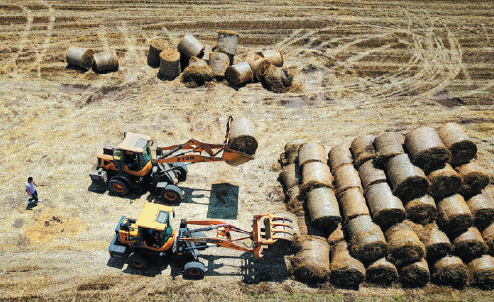
The energy consumption per unit GDP and water consumption per unit GDP will be reduced by 13.5 percent and 16 percent, respectively. The comprehensive utilization rate of crop straw will remain above 86 percent, and the comprehensive utilization rate of both bulk solid waste and construction waste is set to reach 60 percent.
According to the plan, the use of waste paper and scrap steel will reach 60 million metric tons and 320 million tons, respectively, and the output of recycled nonferrous metals will hit 20 million tons by 2025. By then, the resources recycling industry will be worth 5 trillion yuan ($773 billion).
The NDRC said in the plan document that it will step up efforts to promote green design of key products, boost clean production in key industries, promote recycling development of parks, improve the recycling network of waste materials and improve the level of processing and utilization of renewable resources.
The plan document stated that more efforts will also be made to promote well-regulated growth in the secondhand market, promote the high-quality development of the remanufacturing industry, build a recycling system for waste materials, strengthen the recycling of agricultural and forestry wastes, strengthen the recycling and utilization of waste agricultural materials, and implement a circular agricultural development model.
Xia Guocai, a former official of the NDRC, said: "After years of rapid economic development, the ecological environment has previously been severely damaged and polluted, and ecological disasters such as land desertification, land salinization, soil erosion and forest resource destruction have seriously threatened the survival and development of human society.
"Against that backdrop, we must adopt the method of development of a circular economy to transition from the previous cycle of 'resource-product-waste' to a new model of 'resource-product-waste-renewable resources'."
In an article published on the NDRC website, Xia said that while China has made considerable progress in boosting economic and social development during the past decades, problems like resource shortage and environmental pollution also popped up as part of the traditional development model of mass production, mass consumption and mass wastage.
Yin Zhongshu, an analyst at Everbright Securities, said the development of circular economy will help China reduce carbon emissions and strengthen the new dual-circulation development pattern that takes the domestic market as the mainstay while domestic and foreign markets complement each other.
"The development of circular economy will help reduce the high-energy consuming processing for raw materials, improve the efficiency of domestic cycle, boost China's standing on the stage of international industrial chain and make China less dependent on foreign scarce raw materials," Yin said in a recent Everbright report.
Looking ahead, Yin said the government needs to take more steps to boost the development of circular economy such as clarifying producers' responsibility for the treatment and disposal of post-consumer products.




















