



Govt to create circular economy for electric power batteries









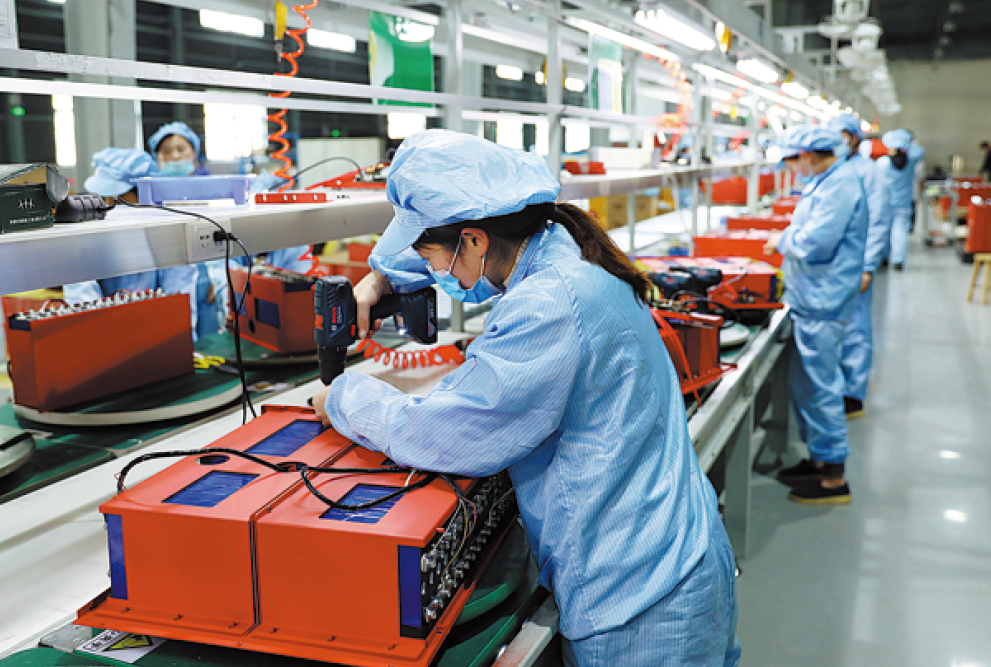
The Chinese government has released a plan to reduce the impact that batteries used in new energy vehicles have on the environment, as NEVs continue to grow in the automotive sector as a whole.
The plan focuses on how batteries' remaining power is utilized after their primary use, as well as more effective recycling.
According to a five-year plan for developing the circular economy released by the National Development and Reform Commission earlier this month, China will step up building a traceability management system for NEV batteries.
More measures will be taken to encourage NEV manufacturers to set up recycling service networks by themselves or in cooperation with upstream and downstream industry players.
The plan highlights the role of echelon utilization of power batteries, which refers to the utilization of the remaining capacity of power batteries in other areas.
Industry insiders said this move will promote safety as well as greater commercial feasibility of the battery recycling industry.
If the heavy metals contained in power batteries are recycled improperly, it poses severe challenges to the environment, which is against the eco-friendly intention of NEVs, insiders said.
Roy Lu, a senior industry analyst at Gotion High-Tech, said it is time to recycle the first batch of NEV batteries after the market's initial boom five to seven years ago.
"The sales of new energy vehicles have maintained high growth, so it's imaginable that it will be a challenge for the industry," Lu said.
The number of NEVs on China's roads has been rising by 1 million annually for the past three years.
By the end of 2020, the country had 4.92 million NEVs on its roads, of which 4 million were electric cars. The China Association of Automobile Manufacturers estimates that NEV sales will surpass 2.4 million units this year.
Data from the China Automotive Technology and Research Center shows the country's total of decommissioned power batteries reached some 200,000 metric tons by the end of last year, given the life span of power batteries is usually about six to eight years.
The center forecasts that decommissioned power batteries will reach 780,000 tons by 2025 and the power of the batteries needed to be recycled will reach 137.4 gigawatt-hours, or around 110 tons.
According to a report by Everbright Securities, the recycling of ternary and lithium-ion phosphate batteries will generate a market worth 100 billion yuan ($15.5 billion) by 2030.
With such development prospects, many battery recycling-related companies have emerged.
The statistics from QCC, an enterprise credit rating system, show that 9,435 power battery recycling-related companies were registered in the first half of this year, 26 times that of the same period in 2020.
There were a 2,579 related companies registered in 2020, up 253.3 percent year-on-year. There are currently 15,000 enterprises related to power battery recycling in China.
The power battery market nowadays is similar to the NEV market years ago, which shows a positive development trend but also needs more policy coordination and regulation to become more market-led, Lu said.
He said the industry should build a responsibility mechanism and cooperation standards covering raw materials for batteries, car companies, battery after-sales service and battery recycling.
Battery suppliers and carmakers have advantages in recycling batteries, he added, with high-quality battery enterprises having the corresponding upstream and downstream resources of the industry.
Car companies have the responsibility to establish a battery after-sales and recycling system. They have the ability to require raw materials, battery manufacturers and professional third parties to jointly build a standardized and environmentally friendly battery recycling system, Lu said.




















