


A manifesto of progress









Important exhibits include the earliest German version in the library's collection from 1883, the 1888 English version, which was edited and added a preface by Engels, reiterating the core idea, birth and spread of the book, and some original manuscripts of Marx and Engels.
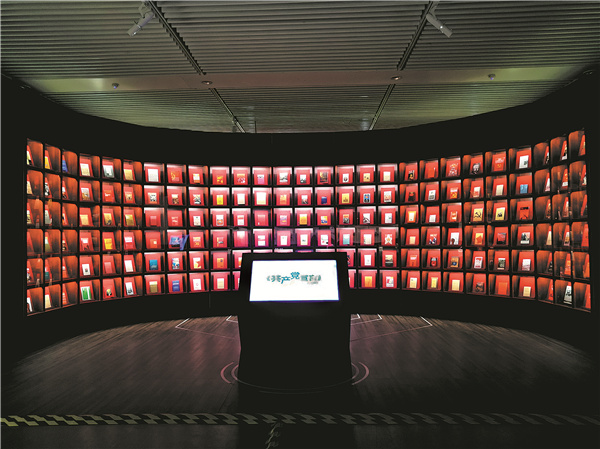
People can participate in an interactive experience to appreciate different versions of the book. Standing in front of an 11-meter semicircular bookshelf beside a touch screen, people can view 162 versions of the book in various languages. By clicking any one of them on the screen, the chosen one will be highlighted by red lights on the shelf. People can also read the first German and English versions of the book, alongside seven Chinese versions of it on touch screens placed in various locations.
The exhibition introduces the translation of the book in China. President Xi Jinping once told the story of Chen Wangdao, the translator and scholar who completed China's first translation of the book in 1920.
When Chen was devoted to the translation, his mother made him sticky rice dumplings, or zongzi, and suggested he dip them in brown sugar water to eat. But later his mother found his mouth was covered with ink as he was so focused on the translation that he had dipped the dumplings in his ink rather than the sugar water.
"The 1,000 copies of Chen's translation were published in August 1920, and they sold out in just one month. The version was published again in September and was still very popular," says a tour guide surnamed Ren at the National Museum of Classic Books.
Copies of Chen's version, published in August and September 1920, are both on display, with his autograph from when he visited the library in 1975.
Others who translated the book into Chinese include educator Hua Gang, translator Cheng Fangwu and revolutionist Xu Bing. People can see and compare their translated versions at the exhibition.
According to Li Kuiliu, a professor at Beijing Foreign Studies University who helped Cheng Fangwu to translate the book in the 1970s, "As one who has carefully learned and translated the book, I find the theories which Marx and Engels clarify in the book are still correct from a current perspective. But the practical use of the theories needs to combine the realities of a given situation.
"I believe the reason why the CPC achieved victory in the revolution, and made the achievements it has in China's development is that we understand the theories of Marx and Engels, and combine them with China's reality. By visiting the exhibition, we may gain even further insight," says Li.