Voracious consumers bolster Sino-US trade









Imports, exports between two countries boom in first half of 2021
Looking at the latest China-US trade figures, fueled by voracious consumer demand, it would be hard to tell the two countries have been involved in a trade standoff for over three years.
"We said during the trade war the global economy would continue to grow and prosper, and it has. China was, and remains, our largest trading partner, accounting for about 60 percent of containerized imports and 30 percent of exports in 2020," Noel Hacegaba, deputy executive director of the Port of Long Beach in Southern California told China Daily.
"Strong consumer demand that surfaced in the early months of the pandemic has continued, and the amount of cargo our terminals and dockworkers have been moving is incredible."
According to US Census Bureau data for May, the latest figures available, trade with China was responsible for 13.9 percent of all US trade, after Mexico (14.7 percent) and Canada (14.5 percent).
The United States imported $189.7 billion worth of goods from China-the most imports from any country, accounting for 17.3 percent of US imports so far in 2021-while China took in $59 billion worth of US goods, as its agricultural purchases have increased.
China's trade numbers also show percolating activity.
Bilateral trade grew 45.7 percent year-on-year to $340.8 billion in the first six months of 2021, faster than China's trade with Association of Southeast Asian Nations (up 38.2 percent) or the European Union (up 37 percent), statistics from the General Administration of Customs released on July 13 showed.
China's exports to the US surged 42.6 percent with Americans' appetite for computers, home appliances, smartphones and clothes remaining steady, according to Chinese customs authorities. Imports from the US jumped 55.5 percent in dollar terms.
Perhaps it is the healthy post-pandemic appetite of consumers in both countries that is overriding the political differences.
"The bustling trade has defied all expectations that the tariffs on hundreds of billions of dollars' worth of merchandise would force a decoupling of supply chains. Instead, both sides have learned to live with the taxes, with Chinese firms buying more to fulfill the terms of the 2020 trade deal, and US companies purchasing goods they can't get elsewhere to meet elevated household demand fueled in part by trillions of dollars in government stimulus," bloomberg.com said in a report.
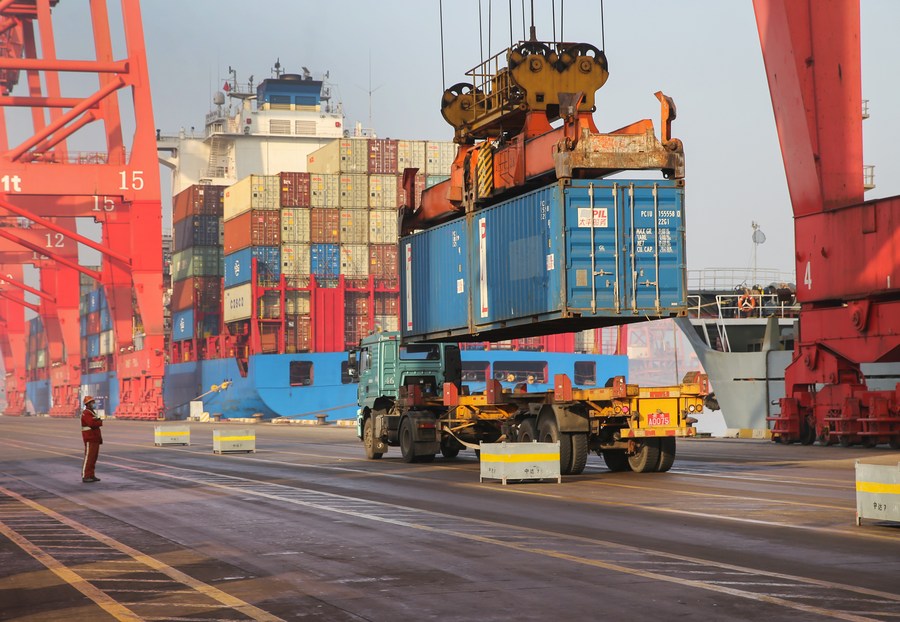
That demand is reflected in US port traffic.
"To illustrate how busy we've been, the port's May container volumes were up 44 percent from the same month a year ago. It was also the first time we processed more than 900,000 containers in a single month, surpassing the previous record set in March," said Hacegaba, of the Long Beach port.
Almost half of the $259 billion in cargo passing through the nearby Port of Los Angeles involves trade with the Chinese mainland and Hong Kong.
"Key economic indicators all suggest that US consumer spending will remain strong through the remainder of 2021," said Port of Los Angeles Executive Director Gene Seroka.
"Fall fashion, back-to-school items and Halloween goods are arriving on our docks, and some retailers are shipping year-end holiday products early," Seroka added. "All signs point to a robust second half of the year, which is good news for the nearly 1 million residents in the region who have jobs tied to the San Pedro Bay port complex."
Craig Allen, president of the US-China Business Council, in a June 24 article on politico.com noted that the economies of the individual US states often are not considered when Washington takes action on bilateral trade.
"States and municipalities across America are caught in the crossfire of the trade war. For years, states have increased trade ties with China, which has created complex, two-way relationships. Recognition of the deep local relations aiding US-China trade is often missing in the larger policy debate," Allen said.
Citing a 2019 Business Roundtable study, Allen said that up to one in five jobs in California depend on international trade, with almost 146,000 jobs supported by exports to China.
And while the bilateral relationship isn't characterized by the volatility of former president Donald Trump's tenure, the Biden administration hasn't sought to remove any US tariffs on $360 billion worth of Chinese goods.
The White House has been conducting a review, now in its seventh month, of the economic relationship between the two countries. The review includes the 2020 phase-one trade deal.
Treasury Secretary Janet Yellen, in a July 16 interview with The New York Times, however, said that the tariffs "are taxes on consumers". As to talk of the two countries decoupling economically, Yellen said: "I think we should maintain economic integration in terms of trade and capital flows and technology where we can."
Gary Hufbauer, a senior fellow at the Peterson Institute of International Economics in Washington, said that Yellen and US Trade Representative Katherine Tai should seek to return US-China trade to normal "most favored nation" status over the next year or so. "The complaint (by Tai) about unbalanced (trade) is a political statement not an economic analysis," he said.
Hufbauer said that US President Joe Biden's rhetoric "is much calmer than Trump's, but the substance of policy hasn't changed".
Robbin Goodman, director of business programs and corporate affairs at the Dallas-based George H.W. Bush Foundation for US-China Relations, said: "While it is true the trade deal is fraught with unrealistic commitments that do little to address the fundamental problems undergirding US-China relations today, certain commitments, such as those around agricultural regulations, have produced meaningful results in terms of harmonizing US and Chinese standards.
"These small victories are worth preserving," he said, adding that it was "imperative" that the Biden administration swiftly move to repeal the "nonsensical tariffs that remain in place today".
Belinda Robinson in New York and Liu Yinmeng in Los Angeles contributed to this story.