



Protection efforts see Tibetan antelope population rebound









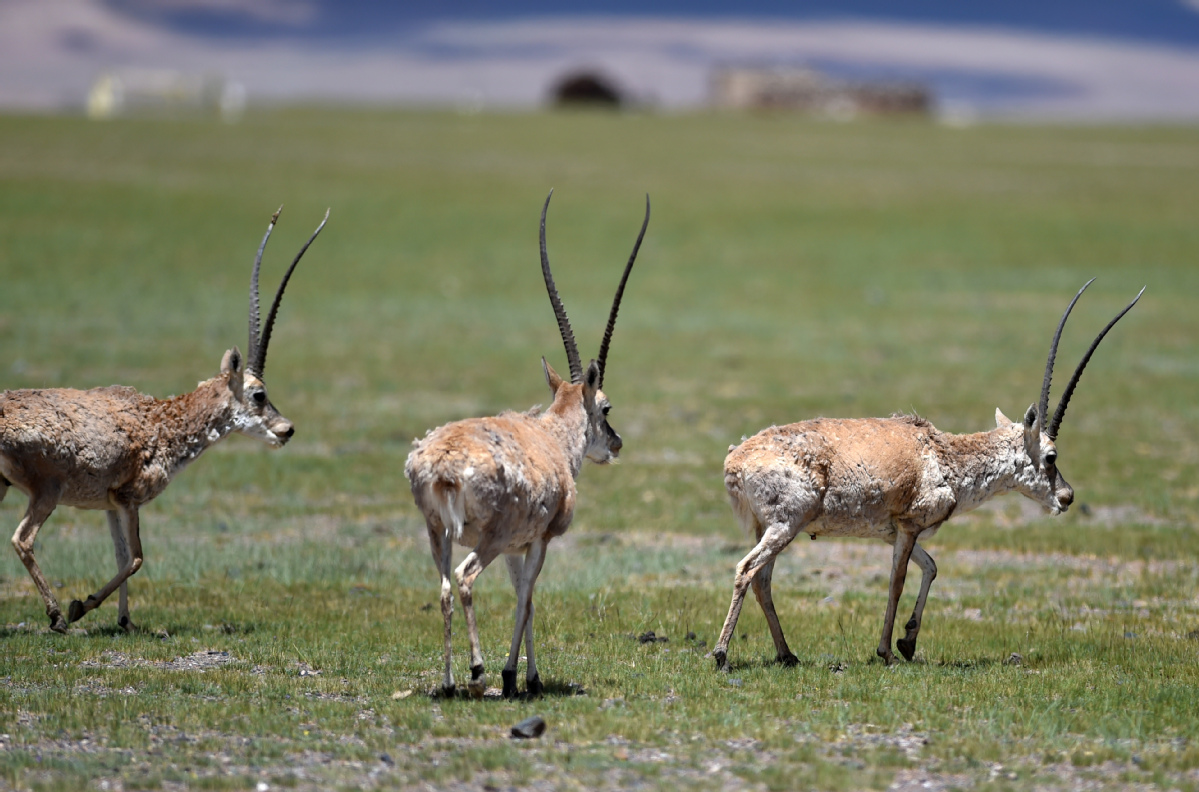
Efforts to curb poaching paying off as species now numbers around 300,000
Tibetan antelopes, a species under top protection in China that was once threatened by illegal hunting, have witnessed stable population growth in recent decades thanks to environmental protection and anti-poaching efforts.
The number of Tibetan antelopes in China has increased from less than 70,000 in the 1980s and 1990s to nearly 300,000, according to a statement released recently by the National Forestry and Grassland Administration.
Tibetan antelopes are mostly found in the plateau region of western China, including the Tibet autonomous region, Qinghai province and the Xinjiang Uygur autonomous region.
In the 1980s, the population declined sharply due to illegal hunting.
In recent decades, unremitting conservation efforts have been made to improve its habitat and crack down on illegal hunting, which resulted in its population bouncing back.
In Qinghai, Tibetan antelopes mostly inhabit the Hoh Xil National Nature Reserve in the Three-River-Source National Park. Anti-poaching and protection efforts were initiated in the province in the 1990s.
In recent years, the Tibetan antelope population in Hoh Xil has increased from less than 20,000 to more than 70,000.
In 2008, the animal was listed as an endangered species on the Red List of Threatened Species by the International Union for the Conservation of Nature and Natural Resources. As its population recovered, the IUCN lowered the level of concern from "endangered" to "threatened" in September 2016.
"The Hoh Xil nature reserve has not reported any poaching for more than 10 years, and the population of Tibetan antelopes in the area has recovered," said Dawa Drolma, an official at the park's administration bureau.
"Our mission is, as always, to work toward anti-poaching and the prevention of human interference through traffic control during migration, escorting during farrowing and the rescue of injured animals."
At Hoh Xil's Sonam Dargye protection station, named after Sonam Dargye, who died protecting Tibetan antelopes in the 1990s, more than 80 patrollers safeguard the antelopes' annual migration.
Every year, starting from around May, all the female antelopes from Tibet's northern Changtang grassland, the Three-River-Source National Park and Xinjiang, take part in the migration to deliver their young at Zonag Lake, at the heart of Hoh Xil, which has been dubbed the species' "delivery room".
Apart from regular patrols targeting illegal hunting, traffic is also controlled at major crossing points along their migration route to reduce interference from human activities.
Since mid-July, more than 1,500 antelopes have crossed the Qinghai-Tibet Highway safely and continued toward Zonag Lake, the local forestry department said.
Wu Xiaomin, a researcher at the Shaanxi Institute of Zoology, said there are more than 200,000 Tibetan antelopes in Tibet's northern Changtang grassland, more than 70,000 in Hoh Xil and more than 20,000 in Xinjiang.
Since 2013, researchers from the institute have used China's homegrown Beidou Navigation Satellite System to study the migration of Tibetan antelopes.
"We have recorded basic data, including the migration routes and times, and the spread of the species around the Changtang National Nature Reserve, where many endangered wild animals live," Wu said.
In recent years, the institute has also used drones to study the species, in addition to ground-based observation. The drones have conducted 12 observation flights in Changtang, covering more than 100 square kilometers.
"The detailed images produced by the drones were able to recognize newborn antelopes," Wu said. "And the antelope population is calculated by the drones' data-processing software."
He said the habitat for the Tibetan antelope in China covers more than 1 million sq km, mostly in remote, severe environments with altitudes between 3,700 meters and 5,500 meters.
"New technologies have significantly improved our capacity for surveillance and the protection of the antelope," Wu said.


- Cross-Strait bonds shine in Spring Festival fireworks show
- Two confirmed dead after tourist boat capsizes in Southwest China
- AI clip: Discovering more of Hefei after Spring Festival Gala
- Buddha statues at Longmen Grottoes bathed in golden glow
- Gallop into Chinese New Year in Yantai
- PLA conducts combat readiness patrols in S. China Sea








