



Forging a strong community for the Chinese nation









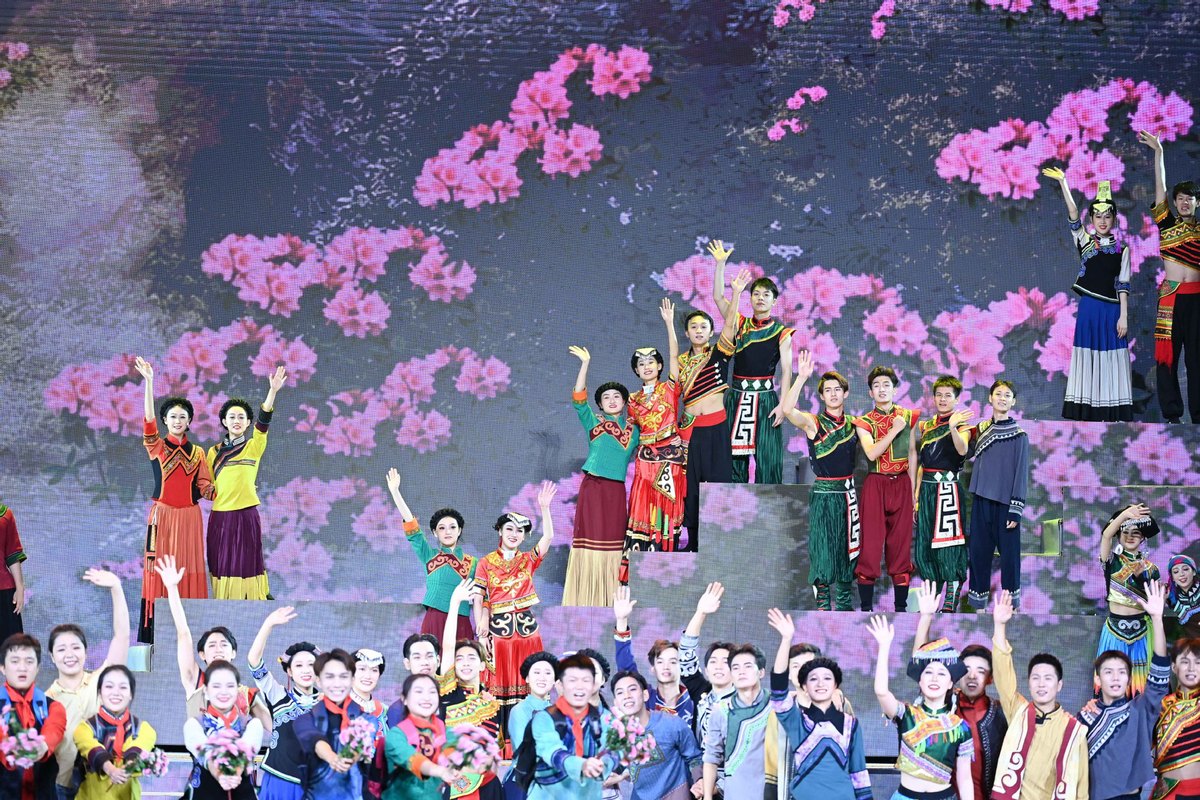
With the concept of building a community for the Chinese nation becoming increasingly popular, discussions have to be centered on ethnology, politics, history and other such subjects.
The recent central conference on ethnic affairs, which once again stressed that forging a strong sense of community is the main line of the country's work on ethnic affairs, promoted the concept of building a community for the Chinese nation. In fact, the emergence and use of the concepts "Chinese nation" and the "community of Chinese nation" are related to China as a multi-ethnic country and are attributed to "nation" rather than "ethnicity" in the general sense.
Only by understanding this point can we understand the significance of forging a strong sense of community in the Chinese nation to ensure the stability and development of China as a multi-ethnic nation.
After the emergence of the unified Qin Dynasty (221-206 BC), there was a division between huaxia, a term used to denote the ancient Chinese people, and the yi minorities, or non-Chinese ethnic groups, but it was emphasized that both huaxia and yi people are members of "one family".
Amid the constitutional reform during the late Qing Dynasty (1644-1911), scholar and political visionary Liang Qichao (1873-1929) introduced the concept of "nation" in China in 1902-as well as the concept of the "Chinese nation". Although Liang defined the Chinese nation as one that consists of "anyone who immediately has the consciousness that 'I am Chinese' whenever he or she meets foreigners", this definition caused some confusion.
In 1939, after seeing the Japanese invaders use the concept of "ethnicity" as a tool to split the multi-ethnic Chinese nation, historian Gu Jiegang systematically interpreted the concept of the "Chinese nation" and its development, and explained that the "Chinese nation", among other things, comprises all the people under the rule of a government within the territory of China.
Xia Nai, a pioneering archaeologist, was one of the first scholars to use the term "community of the Chinese nation". In an article titled "Archaeology of New China" published in the Archaeology magazine in 1962, while explaining the term "community of the Chinese nation", Xia wrote: "There are still many ethnic minorities in China today, and they are different from the Han people, but the ancestors of various ethnic groups have established increasingly close ties with the ancestors of the Han people over the centuries, and they together have formed a community of the Chinese nation."
And in the 1980s, in an article on the pattern of pluralistic integration of China's ethnic groups, sociologist and anthropologist Fei Xiaotong defined the Chinese nation as the"1.1 billion people with ethnic identity within China's present territory", and "all the people living on the Chinese land who have created a unified multi-ethnic China". This definition goes beyond the nature of general "ethnicity" in domestic ethnological research, covering all the people of a sovereign state.
Since the theory of "pluralistic and integrated pattern of ethnic groups in China" was put forward in the 1990s, the academic discussions on the "Chinese nation" have mostly focused on the structure of "pluralism", with "integration" not being the main content of such discussions.
As a result, such misinterpretations have undermined not only the research on the "Chinese nation" but also the Chinese people's sense of identification with the Chinese nation. For example, because of the influence of ethnic consciousness, some people's identification with a certain ethnic group may have been strengthened and their identification with the Chinese nation as a whole weakened.
So to maintain the stability and development of China as a multi-ethnic nation, putting forward the concept of building a strong sense of community for the Chinese nation is certainly the right decision.
The external environment that is affecting China's stability and development as a multi-ethnic nation has created both opportunities and challenges for China. In order to realize the great rejuvenation of the Chinese nation, the country needs to forge community awareness in the Chinese nation, which in turn will help consolidate the unity among its 56 ethnic groups.
Three major legacies of our ancestors will help us promote such a community consciousness. The first is the concept of a "common homeland" created by the different ethnic groups living on the Chinese land-the territory of China as a multi-ethnic state.
The second is the concept of "big family" established through communication and integration in the process of building the "common homeland"-the community of the Chinese nation.
And the third is "common culture", which emanates from the Chinese civilization built by the different ethnic groups living on the Chinese land, with the pursuit of "universal harmony" at its core.
The author is a researcher with the Institute of Chinese Borderland Studies, the Chinese Academy of Social Sciences.
The views don't necessarily reflect those of China Daily.
If you have a specific expertise, or would like to share your thought about our stories, then send us your writings at opinion@chinadaily.com.cn, and comment@chinadaily.com.cn.





