



China advances closer to 'space station era'









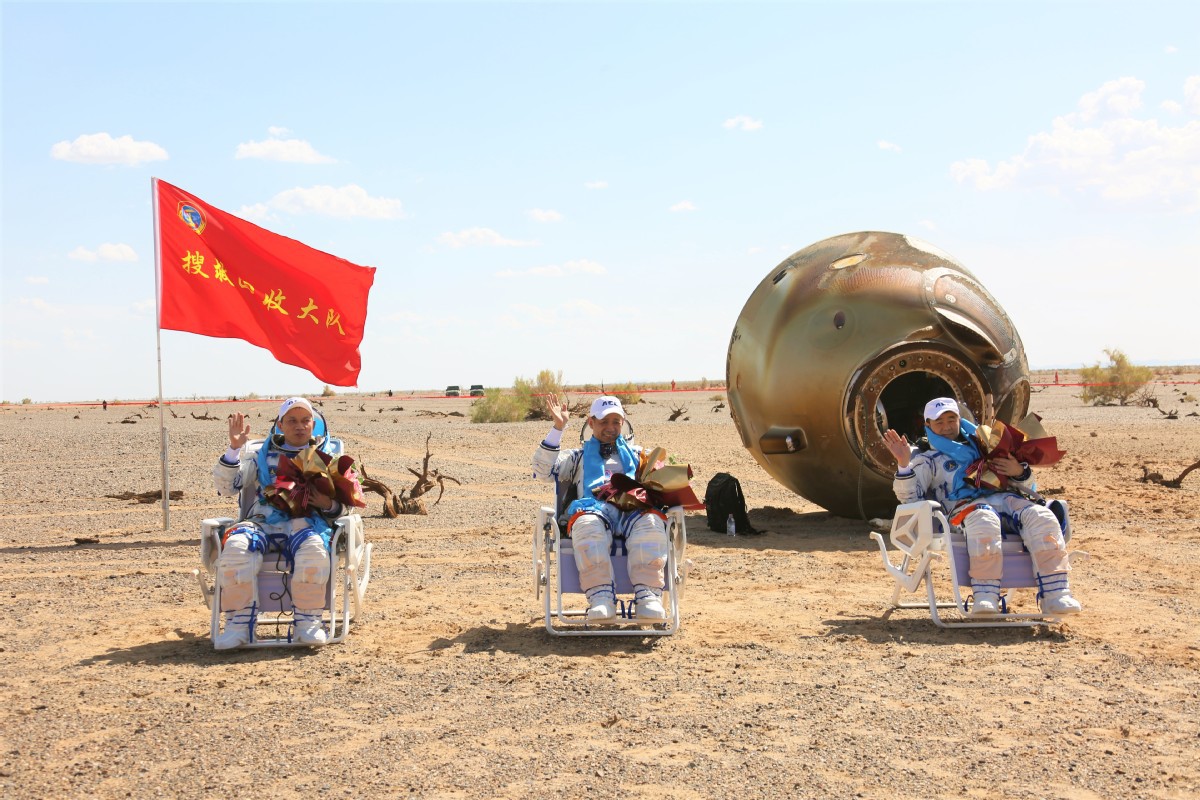
Having worked in the space station core module Tianhe for three months -- the longest-ever human space mission in the Chinese history, three "taikonauts" of the Shenzhou-12 crew returned to Earth on Friday, hitting a new milestone in China's space exploration.
With a resolution for self-reliance in aerospace technology and an open mind for international cooperation, these years China has been converting its space ambitions into splendid achievements step by step.
China's first self-developed space station, Tiangong, is independently constructed and operated by the country, demonstrating the country's breakthroughs in technologies concerning the astronauts' long-term stay and health care, recycling and life support system, supply of space materials, extravehicular activities and operations, as well as in-orbit maintenance.
As scheduled, the Tianzhou-3 cargo craft and the Shenzhou-13 manned spaceship will also be launched later this year to dock with the Tianhe module, and another trio of astronauts will stay in orbit for six months.
For 2022, China is mulling over a blitz of space missions, including the launch of the Wentian and Mengtian lab modules, two cargo spacecraft and two crewed spaceships, for the building of Tiangong, which is slated to be completed next year.
Back in 1992 when constructing a manned orbiting laboratory was still a flight of fancy to the Chinese people, China embarked on a "three-step" strategy to boost its human space program, formulating the goals of sending astronauts into space and ensuring their safe return, testing key technologies needed for a permanent space station, and assembling and operating a permanent crewed space station.
The intervening decades saw China launch seven manned spacecraft, two cargo spacecraft, Tiangong-1 experimental space lab and Tiangong-2 space lab, and send 12 astronauts into space, with the first "two steps" achieved, and the construction of Tiangong will mark a new peak of China's space technology.
Such vigorous stride in space, in some sense, is pushed by the United States, which would change deep space from a frontier of science into a political front with the Wolf Amendment adopted in 2011.
The law prohibited the U.S. National Aeronautics and Space Administration (NASA) from direct bilateral cooperation with Beijing, thus depriving Chinese spacefarer of access to the International Space Station (ISS) since then. Nevertheless, China's advancing capabilities in aerospace have proved the U.S. manoeuvre to hinder China from space adventure is a vain attempt.
China has always stood for international space cooperation based on equality and mutual benefit, peaceful utilization and inclusive development, keeping its space station open to collaborative projects from all countries.
The China Manned Space Agency has worked with the United Nations Office for Outer Space Affairs to invite UN members for scientific experiments aboard the Tiangong station.
In 2019, China released the first batch of nine jointly-selected international projects, involving 23 institutions from 17 countries, in aerospace medicine, life sciences, biotechnology, microgravity physics, combustion science, and other emerging technologies.
With its orbital station to offer brand-new facilities, China is encouraging experiments not attempted in space before, Tricia Larose, a medical researcher at the University of Oslo, was quoted by Nature as saying.
As NASA chief scientist for human exploration and operations Julie Robinson put it, "Increased scientific access to space is of scientific benefit globally, no matter who builds and operates platforms."
The Chinese space station, seen as "playrooms of scientists" though smaller than the ISS, can also mitigate the uncertainty brought by the aging and retiring multi-national space laboratory, which has housed rotating crews and about 3,000 experiments over the past two decades.
Should the ISS stop running sometime between 2024 and 2028, Tiangong could become the only space station orbiting Earth, continuing to answer scientific questions from the blue planet.
There is no limit for the vast universe, nor for humanity's exploration endeavors. Tiangong, as a new outpost in space and a platform for cooperation, will be China's gift and contribution to all humankind.





