



Inquisitive starry-eyed observer is independent celestial traveler









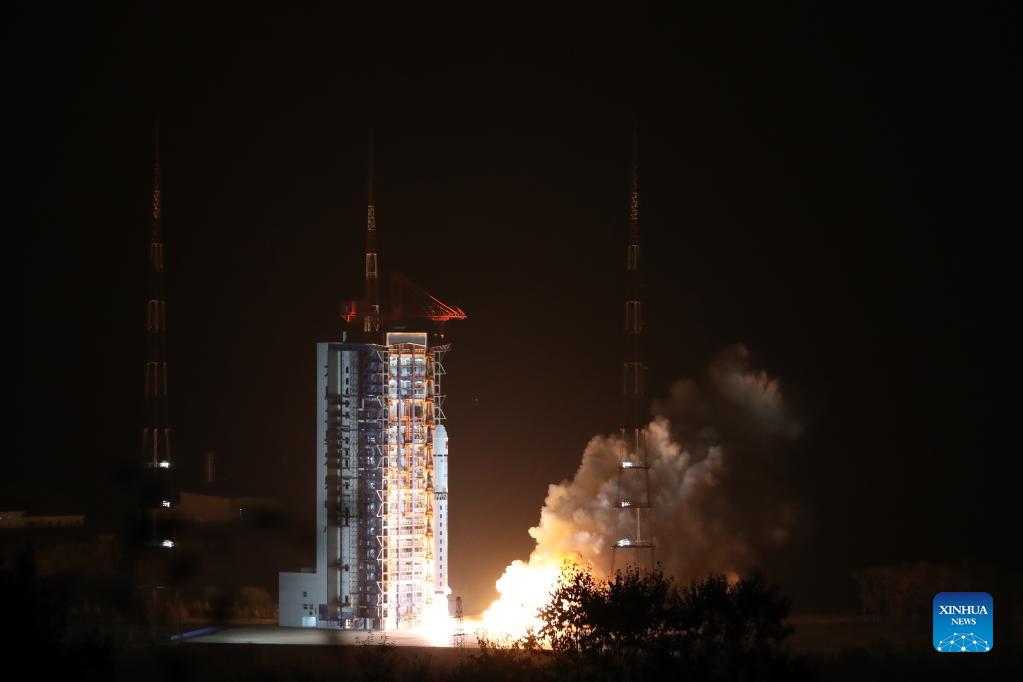
China launched its first solar observation satellite Xihe in Taiyuan, Shanxi province, on Thursday, aiming to help scientists deepen their knowledge of the nearest star.
The 508-kilogram Chinese H-Alpha Solar Explorer satellite was launched by a Long March 2D carrier rocket that blasted off at 6:51 pm from the Taiyuan Satellite Launch Center, and then entered a sun-synchronous orbit about 517 kilometers above the Earth, the China National Space Administration said.
It said the mission is expected to provide scientists with the first high-quality observation data of solar flares and will improve China's research capability in solar physics, adding that it is very meaningful to the nation's space exploration and satellite technology.
The satellite contains China's first space-based solar telescope and is designed to work for at least three years. Its major scientific payload is an H-alpha imaging spectrograph that can, for the first time, acquire full-disk spectroscopic solar observations in the H-alpha wave band.
The instrument is designed to observe and record changes in the sun's physical properties, facilitating scientists' understanding of the dynamics and physics of solar flares.
Several Chinese satellites, such as the Fengyun 3E meteorological satellite, have carried equipment that can collect solar data, but Xihe is the first dedicated to solar observation.
It is important for mankind to study the sun because solar activities have many effects on life on Earth, and obtaining more knowledge about the sun can help to mitigate the adverse effects of solar activities, especially disruption of the Earth's communications and navigation services, and better protect spacecraft and astronauts.
Studying the sun will also allow scientists to deepen their research on the origin and evolution of celestial magnetic fields, the acceleration and distribution of energetic particles, and other physical phenomena, experts say.
Although China is a major contributor of published research papers on solar observations, all the satellite-generated data Chinese scientists use is from foreign spacecraft. Xihe is likely to put an end to China's dependence on foreign satellites and make it a source of data for researchers and scientists of other countries.





