



Biomass growing as viable energy source









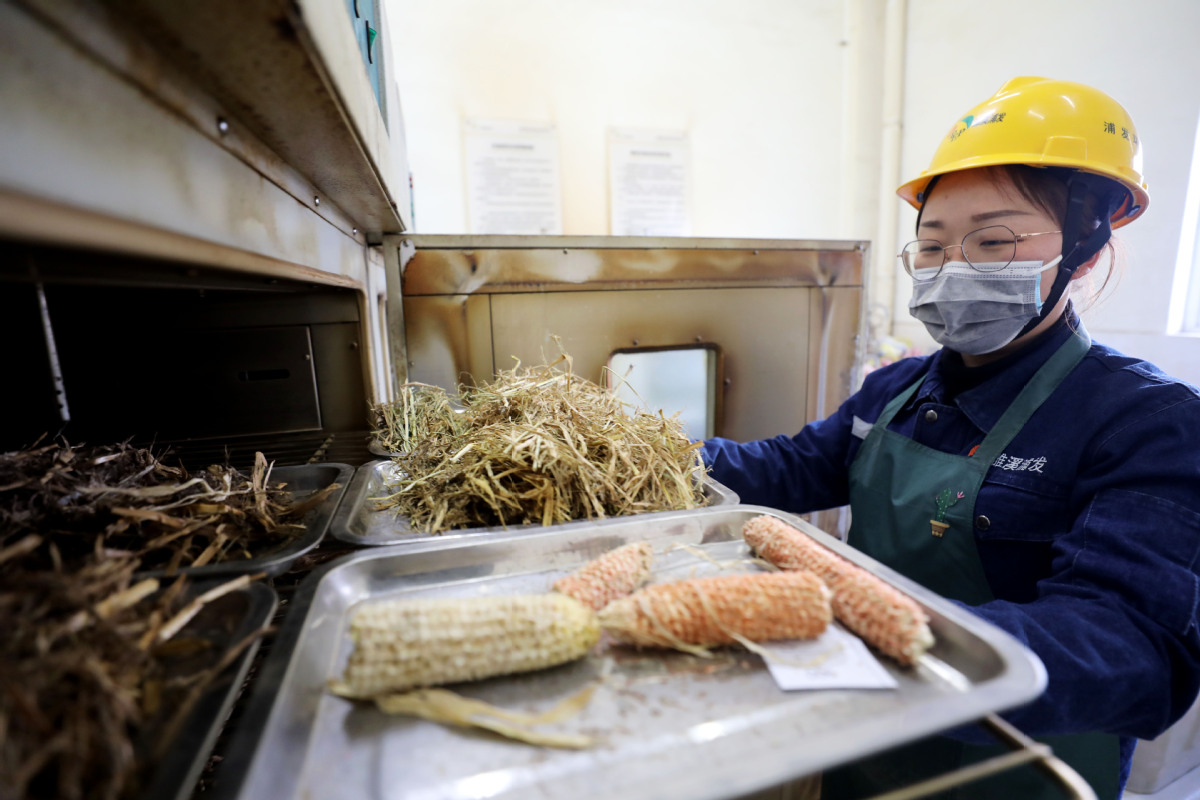
Leftovers from dinner table, farm waste converted into actual power
Do kitchen leftovers and pet droppings always belong in the garbage? Surprisingly, such organic waste may soon be an important energy source to heat your home or power your car.
Organic matter such as vegetable scraps, wood and animal waste is classified as biomass, and it can be used as an energy source to produce electricity or heat through burning, bacterial decay, fermentation or conversion to gas or liquid fuel.
The development of biomass energy is being fast-tracked in China, where it is becoming a focus for investment as the country steps up efforts to produce clean energy and cut reliance on fossil fuels under the country's green commitments.
Use of biomass to produce electric energy during the first half of this year was the equivalent of 78 billion kilowatt-hours, an amount 26.6 percent higher than in the same period last year, according to the National Energy Administration. Kilowatt-hours represent the amount of energy used, measured by hours.
Accumulated power generated by biomass reached a rate of 33.19 million kilowatts during the first half of this year, with Shandong, Guangdong, Zhejiang, Jiangsu and Anhui provinces topping the list. Kilowatts represent the rate of power produced.
China's newly installed capacity for biomass power generation reached 3.67 million kW during the first six months of the year, with Hebei, Guangdong, Zhejiang, Sichuan and Henan provinces having the greatest capacities, the administration said.
Zhang Jianhua, head of the NEA, said the country's rural areas have abundant sources of renewable energy, including wind, solar and biomass, and should further tap the potential for cleaner energy to help the government achieve the goal of hitting a carbon peak by 2030 and carbon neutrality by 2060.
Last year, China vowed to peak carbon emissions by 2030 and reach carbon neutrality by 2060.
During this year's two sessions, the annual meeting of the nation's top legislative and political advisory bodies, China reiterated its strong commitment to green power. The country stated its plans to reduce energy consumption per unit of GDP by 13.5 percent and carbon dioxide emissions per unit of GDP by 18 percent during the 14th Five-Year Plan period (2021-25).
Zhang Dayong, secretary-general of the Biomass Energy Industry Promotion Association, said China's green goals provide considerable opportunities for growth of clean sources of energy like biomass.
As a carbon-neutral fuel, biomass releases the same amount of carbon into the atmosphere when burned as it absorbed during the biomass sources' life cycle, Zhang said. "If equipped with carbon capture and storage technology, the process of turning biomass into energy can achieve negative emissions," he added.
Zhang said developing biomass energy is beneficial to the environment and China's energy structure in several ways. "Compared with other clean energy sources, biomass materials are widely available and easy to access. In addition, development of biomass fuels can reduce reliance on fossil fuels and reduce waste in landfills," he said.
A recent report by the biomass association says the current annual production of biomass in China is about 3.49 billion metric tons, which can potentially produce the energy equivalent of about 460 million tons of coal, but with far fewer emissions. It predicts that with the industry's rapid development, China's annual production of biomass will reach nearly 3.8 billion tons by 2030 and over 5.3 billion tons by 2060.
The report says that despite plentiful biomass material in China, only a small portion is turned into energy, and the share of biomass in the energy picture remains relatively low compared with other renewable energy sources.
"Now, only about 5 percent of organic waste is turned into energy and insufficient collection of waste is an important reason behind the low processing rate," Zhang said.
Major sources of biomass in China include waste from agriculture, forestry, industries, animal manure and sewage, and municipal solid waste.
While the largest contributing sources are estimated to be residues from annual crop production like wheat straw, much of the straw and stalks are presently used for cooking and heating in rural households at low efficiencies, according to BioEnergy Consult, an international consulting service provider based in Aligarh, India, in the waste-to-energy sector.
Therefore, agricultural and forestry residues along with garden waste were found to be the most cited resources for energy production in China, it said.
The majority of biomass capacity is in eastern China, with Shandong province accounting for 14 percent of the total.
Given that the cost of transportation and storage of farm waste is still relatively high, many farmers would rather burn straw and crop waste for heating at home, or haul agricultural residues directly to landfills, than selling them to power plants to produce energy, said Lin Boqiang, head of the China Institute for Studies in Energy Policy at Xiamen University in Fujian province.
"In addition, the efficiency of biomass power generation is still relatively low, which means there's far less electricity generated from biomass than from the same amount of fossil fuels, making the energy source a less favorable choice for power generators," Lin added.




















