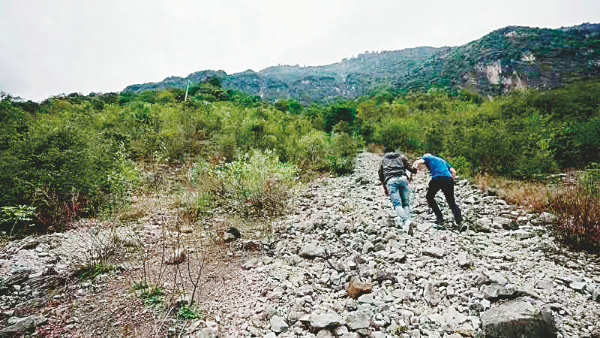

I was up to my knees in rocks. I staggered to and fro as I climbed forward, up the abrupt mountainside, occasionally catching myself with my hands as I lurched one way or another, as if unreasonably drunk.
Each step crunched loudly, followed by the rattling sound of small stones splashing downhill, as my shoes disappeared into the gravel.
At one point, I bent the nail of my big toe backward. A later examination also revealed scrapes and bruises on my shins, despite the benefit of jeans.
I was hiking up the old footpath out of Abuluoha village in Butuo county in Sichuan province's Liangshan Yi autonomous prefecture. The remote mountainous settlement became the final village in China to connect to the road system last June.
Before that, it took eight hours of slogging up the trail I was exploring to leave, and another eight hours back down to return to the settlement-and even longer if it rained.
Previously, severe isolation had condemned residents to extreme poverty and underdevelopment.
As such, our meals during our visits were mostly instant noodles and packaged snacks we'd brought ourselves, since the community's first restaurant was yet to open.
Like so many places where geology sires poverty, the karst landscape was sublime. A silvery ribbon of water fluttered along the foot of the looming peaks that assumed varied shades of purple as I looked further into the distance.
Indeed, China's transportation infrastructure progress is globally recognized as phenomenal, from airports to seaports, from high-speed railways to highway networks.
That said, the paving of the otherwise humble road to Abuluoha is monumental not only in that it was extremely tricky, technically speaking, but also in that it says a lot about China's governance.
Few, if any, other countries would bother to connect such a small settlement to the immense world beyond its borders at all, let alone invest so much to do so.
But China has made development and poverty alleviation its top priorities, and has followed through on its mission, doing whatever it takes to extend these to every citizen.
Geological hazards, such as mountains, have been some of the main obstacles, literally and figuratively, to overcome. Yet the country has done just that, consequently achieving virtual miracles in transportation, poverty alleviation and general development.
Arguably, few people outside the country deeply understand the challenges the nation's surfaces sire.
Roughly two-thirds of its land is crinkled into mountains, many of which are prone to earthquakes and landslides. China also hosts some of the world's more punishing deserts, including the 330,000-square-kilometer Taklimakan-the world's second largest-whose name translates as "place of no return" and nicknames include "sea of death".
That's not to mention the extreme elevations on the tundra of the Qinghai-Tibet Plateau, which lives up to its sobriquets, "the planet's third pole" and "roof of the world".
Also, the country must feed 1.4 billion people with roughly 6 percent arable land.
I've spent the past 15 years traveling to remote communities throughout every province on the Chinese mainland. As such, stories about my experiences on roads feature heavily in my new book, Closer to Heaven: A Global Nomad's Journey Through China's Poverty Alleviation, including earthquakes, landslides, flash floods, accidents, stuck vehicles, breakdowns and traffic jams caused by livestock, sometimes in no-man's land.
It's worth noting that the country's contemporary transportation triumphs hail from ancient wisdom, including the old Chinese saying, "In order to get rich, you must first build a road."
Later that day in Abuluoha, I gingerly trotted back down the mountain path and then hopped into a van to ride along the new motorway out of the village.
As we zigzagged up and down the mountainsides, I looked back at the small, remote settlement. I thought to myself about how this thoroughfare serves as a metaphor for the road China has followed to accelerate development through every corner of this vast nation.