



US draws Lithuania into risky Taiwan game









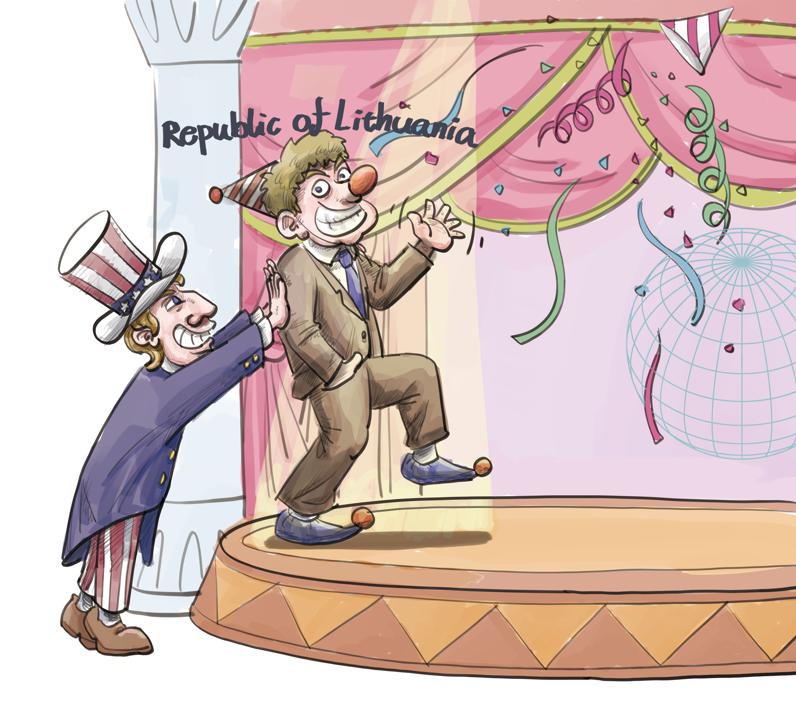
By allowing Taiwan authorities to set up a "representative office" in Lithuania, the Lithuanian government has violated the one-China policy. In a befitting response, China downgraded its diplomatic relations with Lithuania on Sunday to the charge d'affaires level-a move necessary to safeguard China's sovereignty and territorial integrity.
Moreover, if Lithuania doesn't stop making such provocative moves, the possibility of Beijing severing all diplomatic ties with Vilnius cannot be ruled out, although Beijing hopes the Lithuanian side refrains from doing so.
This is not the first time Lithuania has made such an outrageous move. In May, it withdrew from the"17+1" (17 Central and Eastern European countries plus China) cooperation mechanism and urged other CEE countries to do the same.
There are four reasons why Lithuania, disregarding broader bilateral interests, has become a standard-bearer for anti-China forces in Europe.
The first is the United States. The US has played an important role in the "negotiations" between the Taiwan authorities and Lithuanian officials, because it will be the biggest beneficiary of this development.
Since declaring independence from the Soviet Union in 1990, Lithuania has followed the US and even joined NATO. And despite depending on major countries for support, it has kept changing its diplomatic policies siding with the country that appears stronger. The Baltic state's latest move seems to be part of the US policy to contain China's rise, not least because the Taiwan question plays an important role in US strategy against China.
Second, Lithuania prefers national security to economic development, as it has deep historical entanglements with its neighbors, and being one of the least populous countries in Europe, it has always felt geopolitically insecure. The fact that Lithuania calls itself a "frontline state" and considers Russia to be its biggest security threat gave the US the chance to project itself as a defender of Lithuania.
Also, since the China-Russia strategic partnership has strengthened in recent years, Lithuania considers China an unfriendly country, and the US a benefactor and protector. Also, since the Lithuanian authorities do not believe trade with China and Chinese investments meet the country's requirements, they have chosen to side with the US in the hope of getting more economic and security support.
Third, Lithuania's China policy is guided by ideology, as it is willing to adopt a hard-line stance against communism, thanks to the indoctrination by the US.
And fourth, Lithuania's anti-China moves can be attributed to its political system. The center-right party Homeland Union-Lithuanian Christian Democrats won 50 of the 141 seats in the parliamentary elections in October last year, and formed a coalition government with the Liberal Movement and the Freedom Party. And ever since coming to power, the leader of Homeland Union and Lithuania's foreign minister, Gabrielius Landsbergis, has been urging Vilnius, the European Union and NATO to adopt an aggressive policy toward China.
Given these facts, China has no choice but to take counter and preemptive measures to safeguard its sovereignty and national integrity. To begin with, it should take measures to offset the effects of the US' anti-China policy, especially because the Joe Biden administration seems to be coercing Central and Eastern European countries to choose sides between the US and China, by dangling carrots before them and highlighting the importance of Western values and political systems with the aim of stigmatizing China and destroying the trust between China and other countries.
For example, Lithuania signed a $600 million export credit agreement with the US Export-Import Bank after allowing the Taiwan authorities to set up the "representative office".
Since this indicates the China-CEEC cooperation mechanism could face even bigger geopolitical challenges in the future, China needs to adopt a more open and inclusive policy toward other countries. By being a member of a host of international organizations, China has already been following international rules in letter and spirit, upholding multilateralism, and promoting peace and prosperity.
Now it should strengthen its crisis response mechanism to deal with the situation in case some other countries following Lithuania's example and side with the US against China.
Also, China should continue to support the strategic autonomy of Europe. As European countries such as Germany and France don't consider the US to be a trustful ally anymore, the US will try to draw more countries like Lithuania to its side, so as to weaken the EU's cohesion and the bid for strategic autonomy initiated by France and Germany.
The EU attaches great importance to cooperation with China, so it does not encourage EU countries to stand against China. So, despite hurting China-EU ties, Lithuania's moves cannot damage the overall resilient Sino-EU relations. The EU's strategic autonomy is the result of its adherence to multilateralism and multipolarization, a policy followed by China and other developing countries. In fact, this is what will help the two sides to further strengthen ties and offset the negative impacts of Lithuania's moves.
With the US' support, Lithuania has used diplomacy to intensify the Russia-West geopolitical competition in Central and Eastern Europe, which could threaten sociopolitical and economic stability in the region and beyond.
Besides, Lithuania's disregard for mutually beneficial relations reflects its lack of belief in economic globalization. For example, although Lithuania has benefited from the Belt and Road Initiative and the China-CEEC cooperation mechanism, it is no longer happy with the existing arrangements and wants more. Similarly, some other European countries might also think Chinese investments cannot meet their requirements and turn to the US in the hope of getting more benefits.
So China needs to follow targeted diplomacy, taking decisions based on the countries in question and after taking into account their economic, political and security demands, while underlining the importance of cooperation to tide over crises and common challenges. Only in this way can China neutralize the effects of the US' moves.
The author is a research fellow at the Institute of Russian, Eastern European and Central Asian Studies, Chinese Academy of Social Sciences.
The views don't necessarily represent those of China Daily.
If you have a specific expertise, or would like to share your thought about our stories, then send us your writings at opinion@chinadaily.com.cn, and comment@chinadaily.com.cn.





