



Visual effects teams flocking to fresh location









Meaningful collaboration
Nie has taken part in popular TV projects in Beijing, including Return of the Condor Heroes, a 2006 drama series adapted from Hong Kong author Louis Cha's novel. Yet most film projects, especially big-budget productions such as Hero (2002) and The Promise (2016) chose only foreign visual effects teams for their better quality.
Hoping to work in film production, Nie traveled to Shenzhen and joined the cross-regional team.
He said that due to a lack of policy support and resources, the movie visual effects industry was slow to develop in the city, and many team members left to seek opportunities in Beijing, the nation's cultural center and home to a wealth of film resources.
Nie believes that initial cross-regional collaboration was meaningful, as it introduced talent from Hong Kong to work on the mainland, and cultivated a group that later became a significant force in the Chinese movie industry.
In recent years, with the emergence of the Greater Bay Area blueprint, and the region's ambition to develop cultural and arts-related industries, some of the team members have been thinking about returning to Shenzhen to develop their careers, Nie said.
He feels that the city offers many competitive advantages in developing visual effects and movie postproduction work.
Shenzhen is the world's leading manufacturing base for light-emitting diode, or LED, screens, which are of increasing importance in producing visual effects. In the past, actors often performed in front of a green curtain, and technical staff members had to add visual effects by computer. The use of LED screens as a shooting backdrop means that visual effects can be directly displayed on the screen, saving considerable costs and postproduction time.
In October last year, Shenzhen launched its first digital studio for film and TV work. Capable of showing visual effects in real time, the studio is located in the city's Bao'an district, and it is planned to build four or five more.
With a solid foundation in technology, Shenzhen is also home to a number of companies offering cutting-edge cloud-rendering and storage services-key to the operations of visual effects companies.
Nie said that with local government help, companies at the Longgang postproduction base are poised to enjoy support for such services from leading technology company Huawei, which is headquartered in Longgang.
The Longgang postproduction base has pledged to subsidize 30 percent of the postproduction cost of film and TV projects, as well as 50 percent of the cost of renting an office. Nie said such support is more attractive than that offered in Beijing and Shanghai.
Noting that increasing numbers of postproduction staff members in leading film hubs are seeking new operational bases, Nie thinks that Shenzhen and the Greater Bay Area are ideal choices for overseas teams to enter the mainland market, and for their mainland peers to explore opportunities in southern China.
He said that Vancouver has become the production center for Hollywood due to strong policy support, a lower cost of living and convenient transportation services. Nie believes Shenzhen also has the potential to become the production base for China's leading movie-producing areas such as Beijing, Shanghai and Zhejiang province.
To encourage film and TV development, cities in the Greater Bay Area have offered support in recent years, mostly providing tax deductions and subsidies, and setting up large-scale industry bases.
Huangpu district in Guangzhou, capital of Guangdong, established a film and TV postproduction base and launched two special funds to support related projects. Huizhou aims to set up the region's largest studio to shoot films, while Foshan has announced it will develop a cooperation pilot zone to explore new policies in talent introduction, tax deduction and copyright protection.
Projects planned
Such efforts have attracted numerous individuals, teams and companies.
Teddy Chen Tak-sum, who was among the first group of Hong Kong movie directors to collaborate with the mainland on film production, plans to launch seven projects in the Greater Bay Area in the coming three years-five movies, an animation and a drama. Running a film company in Hong Kong, he also plans to open branches of the business in Greater Bay Area cities on the mainland to help these projects.
Another Hong Kong director, Lee Lik-chi, set up an office in Hengqin New Area in Zhuhai, Guangdong, this year, and is in discussions with his peers in Macao to coproduce a series of Macao-themed movies, starting next year.
Last year, several leading film and entertainment companies, including Bona Film Group and Huayi Brothers Media Corp, based in Beijing, and Emperor Entertainment Group, headquartered in Hong Kong, set up or announced they would establish regional headquarters in Guangzhou.
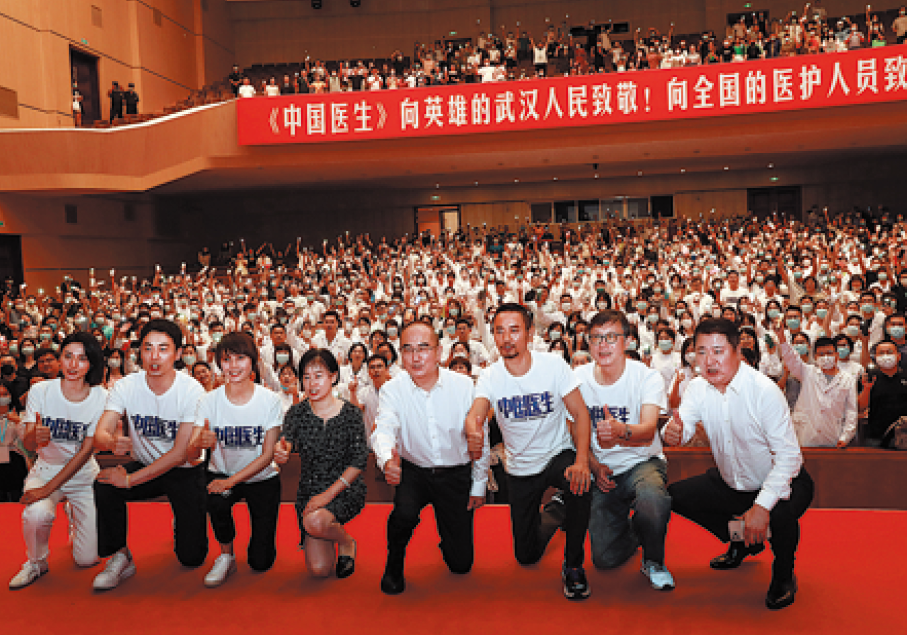
Bona Film's Guangzhou branch this year launched Chinese Doctors, a film featuring medical workers' efforts to combat the COVID-19 pandemic. The movie took more than 1 billion yuan at the box office. Other films produced in Guangzhou, such as the documentary Like the Dyer's Hand and Snake White, which features Cantonese opera, have also performed well in the past two years.
In addition, Greater Bay Area cities such as Guangzhou, Foshan and Zhongshan are becoming popular choices for veteran Hong Kong actors seeking better career development and quality of life on the mainland.
Many second- and third-tier cities, such as Haikou, Hainan province, Chengdu, Sichuan province, and Qingdao, Shandong province, have also prioritized development of the film and TV industry.
Despite these positive signs, challenges remain. The industry has not completely shaken off the shadow of the pandemic. Apart from several top movies with high investment, most mid- or low-budget films are struggling, and a number of companies and theaters are closing.
Liu Yifan, a mainland movie critic, hopes the latest developments will accelerate the industry's recovery in the Greater Bay Area. He has encouraged the region to make good use of the influx of actors, film companies and postproduction teams.
Hong Kong film critic Reeve Wong said that to become a full-fledged film and TV hub, the region needs to hone its strengths in movie shooting and production, and overcome shortcomings in creativity and talent.
He said that several years ago, some Hong Kong film companies planned to produce eight to 10 films in Guangdong, inviting local teams to write scripts. More than 20 scripts were submitted, but the quality was not good enough.
Noting that creativity is vital for the cultural and arts industry, Wong encouraged the region to attach more importance to cultivating scriptwriters, and to improving the methods used to choose and motivate them.
Eddie Chan Shu-chi, president of the Hong Kong Association of Motion Picture Post Production Professionals, said the Chinese market is huge and the Greater Bay Area is promising to become a third hub for visual effects, in addition to Beijing and Zhejiang.
Comparing movie locations, Chan said the Greater Bay Area has better weather and support facilities than Beijing or Zhejiang, including transportation and accommodations.
He suggested the region make better use of resources from Hong Kong for its long-term development, especially talent cultivation and training.
Chan also noted that training courses run by the Federation of Hong Kong Filmmakers for 16 years have helped the city cultivate a large number of talented professionals.
After the boundary with Hong Kong, which has been closed due to COVID-19, reopens, he hopes these courses can be extended to more mainland cities in the Greater Bay Area.



















