US support for water discharge plan could hurt itself









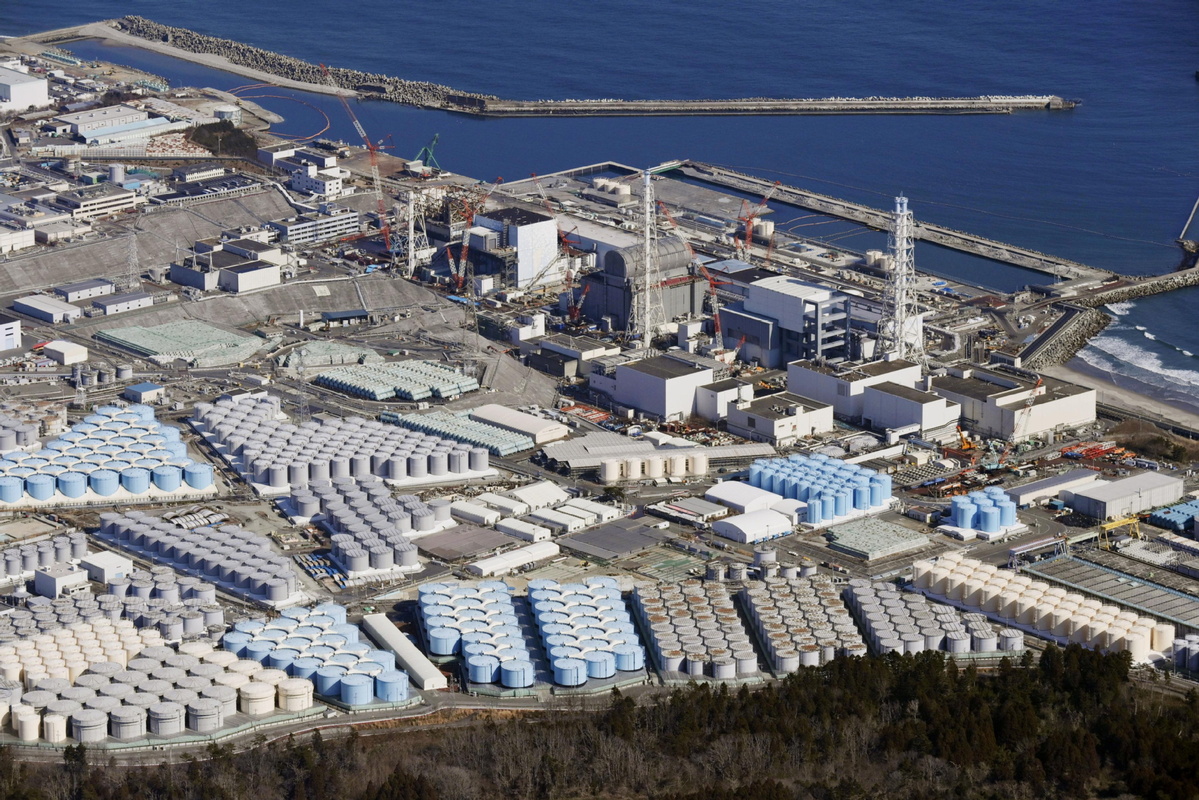
The Japanese government insists on discharging nuclear contaminated water from the damaged Fukushima Daiichi nuclear power plant into the sea ignoring the opposition of many countries including China, the Democratic People's Republic of Korea, the Republic of Korea, Russia and South Pacific island states. On Friday Japan's Nuclear Regulation Authority officially started to review a plan for discharging nuclear-contaminated water into the sea.
Yet despite the international community's opposition, the US has supported the Japanese government's decision. For example, in April US Secretary of State Antony Blinken tweeted after the Japanese government's decision to discharge the radioactive water into the sea, saying: "We thank Japan for its transparent efforts in its decision to dispose of the treated water from the Fukushima Daiichi site."
As for the US State Department, it said: "In this unique and challenging situation, Japan has weighed the options and effects, has been transparent about its decisions, and appears to have adopted an approach in accordance with globally accepted nuclear safety standards."
The US, in supporting Japan, one of its principal allies, has ignored facts and scientific research, violated international law, and turned a blind eye to the irreversible damage the discharge of radioactive water would cause to the marine environment.
First, authoritative scientific research shows the discharge of radioactive water into the sea will have a devastating impact on not only the marine environment but also humans. There are three main sources of radioactive water from the Fukushima plant: the original coolant in the reactor, the water pumped into the plant to cool the reactor core after the accident triggered by the 2011 earthquake and tsunami, and the massive amount of groundwater and rainwater that infiltrated the reactor.
Even Fukushima plant operator Tokyo Electric Power Company has admitted that, unlike other radioactive elements in nuclear water, "tritium" cannot be removed from the nuclear contaminated water. So no matter how well the Japanese authorities try, the nuclear contaminated water will remain radioactive.
According to a report of the International Atomic Energy Agency and the United Nations Scientific Committee on the Effects of Atomic Radiation, the discharge of nuclear contaminated water from the Fukushima plant will have a devastating impact on the marine environment, food safety and human health.
Also, a study by the Helmholtz Center for Ocean Research Kiel in Germany shows that the coast off Fukushima has one of the strongest currents in the world, and as a result, within 57 days from the day of discharge, radioactive materials will spread to most of the Pacific Ocean, and three years later, the coasts of western United States and Canada will be affected by nuclear pollution. And within 10 years, the nuclear contamination will spread around the world.
Also, nuclear experts from Greenpeace have said carbon-14 in the Fukushima nuclear contaminated water will remain at dangerous levels for thousands of years and could cause genetic damage to humans and other species.
All this show the discharge of Fukushima nuclear contaminated water is not just a domestic issue of Japan. It is a serious international issue involving human health, the marine environment and overall environmental security.
Besides, Japan is a signatory to the United Nations Convention on the Law of the Sea, the Convention on Early Notification of a Nuclear Accident, the Convention on Nuclear Safety, and the Joint Convention on the Safety of Spent Fuel Management and on the Safety of Radioactive Waste Management. So it should abide by these conventions and take necessary measures to protect the marine environment and avoid causing marine pollution.
According to Articles 194 and 195 of the UN Convention on the Law of the Sea, Japan should, alone or in conjunction with other countries, take all necessary measures to prevent, reduce and control the pollution from the Fukushima nuclear contaminated water, and ensure nuclear contaminated water treatment activities don't cause cross-border pollution.
The way Japan plans to discharge nuclear contaminated water violates international law on nuclear materials and nuclear wastes. Japan didn't notify or consult neighboring countries before taking the decision to discharge nuclear contaminated water from the Fukushima plant, seriously violating the international law. Japan could have treated the nuclear contaminated water to minimize its environmental impact, but it has chosen the easier way to cut costs.
Moreover, the US administration's support for Japan's decision is not only contradictory, but also could boomerang on itself. The US claims that Japan's radioactive contaminated water discharge policy complies with globally recognized nuclear safety standards, but at the same time it prohibits the import of many Japanese foods, fearing they could be nuclear-contaminated.
No wonder many US experts have called on the administration to ask Japan not to discharge the radioactive water into the sea. For example, US marine conservation biologist Rick Steiner published an article in the Alaska Anchorage Daily urging the US administration to immediately stop Japan's nuclear contaminated water discharge plan. He said that nuclear contaminated water contains many radioactive elements, and if released into the Pacific Ocean, it will pollute the waters near California, Hawaii, Oregon, Washington and Alaska. He also said that Japan's claim that the risk associated with the discharge of the nuclear contaminated water is small is neither credible nor scientific.
Since Japan's plan to discharge the radioactive water into the sea could seriously damage the global marine environment and endanger the lives and health of human beings, governments and people across the world should jointly oppose it.
The views don't necessarily reflect those of China Daily.
The author is a professor with the Institute of International Law, Chinese Academy of Social Sciences.