



Archaeology wins a wider audience









Popular breakthroughs
For Chinese scholars, the term "public archaeology"-presenting and interpreting archaeological data to the public-h(huán)as become key in recent years, particularly following the launch in 2017 of The Nation's Greatest Treasures, a well-acclaimed CCTV variety show.
Numerous positive comments about the show were posted on social media platforms, thanks to its winning blend of cultural heritage knowledge and mass entertainment. In each episode, three key exhibits from a museum were introduced by celebrities, and behind-the-scenes stories of the items were also told by experts and conservators. In the three seasons of the show to date, 81 cultural relics have been highlighted.
In 2018, If Treasures Could Talk, a series of short documentaries introducing such relics with an amusing style of narration, also proved popular with younger viewers.
During public holidays in China this year, a series of video clips from Henan TV that featured dancing went viral online. Performers presented works inspired by Tang Dynasty (618-907) pottery figurines, creating another cultural phenomenon by breaking down barriers between tradition and modern creativity.
Despite this breakthrough, Liu Guoxiang, director of the scientific research department at the Chinese Academy of Social Sciences' Institute of Archaeology, feels that basic artifacts are now insufficient alone to satisfy the public's fast-growing appetite.
He said China boasts many key cultural relics, "and, beyond admiring such artifacts, audiences that are now 'more professional' need to see the bigger picture to comprehensively understand our civilization."
The blurring boundaries between the promotion of cultural relics and entertainment have led to some scholars fearing that the high points of such programs are being overshadowed.
Liu said: "For people who aren't initially archaeology enthusiasts, recordings of excavations can be boring. On the other hand, to better attract audiences, production teams favor ancient tombs, where many eye-catching objects have been unearthed, but they often neglect important city ruins, as they are not so attractive."
He added that this trend could lead to a misconception that archaeology is treasure-hunting, as wrongly portrayed by many novels and films.
As a result, the academy's Institute of Archaeology joined hands with CCTV to present a new variety show, Chinese Archaeology Assembly, to mark the centenary. The program debuted last month.
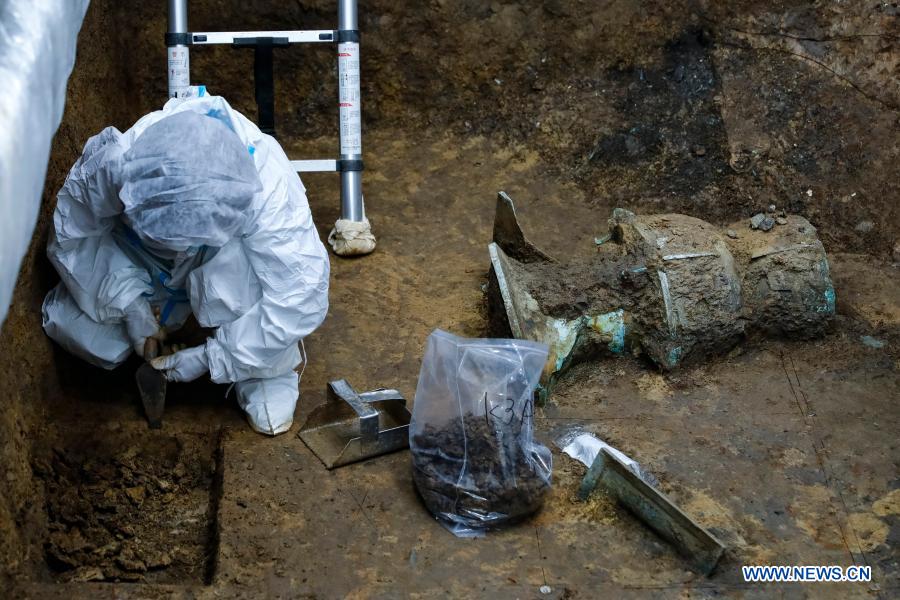
The show features 12 "star" archaeological sites. These range from key locations that witnessed the infancy of Chinese archaeology in the 1920s-the Zhoukoudian site in Beijing, where the famed Peking Man skull fossil was found, and the Yinxu Ruins in Henan, home to China's earliest-known written characters-to the recent discoveries at Sanxingdui.
A lineup of the nation's leading archaeologists and cultural scholars appeared on the show to explain the main findings at these sites.
Pan Yujia, the program's director, said, "China has had nearly 1 million years of human activities, 10,000 years of cultural history, and a civilization of more than 5,000 years, so we choose the 12 sites that represent this entire timeline to reflect these three themes."
Celebrities, including actors and TV anchors, explore for viewers the mysteries surrounding archaeological findings, unveiling intriguing stories behind the key moments for Chinese archaeology during the past 100 years.
Liu, who advised on production of the show, suggested in particular that it include comparisons between the sites and their overseas counterparts.
"In this way, we demonstrate the characteristics of Chinese civilization so we can better know our position in the world. Our stories thus reach a wider audience," he said.
Virtual reality and artificial intelligence are used to digitally portray excavation sites in the studio.
Pan said that for historical accuracy, each digitized studio scenario is strictly based on real sites.
Xia Nai, Pei Wenzhong, Li Ji and many other founding fathers of Chinese archaeology whose names may not be familiar among the public have finally been given the chance to win recognition beyond professional circles.
Li Xinwei, a researcher with the Institute of Archaeology, joined the show to explain the Jiahu site in Henan, where the stunning discoveries of 8,000-year-old flutes were first made in 1986.
"The production team had many brainstorming sessions with us to ensure academic accuracy and look for features to attract people's general interest," Li said.
"It's good to see that this program is not just an introduction to archaeological achievements. We can also see how researchers have overcome difficulties to make such accomplishments, and gain an understanding of how they felt. Personal stories are more touching and they are also crucial for the public to understand archaeology as a whole."
Sina Weibo posts about the first two episodes of the show have been viewed more than 700 million times.
Liu said: "It's as though we've opened a new door for public archaeology. More archaeologists may be willing to talk and more young people may thus be willing to choose such a career. However, there's still a long way to go if we want to have a lasting influence. We need more ideas."
In addition to Chinese Archaeology Assembly, more TV programs have featured the topic this year, including quiz shows and lectures-in turn bringing opportunities for scholars who previously stayed out of the spotlight.
Li said: "It's not extra work for archaeologists to spend time explaining their findings to the public. It's our duty."
He added that people will further appreciate the need to protect cultural heritage sites through the promotion of archaeological findings.




















