



Birth rate falling below 1 percent an early warning









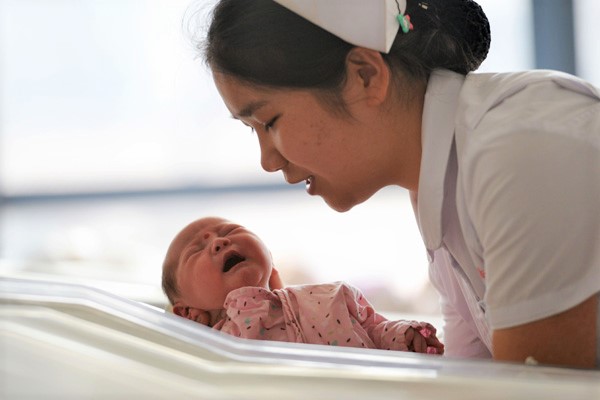
China's birth rate in 2020 is likely to be 8.52 per 1,000, below 10 for the first time, while the natural population growth rate during the same period is expected to be 1.45 per 1,000, according to China Statistical Yearbook 2021 released by the National Bureau of Statistics.
Data show the natural growth rate in 2020 is likely to be less than 25 percent of what it was a decade ago. In particular, since the implementation of the two-child policy in 2016, the natural growth rate has dropped from 6.53 per 1,000 to 1.45 per 1,000, with the decline accelerating since 2017. As for the birth rate, it fell from 13.57 per 1,000 in 2016 to 8.52 per 1,000, a precipitous decrease by all accounts.
This declining trend is expected to continue in 2021 and beyond.
That the birth rate has fallen below 1 percent means the trend of a declining birth rate which started in the early 1970s continues and China will experience zero-population growth earlier than estimated (the original estimate was after 2027).
Also, the population of women aged between 20 and 29 years decreased by 34.63 million from 2010 to 2021. Which shows China's low fertility rate is driven not only by fewer couples wanting to have children but also by the decline in the number of childbearing age women.
The birth rate falling below 1 percent is a major turning point in China's demography. Driven by a low fertility rate, the decreasing young population may exacerbate the economic slowdown, because according to population development rules, an imbalance in population age structure could cause a labor shortage even in the most populous countries.
Since 2012, China's working-age population has been decreasing by several millions each year, with the total decrease exceeding 40 million. China's population increased by 7.37 million in 2017, 5.3 million in 2018, 4.67 million in 2019 and 2.04 million in 2020, showing a declining population growth trend.
What has complicated this problem is the country's rapidly aging population. The resulting imbalance in the population age structure is not conducive to the long-term, balanced development of the population. So China needs to take measures to ensure population security in order to strengthen overall national security. Indeed, a balanced population age structure and a healthy population growth rate are vital to safeguarding overall national security.
Building a fertility friendly society and realizing long-term balanced population development are also necessary to achieve sustainable development and national rejuvenation. So China should maintain the near-replacement fertility rate (total fertility rate of 1.8-2.5) to ensure the sustainable development of the population.
However, there are certain differences in the fertility rate in urban and rural areas, and among social and ethnic groups. So the authorities should help couples among population groups that have a strong fertility will to have more children, reduce the pseudo-low fertility (that is, low fertility caused by cost constraints), identify the groups with higher fertility potential, such as those living in remote or ethnic minority areas, and then provide all-round support to the wider population, in order to raise the fertility rate to a healthy level.
In short, China needs a family-friendly policy and system to develop a new type of fertility culture, with the relevant policies reflecting the meaning of life and ensuring that people respect women's reproductive rights, and employers do not discriminate against women who choose to have more than one child.
The government should also strengthen social welfare services and social security, so as to improve the tangible well-being of the people by, for instance, providing "baby bonus" and longer maternity leave for new mothers, and better protecting the rights and interests of women.
The views don't necessarily reflect those of China Daily.
The author is a professor with the Population Research Institute of Peking University.





