US consumer price index jumps 7% to 40-year high









There are numerous reasons given for why inflation is rising in the US, but there has been no deviation in its recent direction, which is straight up.
The consumer price index released by the US Department of Labor on Wednesday rose 7 percent in the past 12 months through December. It was the largest year-on-year increase since June 1982, following a 6.8 percent rise in November.
The rising costs for rental accommodation and used cars held onto strong gains, bolstering expectations that the Federal Reserve will start raising interest rates as early as March.
The report followed one on employment Friday showing that the labor market was at or near maximum employment. High prices and full employment are ripe conditions for inflation.
"There is still tremendous momentum when it comes to inflation right now. While inflation is likely to peak in the next few months, the overall pace is going to remain a challenge for consumers, businesses and policy," Sarah House, director and senior economist at Wells Fargo, told The Wall Street Journal.
Federal Reserve Chair Jerome Powell on Tuesday said that the US central bank was prepared to do what was necessary to keep high inflation from becoming "entrenched". Powell spoke during his nomination hearing before the Senate Banking Committee for a second four-year term as head of the bank.
"The Fed is going to be forced to begin raising rates in March and depending on the political pressure on them — from both sides of the aisle — they are going to have to raise rates four or more times in this year and potentially more than that next year," said Chris Zaccarelli, chief investment officer at Independent Advisor Alliance in Charlotte, North Carolina.
The Fed's key interest rate, the federal funds rate, ranges from 0 to 0.25 percent. The last time the consumer price index was up 7 percent, the fed funds rate was 11.5 percent, in the early 1980s.
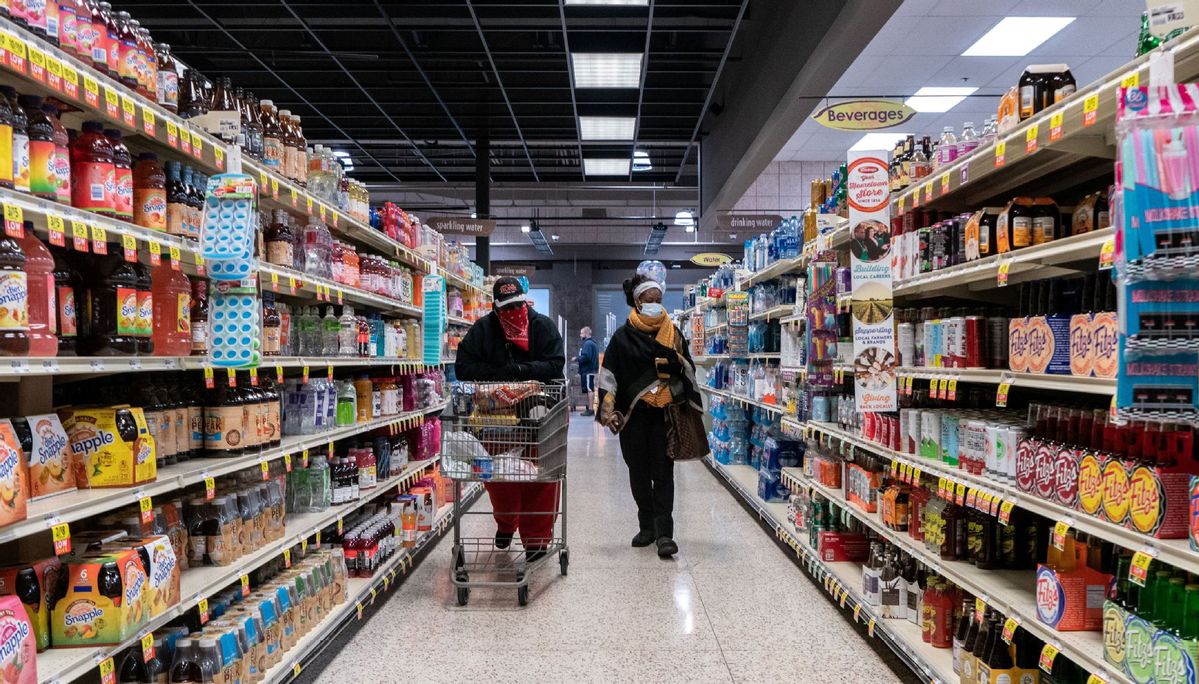
The consumer price index rose 0.5 percent last month after advancing 0.8 percent in November. In addition to higher rents, consumers also paid more for food. There were big increases in fruits and vegetables, but beef prices fell 2 percent after recent sharp gains.
Consumers also got a break from gasoline prices, which fell 0.5 percent after rising 6.1 percent in both November and October.
Rising inflation is also eroding wage gains. Inflation-adjusted average weekly earnings fell 2.3 percent on a year-on-year basis in December.
President Joe Biden said virtually every nation was coping with inflation as the global economy recovers from the pandemic.
"This report underscores that we still have more work to do, with price increases still too high and squeezing family budgets," Biden said in a statement.
Inflation is well above the Fed's flexible 2 percent target. It is also being lifted by wage pressures as the labor market tightens. The unemployment rate fell to a 22-month low of 3.9 percent in December.
Excluding the volatile food and energy components, the CPI increased 0.6 percent last month after rising 0.5 percent in November.
The so-called core CPI was boosted by rents, with owners' equivalent rent of primary residence, which is what a homeowner would receive from renting a home, rising 0.4 percent for a third straight month.
Prices for used cars and trucks jumped 3.5 percent after increasing 2.5 percent in each of the prior two months.
Prices for new motor vehicles rose 1 percent, the ninth consecutive month of gains. A global semiconductor shortage has undercut auto production.
"Inflation will slow in 2022 as supply chains reopen and prices for some items, like vehicles and energy, decline as supply catches up to demand," said Gus Faucher, chief economist at PNC Financial in Pittsburgh. "But inflation for many other goods and services will be higher in 2022 than before the pandemic, due to higher labor costs and input prices. Housing will also contribute to high inflation in 2022."
Bacon prices are up nearly 19 percent from a year ago, men's coats and suits nearly 11 percent, and living and dining room furniture more than 17 percent. Renting a car will cost 36 percent more, on average, than it did in December 2020.
For a little less than a year, inflation has been on a stair-step rise.
In February 2021, the CPI was running 1.7 percent ahead of a year earlier. From there, the year-over-year price increases accelerated steadily — 2.6 percent in March, 4.2 percent in April, 4.9 percent in May, 5.3 percent in June. By October, the figure was 6.2 percent, by November 6.8 percent.
At first, Powell and others characterized higher consumer prices as a "transitory" problem — the result mainly of shipping delays and temporary shortages of supplies and workers as the economy swiftly rebounded from the pandemic recession.
As recently as September, Fed policymakers had been divided over whether to raise rates even once this year. But last month, the central bank signaled that it expects to raise its short-term benchmark rate three times this year in an effort to quell inflation.
"If we have to raise interest rates more over time," Powell told the Senate Banking Committee on Tuesday, "we will."
Instead of sinking into a pandemic-prolonged downturn, the economy staged an unexpectedly strong recovery, fueled by vast infusions of government aid and emergency intervention by the Fed, which slashed interest rates, among other things. By spring this year, the rollout of vaccines had emboldened consumers to return to restaurants, bars, shops and airports.
Businesses had to scramble to meet demand. They couldn't hire fast enough to fill job openings — a near record 10.6 million in November — or buy enough supplies to meet customer orders. As business roared back, ports and freight yards couldn't handle the traffic.
Costs rose, and companies found that they could pass along those higher costs in the form of higher prices to consumers, many of whom had managed to put away significant savings during the pandemic.
But some experts, including former treasury secretary Lawrence Summers, partly blamed Biden's $1.9 trillion coronavirus relief package, with its $1,400 checks to most households, for overheating an already hot economy.
"In retrospect, it was more than what was needed,'' said Ellen Gaske, an economist at PGIM Fixed Income. "I point a finger very strongly at the nature of fiscal policy at this time. It was not just the size of the (relief) packages, but those direct cash payments to households added purchasing power very directly. And when you pushed that up against the supply disruptions because of COVID, the pressure valve was higher inflation.''
Reuters and The Associated Press contributed to this story.