



Serious measures needed to revive real martial arts









Editor's Note: More than four decades of reform and opening-up have not only turned China into the world's second-largest economy but also changed its people's lifestyle. Continuing his focus on people's changing lifestyle and sports, a veteran journalist with China Daily analyzes the development of martial arts.
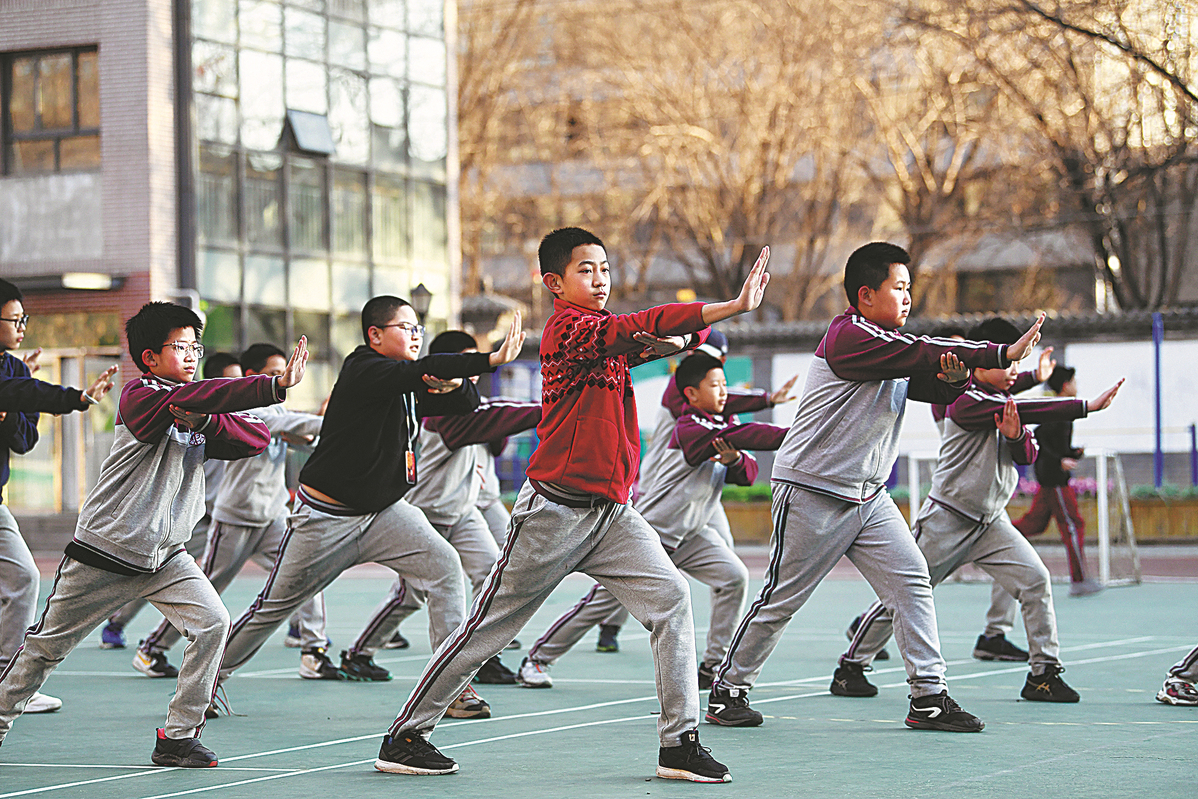
To ensure its employees get some much-needed exercise during the COVID-19 pandemic, when many gyms, swimming pools and jogging tracks were closed, China Daily invited a wushu, or kung fu, master to teach them Baduanjin-a martial arts form that combines tai chi and qigong.
The routine is simple. But the master spent a lot of time teaching us how to control our breathing and stretch our limbs and body to the extreme. "You must move as if you are pushing, pulling, lifting and raising a 20-kilogram object, otherwise what you learn will be only showy postures," the master kept reiterating.
After returning home, when I wanted to show off my new skills to my wife, she told me that she had already learned Baduanjin from dancers in the community square. Accompanied by music, she danced her routines, which appeared much more consistent and elegant than what I have learned. But I had to stop and tell her that her Baduanjin had little to do with the real martial arts form.
Our different routines signify the dilemma of martial arts' development in China. Martial arts were developed by our ancestors so the practitioners would be physically fit, and be able to defend their family, and take on attackers, if need be. They were most popular during the Ming (1368-1644) and Qing (1644-1911) dynasties.
After the founding of the People's Republic in 1949, an estimated 2,000 wushu routines were practiced in China. To establish the rule of law, however, the central government had to arrest the warlords and bandits, with the latter numbering about 1 million.
That most of the bandits were also wushu practitioners prompted the authorities to adopt a discouraging attitude toward unauthorized wushu practices for about a decade, which disrupted wushu's master-disciple teaching system, leading to the disappearance of many routines. A few dozen routines are still practiced, though.
The popularity of kung fu movies starring Bruce Lee in the 1970s revived wushu to a certain extent, as millions of youngsters wanted to learn the "magic skills". But to their disappointment, many masters were either already dead or too old to teach.
For the past few years, however, China's sports authorities have been promoting wushu with the aim of getting it included in the Asian Games, even the Olympic Games. Apart from establishing sports associations and federations, the authorities have also held national and international championships, and adjusted wushu's original routines so that performers' demonstrations could be easily graded and accorded points.
To make such performances more viewer-friendly, the authorities put more emphasis on consistency and elegance while ignoring the inner strength and power of the performers. As a result, wushu competitions have become a mix of gymnastics and acrobatics.
But the fact is, wushu is an exercise regime to strengthen the body and learn/hone martial art skills. By neglecting the combat side of wushu, we are trying to make a hamburger without meat.
Years of misdirected efforts to develop wushu have led the martial arts into a dead end. As a result, while some parents are sending their children to taekwondo and judo classes, others are admitting their children to boxing and yoga clubs. And while community squares are full of "square dancers", the few remaining wushu practitioners have to train in deserted park corners.
The absence of real masters and real kung fu has also created opportunities for swindlers who claim to be the inheritors of some long-lost martial arts schools. They boast of possessing "all-conquering power" and share their skills with only those who buy their books, videos and/or medicines-and pay a hefty fee.
Some experts have suggested a double-track approach to develop martial arts: continuing the promotion efforts because it helps popularize wushu at home and abroad; and issuing supportive policies to encourage real masters to do more to pass down their skills by operating schools and taking in disciples.
As for wushu associations, they should focus more on reviving the disappearing routines with special emphasis on teaching combat skills. Only this way can the traditional martial arts be revived.
The author is former deputy editor-in-chief of China Daily.
kangbing@chinadaily.com.cn





