



China, ROK together for a brighter future









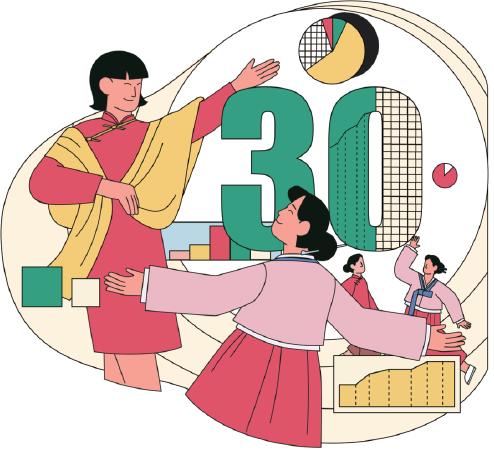
One does not need statistics to realize the benefits of normal relations between the People’s Republic of China and the Republic of Korea. In a generation’s time, the bilateral trade volume skyrocketed, contributing to the economic development and prosperity of both countries. Tourism also flourished, which helped in part to modernize the infrastructure of travel and accommodation.
The benefits of tourism are not restricted to economic and business interests. The people of the two nations had more and better opportunities to meet with each other. They were able to visit places, see and experience for themselves the tourist attractions and culture of the other country.
The fact is, people in China and the ROK were already quite knowledgeable about one another’s country and culture through reading books, watching films, and word of mouth. Academic exchanges have also intensified, particularly in the field of education: about half of some 140,000 foreign students currently in the ROK are Chinese, and before the COVID-19 pandemic, students from the ROK made up the highest number of foreign students in China (50,600 students in 2018).
Unfortunately, however, relations between the people of the two countries seem to have soured a bit. There is a constant volley of complaints, criticisms and even curses between the people of the countries. The reason behind these regretful developments defies reasoning, let alone an immediate and clear answer.
But it requires a sound reflection by the people on both sides, as small instances could have serious consequences, not only on China-ROK relations, but on peace and security of the region as well. I, therefore, propose to broaden our perspective on Northeast Asia as a whole.
The root of the problem lies in our failure to form a community of nations in the region after the end of World War II. I will refrain from going into the deeply embedded causes of the failure and instead will focus on the concrete complaints the people of the three Northeast Asian countries have against one another.
Between the Japanese people on the one hand and the people in China and the ROK on the other, complaints of the latter are mostly about the past: that Japan has fallen short of acknowledging and making up for its past wrongdoings during its militaristic expansion in the first half of the previous century.
The Japanese people, on their part, tend to think that they have done enough both in terms of apology and amendment for their past wrongdoings and question the real motives behind their neighbors’ complaints.
When it comes to the people in China and the ROK, it is on a completely different subject that they take issue with one another: problems related to cultural and historical identity. For instance, the people of the two countries argue about the origins of traditional foods, even traditional costumes. Insofar as I am concerned, this kind of dispute is futile.
One does not have to quote a French philosopher to realize that it makes little sense to quarrel over the origins of a certain culture, or whether a certain artifact, or even a costume was “originally ours”. As Jacque Derrida once remarked, all cultures are a product of interactions and exchanges among different people. He went so far as to say that all cultures today are products of colonialism.
In a tract promoting a project for a community of culture in Northeast Asia, I employed an idea “interfertilization” as its organizing principle. I borrowed this concept from scholars working on comparative culture studies.
But notwithstanding the futility of arguing over the origins of a culture, we should be sensible enough to not under-evaluate the power of political passion based on narrow nationalism. The same applies to the conflicts between the Japanese people and all other countries in the region.
The recipe against conflict, which is caused by misunderstanding, is an arrangement guaranteeing a strong infrastructure for lasting stability and peace in the region. This arrangement should ensure more active and open exchanges among people in diverse fields, including academic, cultural and sports, free from political issues of the day. There should also be concrete measures, or organizations promoting exchanges and cooperation among the countries in the region.
It is important to remember an early pioneer in this area. At the beginning of last century, An Jung-geun, a Korean independence movement activist, left an unfinished treatise, On Peace in East Asia, in which he elaborated plans for a near union of the three countries of the region, China, Japan and Korea: for close cooperation in a number of fields, including common currency, finance, banking, education, even military training to fend off imperialist inroads of the West in the region. He even recommended that the youths of the three countries learn two foreign languages: the languages of the other member countries of the proposed union.
An was executed by the Japanese before he could finish the manuscript. But his ideas have influenced many people concerned with the future of the region, including several Japanese intellectuals. It may be worthwhile paying attention to the ideas of An Jung-geun at a time when an increasing number of people in the region are viewing one another with suspicion.
The author is Distinguished Professor of Gachon University, and former ROK diplomat and senior national security advisor to the Blue House.
The views don’t necessarily reflect those China Daily.
If you have a specific expertise, or would like to share your thought about our stories, then send us your writings at opinion@chinadaily.com.cn, and comment@chinadaily.com.cn.





