



Forest rangers focus on 'special signals' left behind by national park's big cats









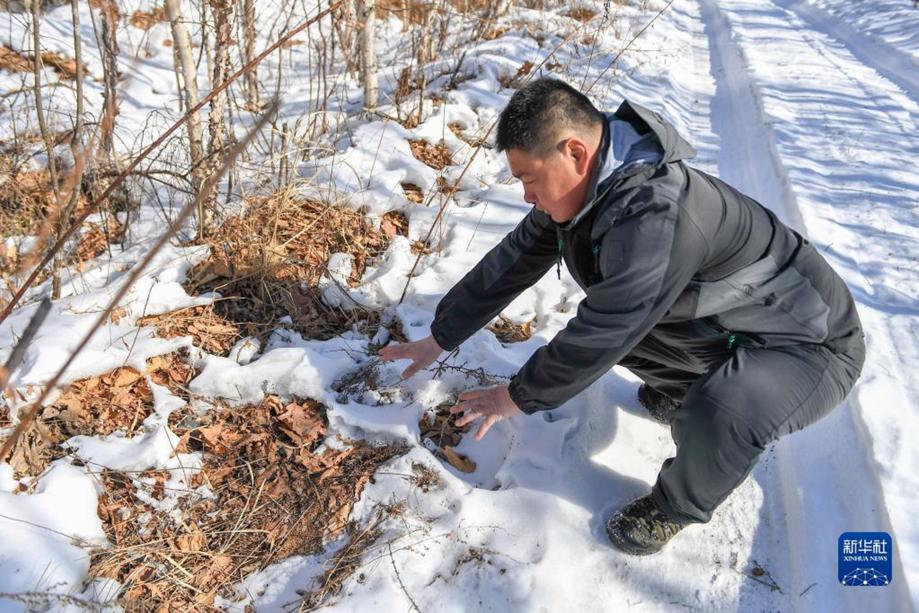
There are many reasons forest patrol teams in Hunchun, Jilin province, enjoy their work. But what excites them most is finding animal feces-especially from big cats.
An Jianwu's team of 10 rangers is responsible for wildlife conservation in the Yangpao conservation zone, part of the Northeast China Tiger and Leopard National Park in Jilin and Heilongjiang provinces that is supervised by the Hunchun forestry bureau.
Walking an average of 10 kilometers a day, the team's main duties are to set up and maintain infrared cameras, find and record the tracks of wild animals-especially endangered species-and remove traps placed by poachers.
But it's the feces that make their day, because they're a sort of communication code between man and nature.
"Feces are special signals sent by wild animals to rangers," said An, deputy director of the Yangpao Conservation Station. "They may contain information about genetics, age, gender or physical conditions."
After retiring from the military in 2005, An returned to his hometown and became a ranger.
The 38-year-old is especially interested in Siberian tigers and Amur leopards, which "have high scientific research value".
The rangers in Yangpao oversee more than 23,000 hectares of forest. To avoid disturbing the animals, they usually set out at 8 am and return about 3 pm.
"In the northeast, it is really cold in winter and snow can sometimes reach to our knees," An said. "However, that can make it easier to see the tracks of wild animals, including their feces and footprints."
Xie Zhiguo, who became a ranger in 2000, also puts the skills and practical experience he has developed over years of fieldwork into wildlife conservation.
"Although I grew up in the forests, it was difficult for me to distinguish the different feces of animals at the beginning," Xie, 44, said. "Every year, the bureau held training courses for us, and we have learned a lot from the forestry experts.
"Taking Siberian tigers as an example, their feces always contain the hair of their prey. Now it is not very hard for me to judge how long ago a Siberian tiger left from the footprints it left."
He said the monthlong training course, which featured both theoretical study and field practice, greatly promoted the overall strength of the team.
The Northeast China Tiger and Leopard National Park, which spans more than 1.4 million hectares, is the most important habitat and breeding area for wild Siberian tigers and Amur leopards in China.
A high-tech surveillance system in the park provides real-time protection for flora and fauna.
The system, which integrates modern communications, artificial intelligence and cloud computing, has captured more than 4,000 images of Siberian tigers and Amur leopards, Hou Ling, director of the park's management office, said.
"Now, there are more than 50 Siberian tigers and about 60 Amur leopards, including more than 17 cubs, in the park," Hou said. "More importantly, the survival rate of Siberian tiger cubs has increased from 33 percent before the establishment of the park in 2016 to 50 percent."
An said: "Over the past decade, we have seen a remarkable increase in the variety and number of wild animals thanks to improved conservation efforts. We can find more of their tracks and sometimes get the chance to see some animals nearby, such as sika deer, roe deer and wild boars."
Rangers are also responsible for implementing anti-poaching measures and raising public awareness of wildlife conservation.
"In our spare time, we visit forest farms and villages to promote knowledge of wildlife conservation and discourage poaching," An said. "Wildlife conservation requires the joint efforts of the entire society.
"I hope to see more young members join the patrol team. We can pass on our experience from generation to generation."






- China's Global Governance Initiative receives positive feedback at forum
- China's Xizang sees steady tourism growth in 2025
- First-of-its-kind pearl auction held utilizing Hainan FTP
- Agarwood exhibition steeps Shanghai museum in fragrance
- The Fujian Coast Guard conducts regular law enforcement patrol in the waters near Jinmen
- IP protection for new fields to improve














