



Fake news used as a powerful weapon in information war









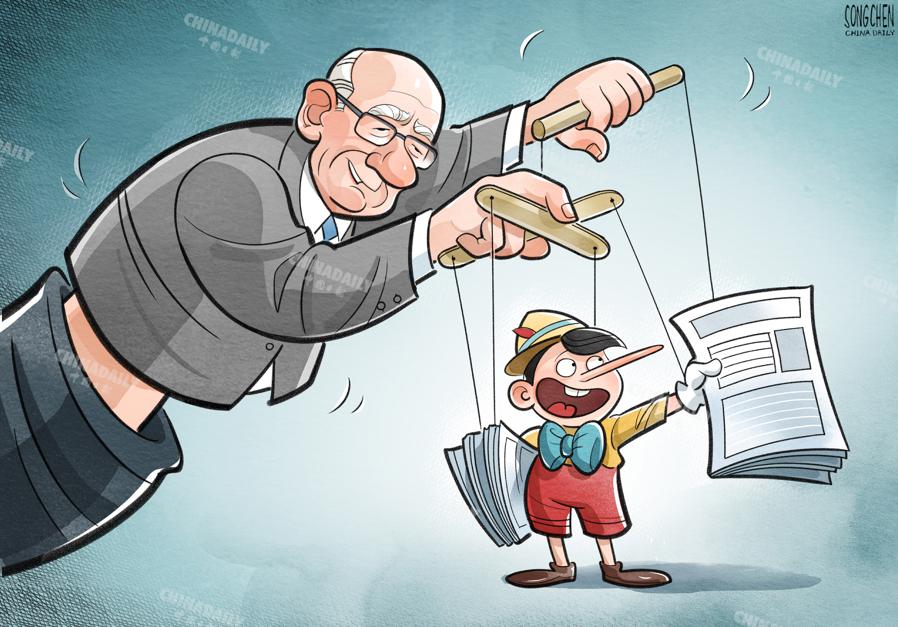
The development of information and communication technologies, including mobile networks, cloud computing and artificial intelligence, has not only increased the speed and expanded the scope of information dissemination, but also accelerated the global flow of fake news.
According to the American News Pathways Project survey released by the Pew Research Center in 2020, the dissemination of fake news is common, but its effects depend on the specific communication channels and the audience's response.
For example, Americans who mainly rely on social media for information are more likely to be exposed to different types of fake news threads than people who prefer to get information from traditional media outlets, even if those outlets are aligned with their political beliefs.
Joseph Zompetti, a professor at Illinois State University, found that social media and its algorithmic mechanisms, too, accelerated the spread of fake news globally. As such, improving digital literacy and the information identification skills of netizens and regulating social media platforms are key to checking the spread of fake news.
The use of disinformation as a political weapon has intensified since the pandemic broke out. For example, a Cornell University research team analyzed 38 million English-language reports on the pandemic in 2020 and found previous US president Donald Trump to be the single largest driver of the "information epidemic".
The Pew Research Center survey also showed that people who have long read or watched pandemic information issued by the Trump administration are more likely to believe in fake news and political conspiracy theories about the pandemic. In fact, this has led to a surge in violence against Asian Americans.
Besides, fake news and political conspiracy theories about the outbreak in China have exacerbated the global public's negative perception of China.
As for the discussion on fake news in the media industry and academia, it has changed from misinformation (fake news) related to the pandemic to disinformation (misleading news), with the former referring to false news in a broader sense and the latter to intentional dissemination of false or misleading information to earn profit, cause harm, or promote a certain ideology.
Academic research on disinformation started in earnest after 2016. Before that, the Western media used the term "propaganda" to define political communication in the non-capitalist countries, and termed Western propaganda as "rhetoric". For instance, former US president George W. Bush used the "war on terror" rhetoric in an attempt to persuade the world to accord legitimacy to his military operations in the Middle East after the Sept 11, 2001, attacks.
Moreover, the Ukraine-Russia conflict has once again drawn the international community into an "information war" full of fake news. The Western media and political and social elites, who more or less control the communication channels and global discourse, say information released by Russia is "misleading news", and claim their own communication campaigns are aimed at safeguarding "democracy, justice, peace, and freedom of the press".
Western countries have also used their control over ICTs and global media networks to ban Russian media outlets, thus preventing the international community from knowing the other side of the story in the Ukraine-Russia conflict.
When Moscow announced on March 5 that strict action, including imprisonment of up to 15 years, will be taken against media outlets spreading "fake news", especially those discrediting the Russian armed forces and calling for sanctions against Russia, Bloomberg, The New York Times, and other Western media outlets suspended their operations in Russia. This has restricted the global flow of news and communication, and further intensified the confrontation between Russia and the West.
It is clear that instead of seriously trying to help end the conflict, the Western powers have been imposing harsher sanctions on Moscow in order to debilitate its financial, foreign trade and other sectors.
Fake news is rampant worldwide. And the latest series of conflicts have exposed how cruel the fact is that some forces manipulate fake news in the information war.
The views don't necessarily represent those of China Daily.
Zhang Chunyu is an assistant professor at the School of Journalism and Communication, Shanghai International Studies University; Guo Ke is the dean of, and a professor at, the same school.
If you have a specific expertise, or would like to share your thought about our stories, then send us your writings at opinion@chinadaily.com.cn, and comment@chinadaily.com.cn.





