


Anthem of courage









Ensemble defies the odds with emotional display and receives widespread acclaim after Paralympic performance, Cheng Yuezhu reports.
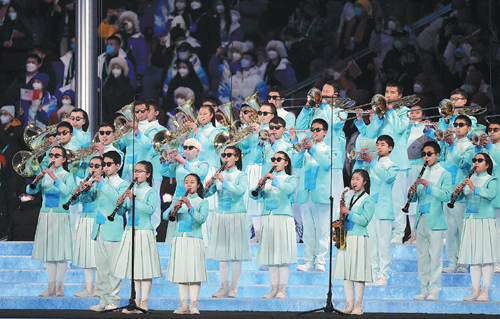
It was a piece of music that seemed to sum up the moment. Not just the bravery of the participants at the upcoming event, but the courage and determination of those actually playing the musical instruments. At the opening ceremony of the Beijing 2022 Winter Paralympics on March 4 at the National Stadium, the Yangfan Wind Ensemble from Chongqing performed Anthem of the Future, the official Paralympic anthem. It was both a solemn and inspirational moment.
At first sight, the ensemble could hardly be called professional, comprising mainly teenagers and without a conductor. However, it did take the ensemble 11 years of hard work to emerge from the Chongqing Special Education Center-a school that provides compulsory and vocational education to young people with visual impairments-and perform in the international spotlight.
The group, appearing at the opening ceremony, consisted of 44 students, the youngest aged 10 and the oldest 22, two teachers with visual impairment, and a conductor who played percussion in the performance.
Zhou Yuanqi, a teacher of Chinese at the school since 2004, recalls that the establishment of the ensemble can be traced back to December 2010, when the teachers and students went to a New Year's concert.
On the bus back to school, the students were all excitedly humming the tunes or discussing the sounds of the different instruments. Seeing the students' enthusiasm, headmaster of the school, Li Longmei, thought to establish a wind ensemble.
"Our school had had a solid background in music education, but it was limited to folk instruments such as bamboo flute and hulusi (the gourd flute), and the children played mainly solo," Zhou says. "Through that concert, the headmaster found that the children were very curious about Western instruments as well, and wanted to upgrade our music courses."
Another key reason for setting up an ensemble, Zhou says, is that, from her observation, students with visual impairment tended to isolate themselves and work independently. Consequently, the school believed that establishing an ensemble would give them more opportunities to work as a team and enhance their sense of cooperation and achievement.
The ensemble was formally established in February 2011, the beginning of the school term. However, difficulties soon revealed themselves, as the external music teachers had no experience in teaching students with visual impairment.
The school then called for their teachers, whose disciplines range from Chinese and math to computers and PE, to join the ensemble, learn the instruments from scratch and then rehearse together with the students.
Zhou also joined the ensemble as a trumpet player. She initially wanted to study the flute, but the seats were limited with the teachers actively responding to the call. Eventually, the ensemble recruited 34 teachers and 36 students.
For two hours every Tuesday and Friday, all of the members of the ensemble attended the music course and rehearsal together.
"At first, we acted as a bridge between the professional music teachers and the children. We had to learn the embouchure, the breath and so on, and then teach the students one-on-one. We also had to sing the music score for the students," Zhou says, explaining the teachers' roles in the ensemble.
With each new piece, the conductor would print out the sheet music for different instruments and parts. The teachers then learn the music and sing to the students, phrase by phrase, for them to memorize.
It was particularly difficult for the teachers with no background in music, who had trouble reading sheet music. They had to translate the scores into numbered musical notation first. They are also required to specify to the students the tempo, dynamics and articulation, and convey to the students the conductor's gestures.