



Himalayan 'Third Pole' continues to lose glaciers









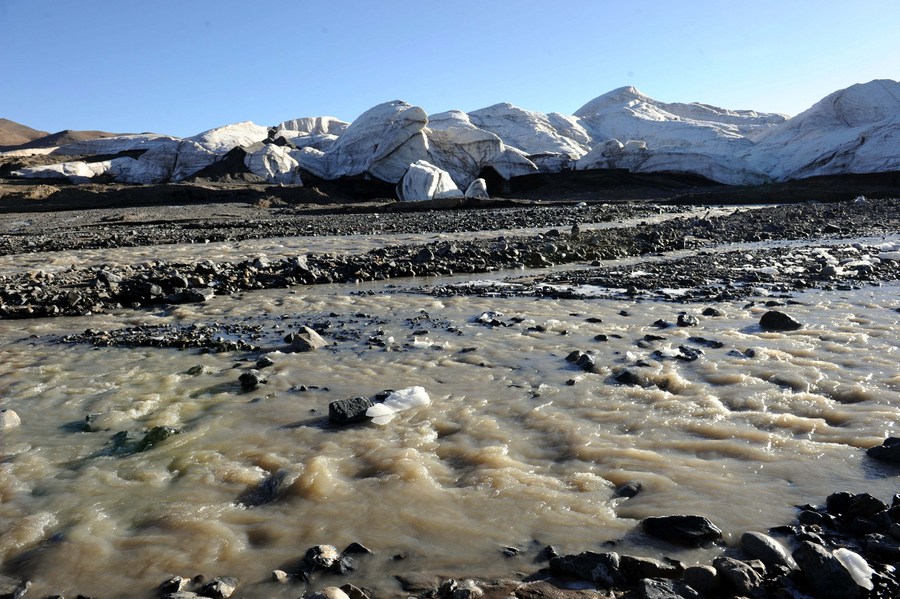
As the risks of climate change loom larger, the "Third Pole" — as the Himalayan watershed is sometimes known — is warming up faster than the global average, resulting in the accelerated melting of glaciers, according to a report unveiled on Thursday.
Produced by the United Nations Environment Program and titled A Scientific Assessment of the Third Pole Environment, the report blamed windblown pollutants for further exacerbating conditions in the highest region on earth.
The Himalayan watershed has experienced increasingly warm and wet weather over the past 60 years, warming at a rate of over 0.3 C per decade, far surpassing the global average. The report also drew attention to a rising cycle in the region.
"Glacier melting has been intensifying since the 1980s, with more intensive melting along the Himalayas and in the southeastern sector of the Third Pole," it said.
The number and the surface area of lakes has been on the rise since the 1990s, with lake water increasing at a rate of 8 gigatons per year, corresponding to an increase in water levels of 0.14 meters per year.
"Projected warming in the Third Pole is greater than the global average; it is expected that there will be widespread increases in annual precipitation over the coming period," the report continued.
The area's high altitude and small population don't make it immune to pollution, as it is located downwind of a number of air pollution hot spots, including South Asia and the Middle East.
Emissions from these regions and dust from nearby deserts like China's Taklamakan blow into the region when wind conditions are suitable.
Accumulated atmospheric black carbon at the southern foot of the Himalayas can cross the mountain range and reach its inland areas. This not only contributes to global warming, but also darkens the surface of glaciers, reducing their reflective albedo and accelerating melting through heat absorption.
Over the past 40 years, the Third Pole has lost a glacier mass of approximately 450 cubic kilometers — between 20 to 80 km3 as a result of black carbon and other light absorbing impurities, the report noted.


- Miao communities celebrate Lantern Festival with fireworks
- Mainland vows safety for Taiwan compatriots amid Middle East tensions, criticizes DPP’s political manipulation
- Zhengding Folk Art Performance draws 30 troupes for Lantern Festival
- China advances in quantum technology, sets global records with new innovations: national political adviser
- Adrian Cheng: HK needs to build platforms for international and local talent exchange
- Mainland offers to resume cross-Strait dialogue if DPP acknowledges 1992 Consensus





