



Textiles and garments go custom, personalized









"Overall, sales during the first quarter were encouraging, and we are confident that the second quarter will continue the same trend," Hu said, adding that the company plans to export products worth between $180 million and $200 million this year.
Dayang Group exported more than 550,000 tailored suits in the first quarter, up 78 percent from the same period last year, and its production plan till September has been scheduled.
As consumers increasingly pursue personalization, not only Chinese style, customized models have gradually won more popularity. The proportion of custom-made suits on their shopping lists has increased year by year. The custom-made suit exports of Dayang Group accounted for about 30 percent of total suit exports between January and March this year, surging 15 percent on a yearly basis.
"We are likely to give priority to 50 percent of the production capacity for orders of customized products. I think many foreign consumers will be keen on or prefer to purchase customized products during the post-pandemic era. Such a fast-growing trend already can be found in Japanese and the United States markets in recent months," she added.
Digital design, production and marketing have formed a seamless chain, effectively pushing the growth of its customized business, she said. The group's business must rely on a complete, elastic and highly resilient supply chain to stay competitive.
For example, there are more than 6,000 manufacturers connected upstream and downstream both at home and abroad on Dayang Group's customized platform. They have ensured its demands for quality materials.
While China's exports of suits soared by 74 percent on a yearly basis in the first quarter, wedding clothing was another popular category to support the growth of China's exports of textiles and garments, according to the China National Garment Association, or CNGA.
Because many foreign couples had delayed their wedding ceremonies during the pandemic and spring is the traditional wedding season in many parts of the world, a number of manufacturers' orders have been expanded to August and September this year, said Jiao Pei, vice-president of the Beijing-based association with more than 1,400 member companies.
In Chaozhou, Guangdong province, one of China's manufacturing bases for wedding dresses, saw its exports of this kind jump by 116 percent on a yearly basis to 180 million yuan ($28.26 million) in the first three months, data from Chaozhou Customs showed.
"Because lawn weddings are the mainstay in overseas markets, simple and light fishtail styles are the most popular products," said Rao Zijia, vice-president of Chaozhou Bonny Jewellery Co Ltd, a major manufacturer of wedding and evening gowns running two factories in Chaozhou.
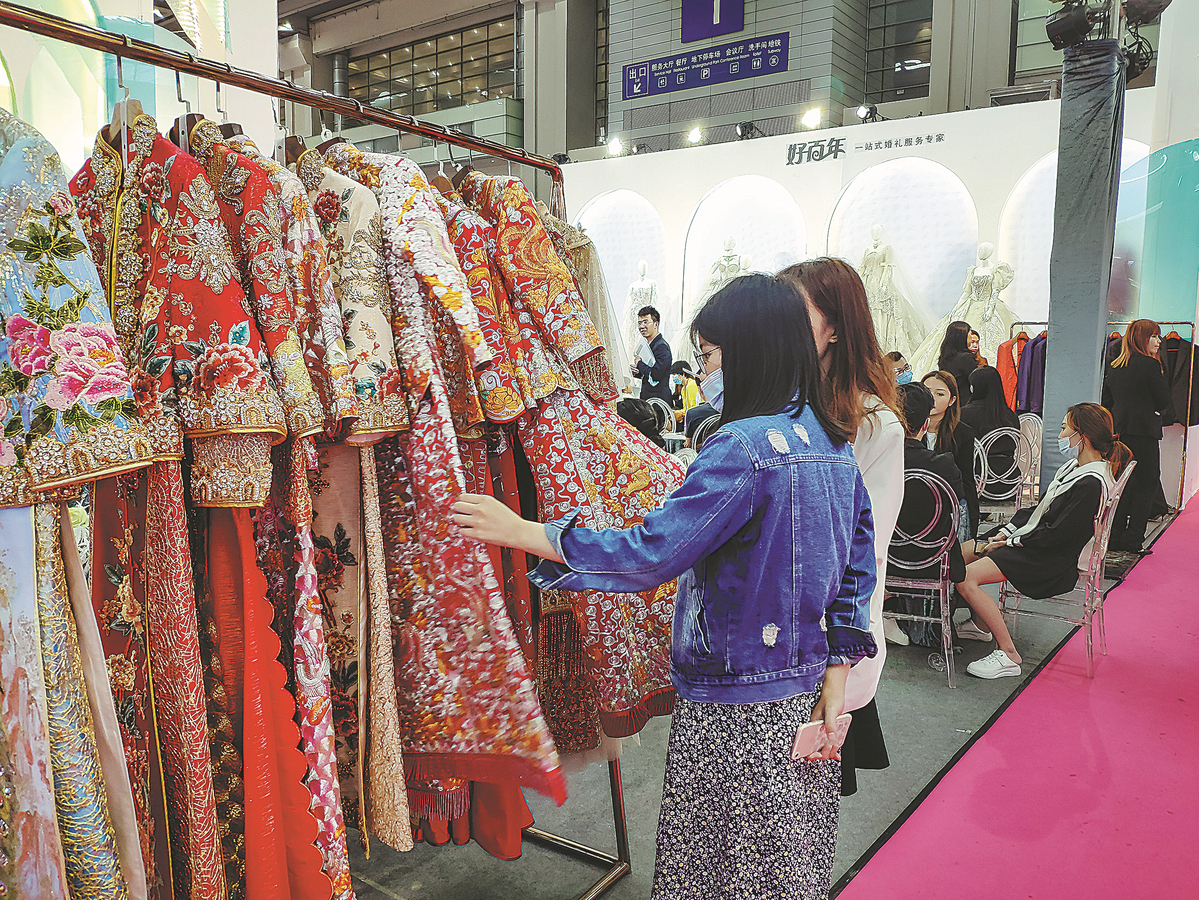
"As a traditional western dress, wedding dresses have collided with new trends after years of production and design in China. Some 'Chinese styles' are gradually incorporated into wedding dresses, and traditional crafts such as the 'cheongsam (qipao) collar' and 'bead embroidery' have become favored items in overseas markets," he said.
"Based on demand from global buyers, we discovered that Chinese elements are favored by many foreign consumers," said Cai Haoli, principal administrator of Chaozhou Bonny Jewellery, noting the company previously used lace made of pure yarn and added many beaded embroidery elements on the dresses to increase their three-dimensional degree, a new way to further enrich the texture and customer experience.
Nevertheless, Cai said that the cost of making wedding dresses, including raw materials and labor costs, has notably soared this year. Since international crude oil prices kept rising over the past several months, the cost of chemical fiber fabrics is also rising. The firm's raw material costs have grown 10 percent so far this year.
In addition to rising costs, Vietnam, one of China's main competitors in this arena, exported $8.68 billion worth of textiles and garment goods in the first quarter, up 20.3 percent on a yearly basis, registering the highest growth for the same period since 2012, according to the Vietnamese Customs authority.
Notably, textiles and apparel contributed the most to Vietnam's export growth, increasing by $1.46 billion and accounting for nearly 14 percent of the country's newly created exports during this period.
Eager to secure the market share in the field of production materials in Vietnam, Zibo, Shandong province-based Lu Thai Textile Co Ltd, which runs more than 40 factories and regional branches in countries including the US, Italy and Japan, announced in late March that it will invest $210 million to build a manufacturing base to make woven and knitted fabric products in Tay Ninh province, Vietnam. This is another step to further expand its market presence after the Regional Comprehensive Economic Partnership came into action.
To mitigate the pressure on exporters, China's State Council released a new set of measures in January to stabilize the country's foreign trade, a key driver of economic growth, to explore the growth potential of imports and exports and ensure unimpeded operation of industrial and supply chains.
While stabilizing industrial and supply chains, the government seeks to encourage businesses to sign long-term contracts with shipping companies and persuade financial institutions to provide inclusive loans to eligible micro and small businesses involved in logistics.
Local authorities have been asked to draft more support policies for labor-intensive sectors, especially textiles, clothing, furniture, plastic products, toys and ceramics, to stabilize their businesses.
Cao Xuejun, an official at the Department of Consumer Products Industry at the Ministry of Industry and Information Technology, said that while further introducing policies to boost the country's exports and product innovation in the textile and garment sector, the government will promote low-carbon, dual-circulation economic development in the industry to pursue sustainable growth across the country in the coming years.
China aims to recycle a quarter of its textile waste and use it to produce 2 million metric tons of recycled fiber annually by 2025, according to a document unveiled by the National Development and Reform Commission, the country's top economic regulator, and other government branches in late April.




















